

Rating Accuracy is the Most Important Objective
For competitions, rating accuracy must be the most important, primary objective. In general, spirits competitions offer distillers a path to brand recognition and many help consumers make informed decisions. However, there are those who place their highest priority on profits. Consequently, they neglect critical choices of glassware. They also fail to apply a scientific methodology to improve sensory aspects of tasting, quality assessment, and scoring reliability.
Glassware and Rating Accuracy
We designed the NEAT glass through the rigorous application of physics, chemistry, and sensory science. It offers competitors a major opportunity to improve diagnostic accuracy, ratings, and evaluation. By minimizing interference from pungent, anesthetizing ethanol vapors, NEAT reveals the spirits’ inherent aroma and flavor profiles. Competitions that adopt the NEAT glass evaluate spirits by their inherent qualities rather than perceptions biased by excessive ethanol.
A Scientific Tool for Rating Assessment
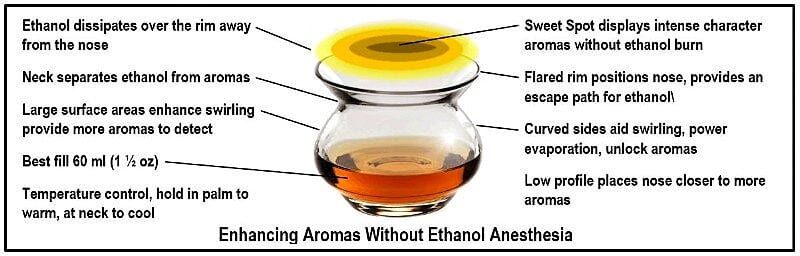
The NEAT glass was specifically developed to improve sensory analysis. As a result, its unique design, with a neck, flared rim, and large bowl, disperses ethanol vapors to prevent masking delicate character aromas. ultimately, this scientific approach improves diagnostic accuracy by eliminating ethanol interference to support consistent, unbiased evaluations.
By contrast, traditional tulip glasses funnel over 65% ethanol vapors directly into the nose. Likewise, ethanol irritates the trigeminal nerve with pungency, dulling the olfactory, and masking subtle but crucial aromas. More on sensory science.
Ethanol Anesthetics Affects Rating Accuracy
Ethanol’s most problematic characteristic is its anesthetic ability to numb the senses without awareness, particularly when concentrated through narrow-rimmed tulip glasses. Repeated trigeminal irritation from ethanol can numb the senses and produce olfactory fatigue. During flights of five or more spirits, this fatigue can severely impair judges’ ability to identify and detect aromas in later samples, placing entrants near the end of the flight at a critical disadvantage. Judges may score those spirits lower because cumulative ethanol exposure has dulled their senses—not because the spirits contain inherent flaws. The objective should be to minimize ethanol exposure.
NEAT mitigates olfactory fatigue by dispersing anesthetizing ethanol vapors and preserving sensory acuity throughout the judging session. Ultimately, this allows spirits judges to evaluate every spirit fairly and without bias, regardless of its position in the tasting sequence.
Ethanol Pungency Works Against Rating Accuracy
The pungency of ethanol distracts the evaluator from focusing on a spirit’s true aromatic profile. Pungency dominates the olfactory experience, concealing more nuanced aromas. By concentrating harsh ethanol vapors, tulips cause discomfort and distort perception. NEAT disperses ethanol vapors away from the nose, reducing this pungency and allowing judges to focus on the authentic aromas of each spirit, resulting in more accurate sensory analysis. Eliminating pungency is a worthwhile objective.
Sampling Vessel Shape Promotes Rating Accuracy
NEAT’s large-diameter bowl and low-profile design offer substantial improvement to the sensory experience. As a result, the shape allows for more effective swirling, releasing volatile compounds and enhancing flavor perception. Unlike tall tulip glasses, which are difficult to swirl, NEAT’s large bowl design releases more complex aromas through swirling.
Moreover, NEAT’s shorter profile brings the nose closer to the aromas, capturing the full range of compounds lifted by vapor pressure and highly volatile ethanol. Once the ethanol is dispersed by controlled diffusion, judges can assess flavor complexity, mouthfeel, and a comprehensive profile of character. In summary, short and fat deliver aroma, and tall and skinny deliver volatile, anesthetic, pungent ethanol.
Ensure Rating Consistency and Fairness Leads to Credibility

Consistency is essential in spirits judging, and tulips concentrate ethanol, leading to inconsistent scoring. NEAT allows judges to maintain clarity and consistency throughout the flight. Accordingly, this ensures each spirit is judged on true merits rather than the limitations of tulip glassware; and promotes fairness and accuracy. The primary objective of accuracy is satisfied.
Over 40 major international spirits competitions annually choose NEAT as their official judging and evaluation glass demonstrating commitment to sensory accuracy and fairness, and ensuring scores are based on true flavor/quality.
Applied Sensory Science Promotes Rating Accuracy
By understanding how human senses interact with ethanol molecules, NEAT researchers optimized the evaluation process by eliminating anesthesia and distracting pungency while enhancing the detection of complex aromas and flavors and delivering reliable results. See peer-reviewed, open-access, research journal paper Technical Report—Applying Physics and Sensory Sciences to Spirits Nosing Vessel Design to Improve Evaluation Diagnostics and Drinking Enjoyment (mdpi.com).
Independent research comparison confirms the effect of dissipating ethanol. Not surprisingly, wider and shorter glasses are the preferred evaluation tool. Glass-Vessel-Aroma-DA-Study-Sept-2019.pdf (sensationresearch.com)
Summary
Spirits competitions often focus on profit rather than accuracy in evaluation. Ratings accuracy must be the primary objective to build credibility. The NEAT glass offers a scientifically reliable solution for those seeking to elevate their judging standards by ensuring every spirit in the competition is evaluated and judged on its true merits. Competitions that adopt NEAT commit to fairness, accuracy, and integrity.
Not only is NEAT preferred by professional judges and competitions who aim for the highest level of sensory precision, but it’s also an invaluable tool for spirits enthusiasts. NEAT enhances enjoyment and understanding as an indispensable vessel to those serious about accurate spirits evaluation and striving for informed purchasing decisions.
Bio: George F Manska, CR&D, Arsilica, Inc.
Qualifications: Published sensory science researcher, and entrepreneur. BSME, NEAT glass co-inventor
Mission: Replace myth and misinformation with scientific truth through consumer education.
Note: Enrolled NEATNEWS subscribers are entitled to a 10% discount on all purchases and free shipping over $55 for as long as you are enrolled. Coupon code: ILUVNEAT
About The Author
Discovered and developed Naturally Engineered Aroma Technology (NEAT) to enhance the presentation and perception of spirits by separating the disagreeable, numbing aromas of ethanol alcohol from characteristic spirit essences. NEAT connects human physiology, chemistry, and basic physics to improve glassware design to appeal to the flavor senses of smell and taste.
Glassware today is designed in the styling studio, and marketing is added later to sell the design and insinuate function. Inventor of the NEAT glass. Our mission is to educate the public and industry professional to improve knowledge on nosing and tasting spirits. Scientifically designed glassware exposes all traits of a spirit, good and bad, and raises the bar of excellence by exposing the true quality previously hidden by nose numbing ethanol. We are: Changing the Way the World Drinks. NEAT is the Shape of Flavor, and Form Follows Function.


