
A Respected Expert Chooses NEAT for Controversial Reasons
We are revisiting our earlier publication of the controversial reasons a respected expert chooses NEAT over Glencairn. Attitudes on ethanol in evaluation have changed little over the last five years.
The Reviewer, Hoke Harden, Expert Evaluator
Hoke Harden is a respected wine and spirits expert educator, consultant, writer, critic, and competition judge. Hoke has over four decades of industry experience. His career spans retailing, bartending, purchasing, wholesaling, marketing, consulting, judging, and education. He joined Brown-Forman in 1992 and later served as director of global wine and spirits education.
Harden holds Certified Specialist of Wine and Spirits credentials, joined the Society of Wine Educators’ inaugural class of Certified Spirits Educators, and qualified as a B.N.I.C. Certified Cognac Educator. He has taught at Mt. Hood Community College and lectured at Harvard University and the University of California, Berkeley.
Setting the Stage to Make a NEAT Point
As author of this article, I consider Hoke Harden to be the most unbiased, educated and qualified professional wine and spirits expert evaluator, writer, and critic in the industry.
Hoke published the following article on a review of the NEAT glass, which I believe to be a factual account and assessment of the performance of two glasses. This is especially significant, since I am co-inventor of the NEAT glass. I am a sensory science researcher. Although age has taken a toll on my olfactory, experience has sharpened my science and mathematical skills. Apparently, Hoke and I both love Cognacs, Armagnacs, and Old Forester Signature.
Where are we going? Read the truly fair assessment, and following that, I will endeavor to discuss how the review highlights the effect of sensory science on the nature of spirits analysis.
Taste & Compare: NEAT and Glencairn | A Hoke Harden Review
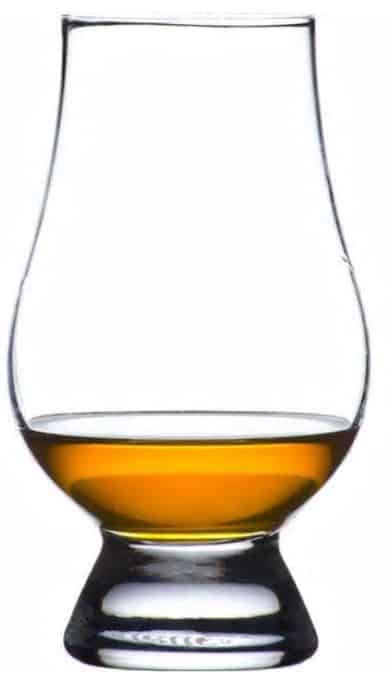
then I wondered how much difference I would perceive from the same spirits in a Glencairn-style tasting glass.
So I found out. I nosed and tasted through the Chateau Garreau Bas Armagnacs, then a Hine Rare Cognac, and finally my go-to house whiskey, Old Forester Signature 100 Proof Kentucky Straight Bourbon.
The results? In every taste, the NEAT glass delivered a better experience for me than the Glencairn. The Glencairn and the NEAT both have dedicated fans. The Glencairn was first and was first favored for Scotch Whisky, then became popular for other whiskeys, and then all sorts of spirits.
I’ve long been fond of the Glencairn for its ability to focus the aromas in such an intense way, to display the core of the aromatic experience of the spirit. “Nothing hides in a Glencairn.” is a standard saying, and for good reason. That ability to expose was also a problem, however. In a brash, brawny spirit raw power can overcome, even obliterate, the more delicate nuances.
The Glencairn is unforgiving. It’s more about force than finesse. It will reveal the charms of a spirit, but it will just as readily exaggerate certain aspects that can make the spirit unpleasant.
The Glencairn is essentially a small, short, glass shaped a little like a glass cannon designed to collect all the aromatic components and volatize them out of the glass up into the nose of the taster. Sounds brutal….and it can be just that if you’re nosing a high-proof spirit, because the alcohol (ethanol) is also conveyed in this ‘shot’ of spirit, and ethanol can carry a mean burn.
Your nose naturally hits that zone so you sense the subtlety of different aromatic impressions which you would not be able to distinguish as clearly within an intense volatile blast.
And here is why: the NEAT glass concentrates the aromatics and alcohol in the bowl, providing a wider, larger surface for releasing the aromas. When they volatize up through the ‘pinched’ waist of the glass the aromatics continue up to that ‘sweet spot’ but most alcohols flow up the sides of the glass to the flared rim and dissipate.
Essentially, with that separation, you receive the aromatics in the zone—the sweet spot—with the lessened impact of the alcohol, which gives you the ability to appreciate all those lovely aromatics you probably paid good money for.
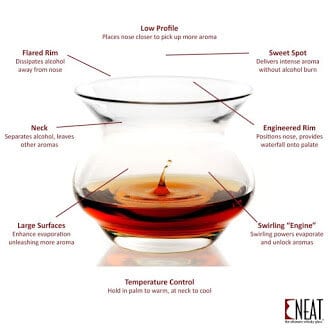
Some people are more impressed with power, intensity, and force; some look for subtlety, complexity, and layers of aroma as their ideal.
If you are in the first group, you’ll likely prefer the Glencairn, which is fine. Some like the brash, bold, ‘in your face’ peat smoke and iodine of an Islay Single Malt. The Glencairn glass will deliver all those aromas—and ethanol—in one focused sniff.
If you’re more like the second group, you’re probably going to go for the NEAT glass. The NEAT glass focuses on the aromatic components while moving the ethanol burn out of the spotlight, as is the case with Hine Rare. The Glencairn sends the ethanol up in force; the NEAT shunts the ethanol gently to the rim and away.
After my casual taste and compare trial, it was clear I preferred the NEAT glass. It provided exposure to all the components and increased my perception of the complexity of the spirit. The Glencairn seemed to punch the spirit into your nose—and in a high alcohol spirit that can stun your nasal passages with anosmia (briefly losing some of your sense of smell).
[Perspective: We constant nosers and sippers tend to get comfortable—or perhaps acclimated is a better word—to high-proof spirits. We also tend to forget inexperienced tasters haven’t developed that familiarity. I might be waxing poetically about my lovely, gentle, balanced spirit, while the row of students are looking at me blankly. I’m enjoying ephemeral spirits; their eyes are tearing because the ethanol just singed their nose hairs. The NEAT attenuates that burn.]
Example 1: Chateau Garreau Bas Armagnac Folle Blanche. This was an experimental spirit, a young Folle Blanche with short-term oak aging to emphasize the primary floral qualities of the grape variety. It was bottled at cask strength. The lovely but delicate fruit/floral expression of the Folle Blanche was shoved out of balance by the ethanol in the Glencairn glass. The NEAT glass shunted away just enough of the ethanol to allow the complexities of the Folle Blanche to emerge
Example 2: Hine Rare Cognac. The Hine is a beautifully constructed blend of different cognacs that contain some older examples, and those hints of extended age and richness are essential to the style of Hine. Again, the Glencairn made the Hine seem heavier and coarser in the nose, while the NEAT allowed those enticing, subtle aromas to separate from the alcohol and float right up to the sweet spot.
Example 3: Old Forester Signature 100 Proof Kentucky Straight Bourbon. This is my go-to house Bourbon. Reliable, consistent, and dependable, the Old Forester nose came through fine from the Glencairn. But the NEAT edged it out just that little bit to soften and warm and expand the wood-aged notes and the lovely rich caramel that characterizes Old Forester.
I’ll add that for all its attributes the NEAT glass is not what I would call a drinking glass. It is a nosing glass/tasting glass, designed for that specific purpose. So, when you come to my house you’ll get your Old Forester Signature 100 Old Fashioned in an Old-Fashioned Glass and your Woodford Reserve Double Oaked Manhattan in a martini glass. But both will have been tasted in a NEAT glass before preparing the cocktail.
NEAT and Arsilica (“Changing the Way the World Drinks”) are now one company. Arsilica plans to bring forth new designs to expand its glass portfolio. Sensation Research did an Independent study.
Nearly six years have passed since Hoke published the article. The review holds special significance for me because Hoke became the first professional evaluator to examine the NEAT glass. I revisit the subject because many evaluators still resist change, while Hoke demonstrated remarkable foresight by recognizing how ethanol affects sensory perception and tasting results.
Harden, H. (2020, September 4). Through a glass, brightly: Tasting with NEAT and Glencairn glasses. Elixir Vitae. https://violentfermentation.blogspot.com/2020/09/through-glass-brightly-tasting-with.html
Assessing the Changing Landscape of Sensory Evaluation
Reviewers rarely echo the conclusions Hoke reached nearly six years ago. His observations show a keen awareness that evaluators should not confuse ethanol’s sensory effects with flavor, even though ethanol serves as an effective carrier for character-defining aroma compounds. Hoke recognized the problem clearly:
“… (The Glencairn’s) …ability to expose was also a problem, however. In a brash, brawny spirit, raw power can overcome, even obliterate, the more delicate nuances.”
Decades of drinking from tulips have conditioned evaluators, including the expert and novice to specific beliefs. “If ethanol remains there, in today’s scientific world, it is meant to be there.” and, “How would you separate the molecules anyway?” Ethanol presence becomes an “irrefutable” fact in the mind’s eye of all who want quick answers so they can move on.
Hoke’s description of how NEAT works is spot-on for the non-science amateur and the experienced evaluator alike. However, the neck has a special quality with a scientific explanation. Molecules are forced to contact each other in the neck as they are pushed closer together. Ever play snooker? The smaller balls move faster than large ones. Same thing with molecules. ethanol is lightest. Collisions with “heavier” flavor molecules makes them run away faster than the flavors move.
It may be uncomfortable to drink from the flared rim of a NEAT or a martini glass, However, you get a better expression of the aromas without the distraction of nose-numbing, pungent, anesthetic ethanol.
Hoke is aware that ethanol “…in a high alcohol spirit that can stun your nasal passages with anosmia.” is certainly different than flavor. Many evaluators today will say they also believe, however, you hear nothing of it when they evaluate cask-strength spirits in the tulip-funnel-ethanol-cannon.
NEAT Sensory Science
Drs. Zsu Zsu Wang and Keith Cadwallader of University of Illinois have completed much scientific heavy lifting with a study recently released. Their research validates and quantifies the detection of aromas in presence of various levels of alcohol by volume. They prove that ethanol plays a serious, large role in sensory evaluation.
Recent studies by Arsilica have derived a formula by which the known geometry of any glassware shape will determine the concentration of ethanol at any given rim plane position. Although we developed NEAT through empirical statistical testing, the formula shows it to be accurate in balancing ethanol and character aromas.
Designing the NEAT glass was no more than application of 12th grade high-school physics class (Oops, they don’t do that anymore). New discoveries bear out what we thought all along, and Hoke Harden picked it up immediately.
Still Controversial, NEAT Gathers Momentum
As it stands, we are on the road to changing the sensory evaluation of spirits to a more sophisticated level. Hopefully, it will invoke principles of true sensory science. The food industry has used sensory evaluation for at least three decades with serious determination. Wine is getting there quickly, and spirits, always late to the science game will get there eventually.
A case in point, the spirits industry seems to adopt changes about 10 years later than wine. Spirits evaluation remains cultish, mysterious, and somewhat personality dependent, as mythical marketing runs rampant. NEAT acceptance improves with exposure to the evaluators who matter.
Summary
This will change as more innovative evaluators like Hoke Harden, finally apply rudimentary science to hone opinions into repeatable fact. The age of the opinionated blogger will be replaced by the educated blogger with accepted science. Tasting opinions will be more similar and repeatable. Only then will the public be able to rely on something other than “celebrity” opinions. Thanks, Hoke, for your incredible insights.
