
Raise Your Spirits with a Better Glass – NEAT is the Best Spirits Glass

Raise Your Spirits with a Better Glass – NEAT is the Best Spirits Glass
It’s all about the glass: Raise your spirits in a better glass. NEAT is the best glass. Many well-informed educators in the industry simply overlook the glass. Is it on purpose, or is it just not considered important? Side-by-side comparison of NEAT and tulips reveal the functionality of NEAT by improving access to all the aromas.
Wine and Beer Tastings
A number of educators at wine and beer tastings demonstrate an exceptional ability to identify flavors, aromas, and other descriptors. They generally bring extensive knowledge, speak with confidence, and actively contribute to discussions of flavor profiles, drink-ability, and pairings.
Event administrators usually avoid suggesting flavor descriptors before attendees taste the beverages. Instead, they discuss beverage characteristics after the tasting. Attendees may comment on balance, acidity, and mouthfeel, and they readily say, “This wine—or beer—is too hot,” referring to its ethanol content. As seasoned tasters share their knowledge, newcomers learn to associate specific flavors with grains, hops, and grape varieties. Spirits events, particularly whiskey tastings, tell a different story.
Whiskey Tastings
Whiskey tastings are much different, having less vocal audience participation. Few at a whiskey tasting say, “This whiskey is too hot.” Additionally, there are no comments on balance acidity and very few regarding profiles, drink-ability, pairings, etc. Seasoned tasters sniff the ethanol, nod their heads approvingly, and look around the room to see if others follow suit. As a result, personal satisfaction occurs at discovery of pungent ethanol. The final assurance they received what they came for is the snort of strong ethanol.
The brand ambassador introduces flavor profile prior to tasting, relating carefully chosen, corporate-prepared descriptors as pre-tasting semi-subliminal suggestions. The sales pitch is all about suggestion. Narrators know well that sniffers do not work well once filled with abundant ethanol fumes. Attendee comments are generally “This is good,” or “I like it,” or the highly descriptive “Wow.”
Spirits lovers reading this will say, “Of course it’s different, they are different beverages, they provide different information,” but that is not the whole story. The result of group tastings should be the experience of flavors and aromas and a forum for sensory discussion regardless of beverage. Whiskey (spirits) drinkers should be able to discern flavor profiles. Given the price of spirits, accurate detection of flavors and aromas should be a primary purchasing decision. Sadly, it is not.
Why? At first glance, the levels of anesthetic ethanol in each type of beverage seem to be about the same, so what could it be? In fact, the real culprit is the glassware. Glassware used for each type of beverage manipulates ethanol and flavors to different degrees.
The Beer Glass
Certain shapes have become identified with specific beers since the medieval era. A few basic styles have survived: the pilsner for lighter beers, the tulip for medium-body beers, and the chalice for stouts, high ethanol, heavy, and highly aromatic beers. Over the centuries, they have gotten it right for most beers, ranging from 3 to 12% ethanol.
However, the public prefers the standard English pub pint glass filled to the rim to ensure a “pour to the rim with no headspace to appreciate aromas. At least, after the first two sips, there is enough headspace to collect aromas to sniff and savor and relatively low levels of anesthetic, ethanol, permit, flavor, and appreciation prior to anesthetization. These drinkers came for a moment of relaxation, not analysis. Serious craft beer drinkers are all about their beer’s flavor, aroma, and taste. Although the glasses could improve, sensory considerations exist, at least to an acceptable degree.
The Wine Glass
Over the years, these have been narrowed down to three basic shapes:
- Large, wide bowl wine glasses are generally best for reds to appreciate the complexity of a wide variety of flavors and aromas,
- Tulips concentrate narrow aroma profiles of white wines and
- Flutes prevent the quick escape of the bubbles in sparkling wines.
Most wines range from 6% to 17% ethanol. Wine glasses have a distinct headspace to insert the nose and appreciate flavors and aromas, except flutes. Headspace size is generally managed by the pour size. Pours are generally much less than half the volume of the empty glass, allowing adequate headspace for nosing aromas.

Too much olfactory ethanol is disagreeable to most wine drinkers, and they know it interferes with their search for flavor. Serious wine drinkers are all about taste and aroma. Although the glasses could stand some improvement, sensory considerations exist to a higher degree.
The Spirits Glass
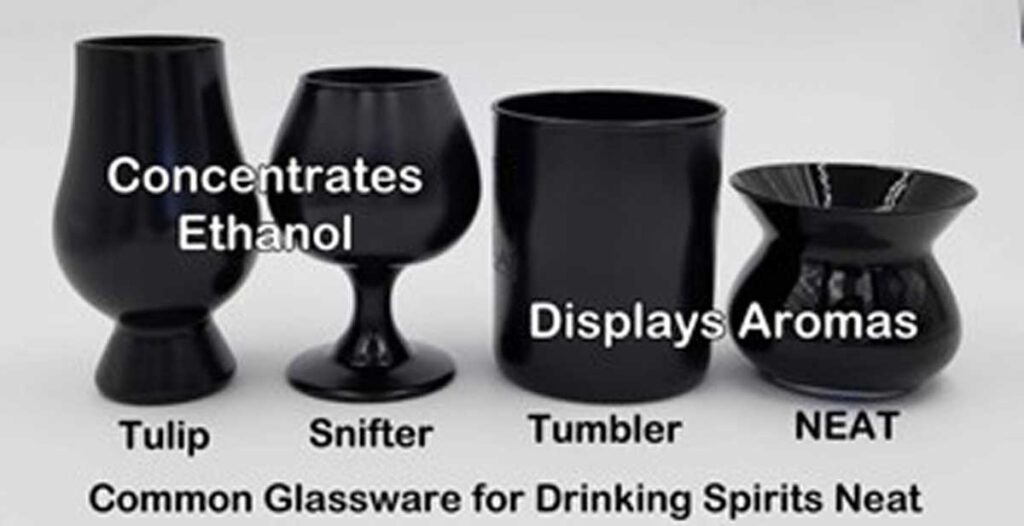
Until recently, spirits drinkers have widely accepted two basic shapes: the iconic tulip and the tumbler. Tulips are most common, an evolutionary descendant of the tiny copita sherry glass. They are characterized by tiny rims too small to insert the nose and small bowl diameters to prevent swirling. Tulips give no choice or possibility of separating pungent, anesthetic, nose-numbing ethanol from the aroma profile. In fact, tulips concentrate headspace ethanol aromas to 65 to 75%. Less than 0.5% are character aromas, the rest being air and water, due to the high volatility of ethanol.
Originally designed for 22% ethanol fortified wines, when tulips are used for spirits, they become an ethanol nose bomb. Also, tulips are frequently referred to as “nose-cannons.” Sensory diagnostics are lingering, but quickly fading two-sniff memories. Even the experts’ opinions are affected by the olfactory ethanol barrier to flavor perception.
The Tulip Problem
Whiskey glassware is a sensory problem. Tulips are the primary reason whiskey event commentaries end with non-descriptive statements “This stuff is good.” The follow-up “I’ll buy it” is often an obligatory response to the free tasting samples and presentation, seldom about personal preference. Tulips are a driving force behind the whiskey drinkers’ quest for higher ethanol.
Distillers, recognizing a windfall opportunity, created a new “cask strength” market segment for straight, neat whiskey drinkers, reasoning that undiluted spirits directly from the cask are the “purest” and “highest” form of whiskey possible. Assessing flavor and appreciating the drinking experience of cask strengths from a tulip is exponentially more complex than 40% ABV(alcohol by volume) spirits. Why don’t more drinkers know this? Because they are completely unaware of the silent, painless onset of ethanol nose-blindness.
State of the Art: In its current state, whiskey evaluation and appreciation is a status participation game designed to replace personal opinion with subliminal buying suggestions.
The Power of Ethanol over the Consumer
Tulips exist as the most common spirits glass solely because whiskey drinkers encourage and unconsciously demand ethanol by prioritizing it over discovery, enjoyment, and discussion. Add to that the tendency to let someone else make your decisions because thinking objectively “hurts your brain.” Gurus, mavens, and competitions guide drinkers only because drinkers confuse ethanol pungency with characteristic aroma and flavor, and many equate high ABV with quality.
The industry is well aware of the effects of tulip glasses. They ignore the ethanol issue because it gives marketing departments opportunities to manipulate those who have a fuzzy connection to the aromas. Brand ambassadors control the narrative, the tulip gives the narrator license to seed the thought process of potential buyers.
Ethanol pungency is exactly the same for all spirits of 40% ABV (escalated for higher ABV) and has absolutely no relationship to character or flavor. Unfortunately, most whiskey drinkers confuse “cask strength” with quality. Since cask-strength spirits cost more, an irrational leap to “more ethanol means better quality” is almost natural.
Summary
Rise above the marketing madness and bring fun, opinion, sensory perception, and knowledge into the whiskey-tasting experience. It begins with glassware designed to deliver flavor and sensory enjoyment. Upfront anesthetic ethanol quickly numbs the nose to aromas and flavors. Raise you spirits by using a better glass. Use one that dissipates the ethanol.
Bio: George F Manska, CR&D, Arsilica, Inc.
Qualifications: Published sensory science researcher, entrepreneur. BSME, NEAT glass co-inventor
Mission: Replace myth and misinformation with scientific truth through consumer education.
More Information: www.theneatglass.com/shop
Note: Enrolled NEATNEWS subscribers are entitled to 10% discount on all purchases and free shipping over $55 for as long as you are enrolled. Coupon code: ILUVNEAT


