
Flavor Intensity is the By-product of Great Design

Flavor Intensity is the By-product of Great Design
Great design is the architect of flavor intensity, and flavor intensity is the by-product of great design. Also, great design in sensory science is about satisfying the objective of improving evaluation. Arsilica, Inc. is dedicated to sensory science research for all alcoholic beverages, spirits, wine, and beer. Since 2002, our mission is to empower spirits lovers with a science-based understanding of spirits evaluation to improve appreciation and enjoyment.
I am Chief of R&D at Arsilica. Sensory research is my life’s passion. My credentials include a BSME, 60 years of product design experience with 20 years in sensory research, and four sensory patents. In addition, I am the author of a published, cited, peer-reviewed beverage open access journal research paper on sensory diagnostics. Also, I have written and published a modern text on distilled spirits sensory science. Needless to say, we take issue when uneducated critics claim tulip glass design is based on science. It most certainly is not.
Applied scientific principles demonstrate that the drinker who uses tulip-style glasses is his own worst enemy when evaluating spirits. During our 20-year history, we have searched extensively for evidence that tulips contribute any measurable benefit. Therefore, we invite anyone to submit scientific evidence that conclusively proves aromas are detected, identified, and analyzed more effectively in the tulip glass design. Unscientific opinion is unacceptable.
Tulip History and Myths do not support Flavor Intensity
In the 1700s and 1800s, glassmakers designed a tiny copita (little cup) for 22% ABV fortified wines. Sherry traders used it to validate cargo and nicknamed it the “dock glass.” traders carried copitas back to the UK, where they appeared in every household that drank sherry, port, or wine. In the late 1900s scotch sales boomed. Since tulips hold a convenient amount of spirit for a single serving, a different, costly glass was out of the question. A new glass would be time-consuming to develop and gain wide acceptance.
The industry quickly deemed a new glass unnecessary because wine tulips performed double duty for spirits, and created the ethanol “nose-cannon” by pouring 40% ABV spirits into a glass that glassmakers designed for 22% ABV wine. The industry introduced the tulip to support expanding scotch popularity. Science is conspicuously absent.
The ISO Whiskey (Spirits) Glass Myth: No Flavor Intensity Claims
Early 1980s, the International Standards Organization’s official wine-tasting ISO-3591 standard was twisted by greedy glassware manufacturers. As a result, they named a near exact copy the “ISO whisky glass” to sell more glassware. There is no ISO whiskey glass standard. Glencairn introduced a tulip derivative which captured industry and consumer, fueled by spirits marketers, and “nose-cannons” become the norm. Rum and other spirits drinkers now have borrowed them from scotch, and tulip popularity grew. No science here.
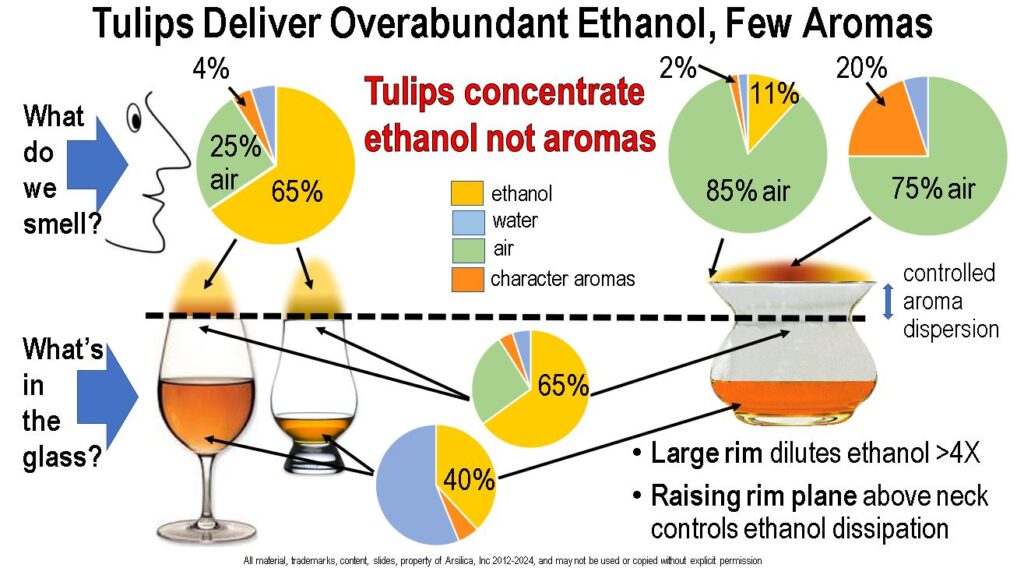
To the untrained, these “fixes” became “science” only because expert marketers, critics, and bloggers have repeatedly said so over the decades. Perhaps science was too busy to analyze how glass shape can control aroma profile until we (Arsilica, Inc. came along). However, when evaluators apply true scientific principles: (1) simultaneous mouth and nose inhaling reduces the olfactory aroma sample, (2) no swirl = few aromas, (3) wafting acclimates pungency, but can’t prevent ethanol numbing, (4) adding water raises surface tension, shuts down ALL aroma evaporation, not just ethanol. Tiny rims mask aromas that hide behind concentrated, pungent ethanol. All the “fixes” fail to handle ethanol, the enemy of accurate evaluation. Science journal paper on Ethanol vs Odorant Detection
Shoulda, Woulda, Coulda Done it Differently
A different glass would have avoided the hoopla and confusion. As opposed to “twisted-marketing science,” “blogger-opinion science,” and “fill-in-the-blank science, true, professional science disciplines (sensory, chemistry, physics, behavioral) dispel myth, disseminate usable knowledge, and reduce the revered critics to just another opinion. We are reminded of a saying attributed to the stoic philosopher Marcus Aurelius, “The opinion of 10,000 men is of no value if none of them knows anything about the subject,”
The Ethanol Problem is Designed into the Tulip Glass
Medical science classifies highly volatile ethanol as an anesthetic. Medical science classifies highly volatile ethanol as an anesthetic. Drinkers remain unaware because numbness occurs painlessly, while faulty thinking reinforces the belief: “If you can’t see or feel it, it’s not there.” A tulip of 1½ oz of 40% ABV rum contains 65% anesthetic ethanol in the headspace. The rest is air, water, and at the maximum, 0.5% character aromas. Ethanol raises detection, identification, discrimination thresholds, slows response time, blocks signals to olfactory receptor neurons, and ruins accurate evaluation with distracting pungency and trigeminal nerve irritancy. That’s science.
Our studies show that after 4 sniffs of a neutral spirit from a tulip, most aromas become undetected or unidentifiable, and many of those detected cannot be discriminated (e.g. peach from apricot, anise from fennel, etc.).
State-of-the-Art: Flavor Intensity Comes from Great Design
For reasons unknown, a scientific approach to glass design was non-existent until 2002 when Arsilica began to research. Decades of marketing have ensconced tulips as the popular glass shape for industry and consumer, subconsciously training multiple generations to rely on the presence of pungent, anesthetic ethanol at first sniff to validate a spirit.
This sets the stage for high ABV levels (cask strength anyone?) to numb the senses, and hands over purchasing decisions to subliminal, suggestive marketers and vicariously influential videos. Ethanol’s mental fog is the perfect screen for opportunistic, prurient marketing and bogus product claims. Craving and seeking out ethanol when tasting spirits has taken priority over distillers’ craft and art. Tulips have created drinkers, not evaluators. Marketing-stoked popularity may be fun, but it’s not science.
Conclusion
The facts: short, fat, wide-rim glasses and swirling provide more aromas to sniff and can mitigate ethanol for better evaluation, providing a pathway to enjoy aromas for longer than the quickly fading first-sniff memory. A decade of research by Arsilica led to the introduction of the sensory-engineered NEAT glass in 2012.
Other glasses such as wide-mouth tumblers provide some olfactory ethanol relief as well. To set the record straight, we love ethanol too, but we don’t want it in the way when we are evaluating spirits. Some will argue “It’s part of the spirit,” and rightly so, as are the many subtle aromas you can’t smell through the overpowering, nose-numbing ethanol.
Find Much More Definitive Flavor Intensity Without Tulips
Tulips may have topped the marketing game, yet scientifically, they fail miserably, working against accurate spirits evaluation. Drinkers encounter a major crossroads on their spiritual journey; (1) stick with the traditional, iconic, unscientific, dysfunctional tulip, or (2) embark on a new experience with a state-of-the-art diagnostic tool. Simply put, you can follow the ethanol-ruled-good-times-tradition-party, or discover the true spirit in your glass. Your glass, your choice.
Bio: George F Manska, CR&D, Arsilica, Inc.
Qualifications: Published sensory science researcher, and entrepreneur. BSME, NEAT glass co-inventor
Mission: Replace myth and misinformation with scientific truth through consumer education.
Note: Enrolled NEATNEWS subscribers are entitled to 10% discount on all purchases and free shipping over $55 for as long as you are enrolled. Coupon code: ILUVNEAT


