
Tasting Observations are Important to Revealing Hidden Consumer Psychology

Tasting Observations are Important to Revealing Hidden Consumer Psychology
Observations at tastings are revealing important clues to consumer psychology. We see you at whiskey, tequila, and rum tastings. Whether you are an attendee or administrator, your attitudes toward high ABV spirits and ethanol become apparent and provides insight as to how corporate brand ambassadors play on your personal emotions and thought process to sell spirits.
Observations: Drinker/Consumer Psychology
- You look down, averting eye contact, hiding your facial expression, spirit sample in hand, as you brace for that first sniff of ethanol pungency. Hesitating for a brief moment, politely waiting for the brand ambassador to finish telling you what you will taste, you then take that first sniff.
- The initial wince and eye squint from the overwhelming first acrid sniff is revealing. You know it’s unavoidable and accept it. The pungency passes quickly. You fleetingly note the sharpness which indicates the presence of ethanol before it fades. As soon as pungency abates, you begin to sniff to determine just how much ethanol is there. Is that the real reason? Actually, you came for the ethanol, a quick buzz of slight euphoria prior to slipping back into other obligations. At least three, more like 5 sniffs get that buzz going. These tastings are fun, and ethanol, the “harmless” drug enhances enjoyment.
- Then, you taste. The discomfort and uncertain look on your face because you don’t detect the aromas described by the tasting leader/host or brand ambassador is revealing. With frequent re-sniffs, you try your best to detect them. However, the game is not to let on, but nod and smile in agreement with the others. After all, you also want to show your gratitude for the gift of ethanol.
- Your facial expression clearly indicates perplexity, and you give that final shrug as you realize one or more of the following:
- You doubt your own ability to detect aromas and feel the anxiety of “missing” the experience, particularly when you are surrounded by smiles and approving nods. You ask, “How come everyone else seems to get it but I don’t?” or “I can never seem to get the aromas at tastings.”
- Your sense of smell is off today, or worse, it just is not good enough and never has been when it comes to spirits, but at least you got a free buzz.
- Frustration with playing the mystery game of “What’s in the drink?” at every tasting.
- After a few sniffs, there is a positive. It has the expected ethanol content, so at the very least, it’s a nice feeling, well worth time taken to stop for a minute or two.
- You ask yourself, “Am I the only one who cannot taste what the administrator described? Why doesn’t anybody say something, or admit it?” Unfortunately, everyone sees an admission as weakness.
- Conspicuous by its absence, the commitment to buy is seldom seen, because “I came to buy” said nobody, ever. I came for the freebie drugs is a little more like it. Exit or buy first is a telltale of consumer psychology. Use those observations to reflect on what really occurred at the tasting.
Let’s Find Out Why
These circumstances don’t apply to everyone, but they do represent thousands of consumer experiences at spirits tastings everywhere. For the most part, the smiling “actors” are experiencing the same struggles and have no intention of admitting that they do not really smell the aromas. Why does it happen? Four key reasons interact and combine to define the state of the art of spirits tastings:
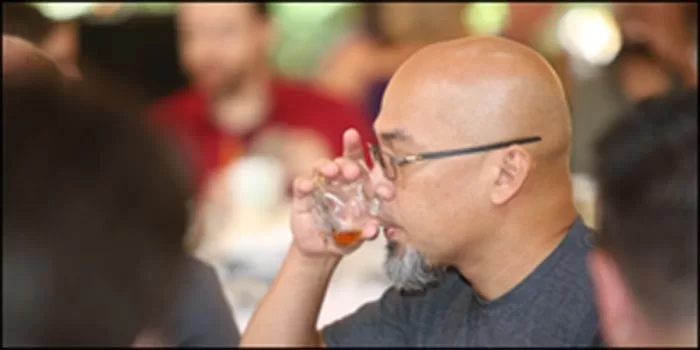
Observations: Irritating Ethanol is the Enemy of Sensory
- Ethanol is a medical anesthetic, irritating the trigeminal nerve endings and massively impeding sense of smell from first sniff. However, that doesn’t stop drinkers, they adapt quickly.
- The sharp, pungent ethanol stimulus diverts focus away from aroma detection.
- Ethanol is the most volatile compound in any spirit, (whiskey, rum, tequila, vodka, gin, cognac, and all), evaporates first, travels quickest, and in tulip glasses, crowds out less prevalent aromas on its way to the nose to irritate the trigeminal nerve endings.
- Subsequent sniffs increase irritation, and the lingering first sniffs of defining aromas disappear. Without conscious pain or warning, the consumer has no clue that ethanol up the nose destroys aroma detection and identification. In a nutshell, that is why we can’t detect the aromas.
Observations: Irritating Ethanol is the Enemy of Sensory
- For sure, the consumer is neither stupid nor ignorant. However, our observations reveal they are grossly misinformed since prurient marketing messages reach their emotional needs before scientific fact, and emotional reasons subconsciously direct our actions much more than factual statement. Consumer’s psychology becomes apparent with closer observation.
- We know ethanol is a drug, but discussion of that aspect is socially uncomfortable. We expect and even demand it, and we enjoy the buzz. Consequently, little else ever matters.
- Ethanol’s presence takes priority over the personal quest for seeking character aromas.
- Other than plastic cups with possible off-gassing issues and no headspace to collect aromas, most tastings use tulip glasses and have for decades. Even more common when you had to pay for the tasting experience.
- We never question the tulip glass used by most drinkers and industry educators.
- Very few buy because they like the aromas since, in reality, they could not smell any.
- Decades of tasting with tulip glasses have conditioned the consumer to accept high concentrations of pungent, nose-numbing ethanol. Our observations indicate that many serious tasters dislike tulips.
- Peer pressure plays an important part, in the drinker psychology as many tasters nod in approval at brand ambassadors’ statements.
- Since most drinkers never wish to be perceived as shallow or uninformed, many display a false sense of appreciation while carrying an inner perplexity about the value of the experience.
- Who doesn’t want free samples of ethanol, or that quick buzz.
How Spirits Industry Observations Set Up the Emotional Sale
- Industry marketers, tasting admins, and brand ambassadors know you can’t really smell character intensity through the ethanol mask; they’ve known it all along. Therefore, they carefully script their presentations, hoping your observations are not that keen.
- Evoking an emotional connection is a key marketing objective to convert sales. As a result, a good background story or attractive brand ambassador cements the deal.
- Tasting hosts attempt to provide as many reasons as possible to convert attendees to loyal buyers.
- Unique bottle shapes, stoppers, label designs, bright colors, and art evoke specific buyer emotions.
- Our observations reveal that bloggers and author/critics all help steer drinkers to purchase their personal favorites, using emotional phrasing, and many are paid to write glowing reviews.
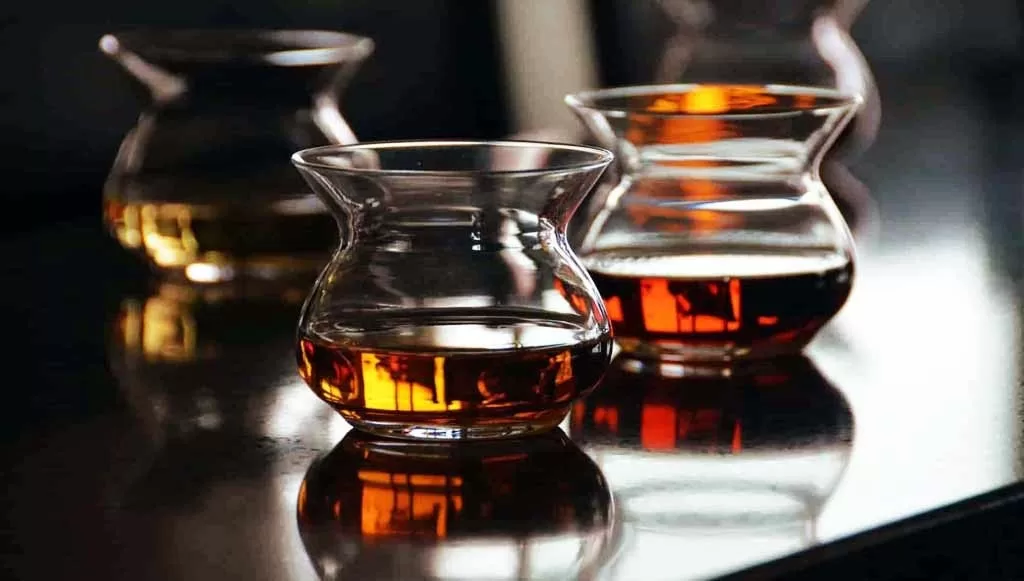
Industry Marketing is in Control, not Likely to Give it Up
Corporate and distributor designed spirits tastings are all about controlling sales conversions. Psychology is the “secret weapon” of the marketing department, never publicly discussed. “Swept under the rug,” are true, personal purchasing motivations, in favor of the marketing engine room, and controlled by the tasting administrator, where incisive and effective marketing is carefully designed and implemented to push product over personal sensory appeal.
The engine room shelf of tools includes a compelling story, subliminal suggestions, and many others. The consumer buys if the engine room tools are convincing enough to push personal preferences aside to buy history, celebrities, colorful labels, unique bottles. Observation includes examining the product and packaging to improve awareness of the play on personal psychology.
We Love Ethanol and Its a Problem
Spirits will always have ethanol; it’s why we drink. However, the face of the spirits tasting is whatever the industry wants it to be, as they continue to support numbing the consumers’ senses and manipulation. If the consumer is silent, then the administrator will leave it there. Silence is golden for the taster, but does not result in a sale. Ethanol “haze” is the gift of the ambassador, who hopes some remnant of the experience will later result in a sale. Science journal paper explains what ethanol does to our olfactory.
Summary
The tulip is worthless as a functional diagnostic glass, and it is the enemy of our personal sensory faculties. Sadly, drinkers who prefer the iconic, traditional tulip-shaped, nose-bomb glass generally use it because everyone else does, or because he/she is compelled to honor centuries old tradition. As in politics, the uneducated are resistant to change and comfortable as sheep is a norm.
Ethanol is a double-edged sword. We love it, but if we can keep it away from our noses, we can make more satisfying and intelligent decisions about what we want to keep in the cabinet. The reward is an improved tasting experience. Finally, any wide-mouth glass is a boon to the olfactory.
Conclusion
The consumer can regain the sensory-driven personal choice initiative, but only if he/she wants it. If you are a serious spirits drinker, then the solution truly begins by acting on your personal sensory preferences and your personal psychology. Our observations reveal that personal preference most often gets side-lined in favor of well-constructed marketing.
Glass choice is key to traveling the enlightened path to a more rewarding flavor and tasting experience. Tulips concentrate ethanol, plastic throw-away cups have no headspace for accurate evaluation. These are the most common vessels at tastings.
Upon personal examination, one may ask: “Who am I?” – a superficial, comfortably numb, eth-head? Or am I serious about appreciating the craftsmanship of distilled spirits? Well trained brand ambassadors have got your number. Heed these tasting observations, take stock of your own psychology, and improve your enjoyment.
Bio: George F Manska, CR&D, Arsilica, Inc.
Qualifications: Published sensory science researcher, and entrepreneur. BSME, NEAT glass co-inventor
Mission: Replace myth and misinformation with scientific truth through consumer education.
Note: Enrolled NEATNEWS subscribers are entitled to a 10% discount on all purchases and free shipping over $55 for as long as you are enrolled. Coupon code: ILUVNEAT


