
Secrets of the Stem, Silent, Ingenious Glassware Innovator

Secrets of the Stem, Silent, Ingenious Glassware Innovator
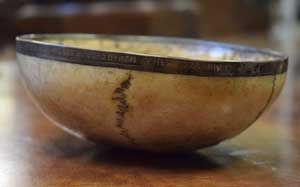
The stem is a silent innovator of the glassware industry. Few know the secrets of how stems influenced the public, the rich, the kings and queens of the world. Why stems? This short history sheds light on how ingenious, stemmed glassware became fashionable throughout Europe, Russia, Great Britain and its colonies. In order to keep with our topic of sensory evaluation, this article is about the effects of visual aesthetics.
Evolution of the Drinking Vessel
Drinking vessels are as old as man himself. The earliest vessels are cupped hands evolving to folded leaves, coconut shells, animal skulls, seashells, bamboo, carved wood, gourds, animal horns, bark and pitch. Man employed many common, natural materials that could hold liquid. Glass is the material most commonly in use today. However, the reason stems are popular on wine and spirits glasses is not so apparent.
Ancient Stem Glassware History
Glassmakers first created man-made glass in multiple locations. Syria, Mesopotamia, and Egypt, probably around 3600 years BCE in the form of beads fashioned from sodium carbonate. Later, glassmaking technology flourished in the bronze age (3300-1200 BCE). The prominent manufacturing method was wrapping a molten, ductile cord of glass around a preformed sand core-shape. Even later, artisans tediously ground a hunk or glob of glass into the desired shape. Highly valued, vessel creation involved much time and expert craftsmanship. Glassmakers first created man-made glass in multiple locations. Syria, Mesopotamia, and Egypt, probably around 3600 years BCE in the form of beads fashioned from sodium carbonate.
Later, glassmaking technology flourished in the bronze age (3300-1200 BCE). The prominent manufacturing method was wrapping a molten, ductile cord of glass around a preformed sand core-shape. Even later, artisans tediously ground a hunk or glob of glass into the desired shape. Highly valued, vessel creation involved much time and expert craftsmanship.
Manufacturing was Secretive
Manufacturing techniques and formulas for glass were guarded secrets of the ancients, with Syria and Cyprus the origin of colorless glass around the 9th century BCE. Later civilizations saw the drinking vessel as a seriously expressive art form combined with a useful purpose. Style and decoration became an important part of glass manufacturing. Early Egyptians discovered that experienced innovator artisan could crush quartz into a fine powder, mix it with plant ash, and cast the mixture into ingots for future melting and shaping.
Greek and Roman Glassware
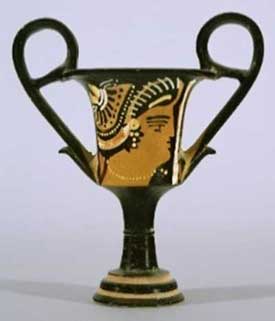
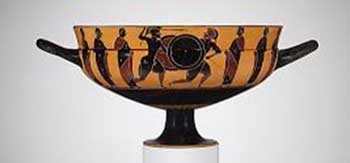
The Greeks, however, relied on pottery as their drinking vessel material of choice. Greek potters shaped their first pieces as very wide, shallow bowls with pedestal bases. In time, the stem appeared as a base connector in many shapes. Then, Greek potters connected vessels such as Komast, Krater, and Siana “cups” to their bases with stems. Could Greek and Roman artisans have added stems to their vessels for visual reasons? A visual reason for stems seems far-fetched.
On speculation, one could ponder that ritual or religious reasons behind Greek and Roman glass designs may have been a valid reason for the stem, its purpose to elevate the drink higher. At many intimate gatherings, reclining attendees rested below the level of the center table, where hosts placed the large wine vessel. Could this be reverence to the spiritual inspirations from the wine? Far-fetched, but not entirely impossible.
Venetian Glass
Venice and its island, Murano, became the center of fine glassware to the royal houses of Europe in the 13th century AD. Glassmakers gathered natural crystal pebbles from the Ticino and Adige Rivers. Then, the pebbles were examined for high clarity, free of veins and cracks, and their ability to “spark” when struck. Murano glass requires very high melting temperatures. As a result, vessels must be formed to shape quickly prior to cooling.
Murano cristallo artisans lengthened stems to allow a grip of at least a thumb and two fingers, resembling the stemmed glassware in use today. Murano glass was the choice of royal tables throughout Europe and Russia, peaking in the 16th and 17th centuries. As a result, Murano glass became the most expensive glass produced anywhere in the world.
Neo-Modern Glassware Stem History – The Appearance of a Visual Function
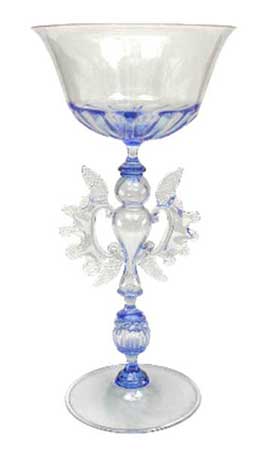
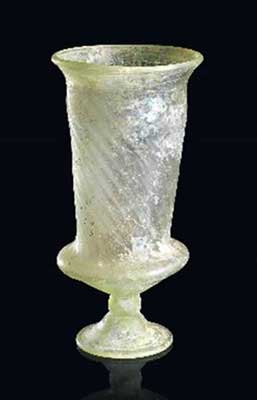
Large candle-lit halls with long dining room tables were able to sit 60-plus guests. Electric lighting was non-existent. Therefore, dim candles lit the rooms, and hosts sought more creative ways to improve the lighting. Soon, it became apparent that fine wines and spirits could be further enhanced visually, if stems were taller to catch more candlelight.
At the same time, drinkers could confine greasy fingerprints to the stem, preserving the pristine beauty of a clean, filled glass. Murano glass sparkles with tiny rainbows at the edge of each facet when cut and highly polished, as it has a very high index of refraction. As a result, stemmed Murano glassware was the sign of a very wealthy household.
Ravenscroft: Stem Innovator and Artisan
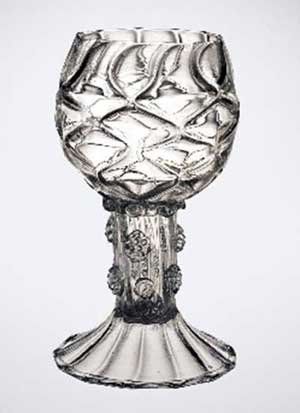
George Ravenscroft re-introduced leaded (PbO) crystal, originally a lost process form Assyria. Leaded crystal was extremely affordable, with little difference in appearance from the renowned Venetian glass. The status-seeking middle and business classes became buyers of economic affordable leaded crystal. Later on, George Ravenscroft was also the innovator of Georgian glass. Hollow stems avoided English glass taxation by weight. Georgian glass is the beautiful, long-stemmed ornately decorated glass popular from the late 17th century to the end of the 18th century. Today, in modern lighting conditions, stems still exude a certain elegance, and conveniently still keep fingerprint smears off the bowl, preserving the pristine ruby appearance of a fine vintage claret.
Leaded Glass Disappearing Act
Leaded glass popularity didn’t last, and many countries have banned its use due to lead poisoning. However, German and Eastern European glass manufacturers (Riedel, Spiegelau, Schott-Zweissel, Stolzle, Rona, and others) have distinguished themselves with strengthening additives, unique stem-pulling techniques, and crystalline glass material to ensure the tradition of the stem continues. Finally, their efforts strive to maintain the high index of refraction. Will the stem ever die? Certainly not in the near future, and some manufacturers offer stems of 12” or more. Truly impressive. Could there be room for another stem innovator?
Summary
In summary, the coveted stemmed glass became important to royalty and the wealthy because of leaded crystal. Eventually, it provided a common, affordable style of glassware for all. We love and prioritize science, invention, art, and history in that order. Certainly, form follows function in science and design, invention springs from needs, and art is the materialization of the creative mind. Hence, the innovator is king. NEAT has a stem, too. Check out how the science works. Independent Research on Glassware.
Bio: George F Manska, CR&D, Arsilica, Inc.
Qualifications: Published sensory science researcher, entrepreneur. BSME, NEAT glass co-inventor.
Mission: Replace myth and misinformation with scientific truth through consumer education.
Comments Welcome – Contact: george@arsilica.com, phone 702.332.7305.
More Information: Technical Report—Applying Physics and Sensory Sciences to Spirits Nosing Vessel Design to Improve Evaluation Diagnostics and Drinking Enjoyment
About The Author
Discovered and developed Naturally Engineered Aroma Technology (NEAT) to enhance the presentation and perception of spirits by separating the disagreeable, numbing aromas of ethanol alcohol from characteristic spirit essences. NEAT connects human physiology, chemistry, and basic physics to improve glassware design to appeal to the flavor senses of smell and taste.
Glassware today is designed in the styling studio, and marketing is added later to sell the design and insinuate function. Inventor of the NEAT glass. Our mission is to educate the public and industry professional to improve knowledge on nosing and tasting spirits. Scientifically designed glassware exposes all traits of a spirit, good and bad, and raises the bar of excellence by exposing the true quality previously hidden by nose numbing ethanol. We are: Changing the Way the World Drinks. NEAT is the Shape of Flavor, and Form Follows Function. See Beverage Journal Paper for more science.


