# The NEAT Glass
> The Ultimate Spirits Glass
> Generated by All in One SEO Pro v5.0.3, this is an llms-full.txt file, used by LLMs to index the site.
## Posts
### [Using the Best Tools to Extract Important Information](https://theneatglass.com/useful-information-best-tools/)
**Published:** March 15, 2023
**Author:** The NEAT Glass
**Content:**
## Using the Best Tools to Extract Important Information
Using the best tools available is the only way to discover the most important information from a spirits tasting and evaluation. The right tool can provide a large amount of useful information regarding the character and quality of the spirit.
We often use the wrong equipment to diagnose and evaluate. We trip over the objective of accuracy to pick up the most common or prevalent notes in the spirit. Since almost everybody uses these tools, no one ever questions if they right for the task. Imagine trying to remove a Philips head screw with a crescent wrench. That is what happens when we try to get important information from a tulip glass.
- **Q:** “Why are tulip rims so small?” **A:** “Small rims collect all aromas so none can escape detection.” **Truth:** 97%+ of all ***detectable*** molecules at the tulip’s rim are pungent, nose-numbing ethanol. Small rims concentrate pungent, anesthetic ethanol. The rest are congeners/flavors.
- **Q:** “Why is it so pungent?” **A:** “Ethanol can’t be separated, live with it, drinking procedures help to get used to it.” **Truth:** A simple glass design change can open the world of flavor.
## Ethanol Effects on Sensory and Social Perception
Few understand ethanol’s impact on olfactory (sense of smell). High vapor pressure, low boiling point and surface tension accelerate evaporation, and it is by far the most abundant airborne molecule in whiskey. *Definition: Highly volatile, anesthetic (nose-numbing), sharply pungent when concentrated (neat).* Spirits = 40% ABV ethanol + 60% water and flavors. [More Science](https://www.mdpi.com/2306-5710/4/4/93 "More Science")
## Sensory Ethanol Masks Useful Information
- Raises detection, identification, and discrimination thresholds; subtle aromas are masked.
- Disrupts calcium ion flow, suppressing sensory data flow to the brain.
- Sharp pungency detracts from the focus on detection and identification.
- The common result is known as olfactory fatigue, nose-blindness, or ethanol lock-out.
- The best tools (glassware) deliver more aromas, less ethanol
**Female Participation:** Why are so few women whiskey club members? Female olfactory receptor neurons (ORNs) are 43% more abundant than male. Ethanol pungency raises caution alarms when smelling from tiny-rim tulips. As a result, few female tulip users sniff spirits ortho-nasally, preferring retro-nasal sampling to avoid pungency.
## Industry Education Fails on Delivering Useful Information at Tastings
In the first place, brand ambassadors and spirits industry educators employ tulip glasses to educate, yet do not teach sensory or ethanol’s influence on social group mentality. Additionally, few are willing to risk their reputations by rejecting the accepted tulip norm. Finally, it’s always easier when you don’t have to explain. Tulips are not the best tools to deliver detectable congener aromas. [Independent Research](https://sensationresearch.com/wp-content/uploads/2020/01/Glass-Vessel-Aroma-DA-Study-Sept-2019.pdf "Independent Research").

## Defining the Best Tools: Tulip Tasting Crutches
1. **Don’t swirl.** Swirling is the “engine” that powers evaporation. Narrow bowls restrict swirling. As a matter of fact, wide rims, short height, and fat bowls mean better swirling.
2. **Breathe through mouth and nose.** Mouth intake is air only, no spirit aromas. Close the mouth and use a glass that does not concentrate ethanol at the nose. Smell is 90% of flavor, therefore, all molecules should pass through the nasal cavity.
3. **Add a little water.** Ethanol is the most volatile component. Water shuts down ***all*** aroma evaporation, including character aromas. Despite attempts to find useful information, in reality we have destroyed it. Equally important, we now have a false impression that it “opened up” the spirit.
## Tulips vs Best Tools: NEAT – Useful Information
Within traditional glass shapes a large, wide-mouth tumbler works much better. However, the only shape ever scientifically engineered is the NEAT glass. Not only does NEAT divert anesthetic, pungent ethanol, it also enhances aroma detection and identification. Furthermore, tulips can’t do that.
In Summary, Industry and consumer benefits are positive and meaningful. First, NEAT addresses gender equity. Second, it contributes to quality improvement, and third, NEAT raises consumers’ product perception level. Finally, you get more important, useful information from the best tools. [Learn more](https://www.mdpi.com/2306-5710/10/4/116 "Learn more") about how ethanol affects aroma detection.

**Bio: George F Manska, CR&D, Arsilica, Inc.**
**Qualifications:** Published sensory science researcher, and entrepreneur. BSME, NEAT glass co-inventor
**Mission:** Replace myth and misinformation with scientific truth through consumer education.
**Note: [Enrolled NEATNEWS subscribers](https://theneatglass.com/neat-news/) are entitled to a 10% discount on all purchases and free shipping over $55 for as long as you are enrolled. Coupon code: ILUVNEAT**
#### About The Author
[The NEAT Glass](https://theneatglass.com/author/georgearsilica-com/)
Discovered and developed Naturally Engineered Aroma Technology (NEAT) to enhance the presentation and perception of spirits by separating the disagreeable, numbing aromas of ethanol alcohol from characteristic spirit essences. NEAT connects human physiology, chemistry, and basic physics to improve glassware design to appeal to the flavor senses of smell and taste.
Glassware today is designed in the styling studio, and marketing is added later to sell the design and insinuate function. Inventor of the NEAT glass. Our mission is to educate the public and industry professional to improve knowledge on nosing and tasting spirits. Scientifically designed glassware exposes all traits of a spirit, good and bad, and raises the bar of excellence by exposing the true quality previously hidden by nose numbing ethanol. We are: Changing the Way the World Drinks. NEAT is the Shape of Flavor, and Form Follows Function.

The NEAT Glass (CSO) Corporate Strategy Officer, inventor and entrepreneur, (CRD) Chief Research and Development Arsilica, Inc.
[See Full Bio](https://theneatglass.com/author/georgearsilica-com/)
[Facebook](https://www.facebook.com/theneatglass/) [Instagram](https://www.instagram.com/theneatglass/) [TikTok](https://www.tiktok.com/@theneatglass.com) [Pinterest](https://www.pinterest.com/TheNEATglass/) [YouTube](https://www.youtube.com/@TheNEATGlassChannel) [LinkedIn](https://www.linkedin.com/in/theneatglass) [Tumblr](https://www.tumblr.com/the-neat-glass)
**Categories:** The NEAT Newsletter
---
### [The Truth About Sea Salt Aromas in Whisky](https://theneatglass.com/truth-sea-salt-in-whisky/)
**Published:** April 26, 2023
**Author:** The NEAT Glass
**Content:**
## The Truth About Sea Salt Aromas in Whisky
Sea salt aromas have never and will never appear in Scotch whisky distilled in the islands, or anywhere else, for that matter. Sea salt is sodium chloride, and it has no smell. Serious whisky drinkers read constantly to discover new information on spirits. Scientists keep quiet while acclaimed scotch whisky critics, authors, evaluators, and mavens swear by the salty smell of scotches distilled near the seacoasts of Islay, Jura, Skye, and Arran. Moreover, they credit salty sea air for salty aromas. Marketing again executes falsehoods as science fails to push back to debunk misleading information.
## The Truth: Sea Salt (Sodium Chloride) has no Smell
Salt has no smell. Placing saltwater on the tongue reveals salt as a taste, not a smell. Some scotch whiskies are produced in an atmosphere that periodically contains salt spray, but how can salt get in the barrel? If salt could get in, scotch could get out, leaking or quickly evaporating (some evaporates – “angel’s share”). The salt stays outside the barrel. Interestingly, scotch reviewers never discuss how salt gets in the whisky.
One highly improbable explanation could be that during distillation; the spirit was made or cut with salty water or was the barrel washed with saline water? Was salt added to the barrel? Indeed, a good distiller never does that, much less, would ever admit to it.
## Salt is Not in the Barley
Some Islay-grown barley is a component of some Islay scotch. However, if salt deposits on the barley, does it survive processing and cleaning? Does the distillation (high-temperature evaporation) process leave enough salt to be detectable on the tongue? Highly unlikely. Modern barley processing through soaking, screening, shuttles, and milling minimizes any possible trace of salt, only 20% of husks (popular milling mix), eliminate 80% of the potential problem. Therefore, even the slight possibility of detectable husk salt is nil.
Sea spray (spume) is a natural product of violent waves and wind. Called SSA (sea salt aerosol), tiny sea spray bubbles burst at the interface of water and air, rising up from crashing waves, commonly leaving light salt deposits on the pier, docks, and buildings close to wave action and weather.
During fierce storm conditions in the cool fall and winter, sea spray travels as much as 25km within the atmospheric boundary layer. However, jet droplets and spumes from normal wave action throughout the year travel only about 20cm above the water surface and may travel a horizontal distance of 100 feet.
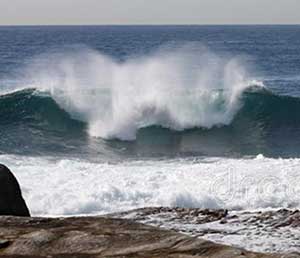
**What is Sea Spray?** Sea spray consists of 60-90% DOC (dissolved organic carbon), and an additional percentage of dead algal cells, the product of algae blooms. Do any critics ever discuss the latent aromas of rotting fish and dead algae? Not that we know of. Subsequent rain in the aftermath of most storms washes salts and DOCs to the ground, and salt crystallizes. Inside storage facilities, atmosphere salt levels are extremely lower than those just outside the structure, and non-existent in the barrel.
## Salt Will Not Permeate the Barrel
Barrels are tight, and air can slowly permeate the wood, but the probability of salt migrating through the wood membranes or tightly swollen stave seams is unlikely, if not impossible. In the likelihood that salt crystals reach the barrel, they will leave a tiny white line at every leaky seam. Certainly, microbial bacteria have a better chance to permeate a seam than does crystallized salt.
**The test:** We prepare a saline solution of .05% NaCl (table salt) and verify that with a calibrated salinometer. Washing the salinometer after each test, we test several Islay scotches which reviewers note as “sea salty” for an indication of salinity. They all test at 0.00% salinity. If salt isn’t in the liquid, how could it be in the aroma? Among four reputable tasters, none can distinguish (blind) taste or smell differences between .05% and 0.00% NaCl water.
## The Obligatory Sea Salt Taster’s acknowledgment
Reviewers believe a reference to salty aromas is obligatory in their notes on island/Islay scotches *due to proximity to the sea*. They know in advance which scotch they are tasting, and fear omission of ocean flavors is an unforgivable oversight, because “It ***ought*** to be there.”
## There are Worse Aromas than Non-Aromatic Sea Salt
If there are nearby sewage treatment plants or fertilizer factories, they surely ignore *that* description. If there are rose gardens or pine forests nearby, they certainly take advantage of the opportunity to describe enticing floral and woodsy notes. Brand marketers support the myth to enhance diversification from other scotches because they can, and it sells whisky. Salt exists in scotch whisky because reviewers attempt to make their notes interesting and appealing.
## Personal Ambitions
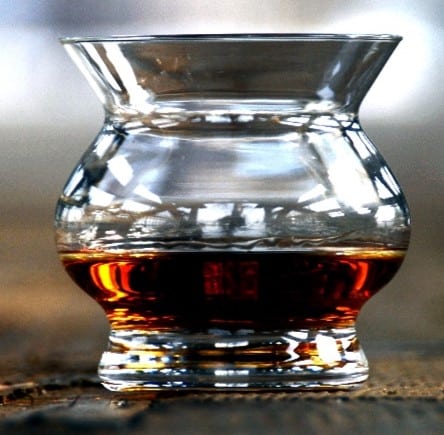Perhaps the critics believe followers will applaud their exceptional sensory prowess in salt detection when no one else can. Indeed, it is a nearly unchallengeable opportunity to enhance the taster’s mystique and prowess. Especially if other reviewers do not note salt in the same spirit; it’s flagrant one-upsmanship, “My nose is better than yours.”
## Summary
As a personal experiment, taste scotch double-blind (no peeky label/bottle, someone else determines the order). Construct flights with some “sea salty” (according to a reviewer’s designation) samples. Salty air comments appear because tasters know the brand/label/bottle shape/distillery location indicates a particular spirit is made near the ocean. Indeed, tasters also gather clues from surreptitious hints of high phenol peat smells, which may indicate the spirit is made near the ocean (Islay scotches for example). Finally, unless “sea salty” shows up in professional sensory evaluations, it is not a proven attribute of spirits *made/aged near the sea*. **[Back to Home](http://www.theneatglass.com "Back to Home")**. **[Sensory Science and Tasting Glasses](https://www.mdpi.com/2306-5710/4/4/93 "Sensory Science and Tasting Glasses")**
**Bio: George F Manska, CR&D, Arsilica, Inc.**
**Qualifications:** Published sensory science researcher, and entrepreneur. BSME, NEAT glass co-inventor
**Mission:** Replace myth and misinformation with scientific truth through consumer education.
**Comments Welcome – Contact:** george@arsilica.com \| 702.332.7305
**More Information:** [www.theneatglass.com/shop](http://www.theneatglass.com/shop)
#### About The Author
[The NEAT Glass](https://theneatglass.com/author/georgearsilica-com/)
Discovered and developed Naturally Engineered Aroma Technology (NEAT) to enhance the presentation and perception of spirits by separating the disagreeable, numbing aromas of ethanol alcohol from characteristic spirit essences. NEAT connects human physiology, chemistry, and basic physics to improve glassware design to appeal to the flavor senses of smell and taste.
Glassware today is designed in the styling studio, and marketing is added later to sell the design and insinuate function. Inventor of the NEAT glass. Our mission is to educate the public and industry professional to improve knowledge on nosing and tasting spirits. Scientifically designed glassware exposes all traits of a spirit, good and bad, and raises the bar of excellence by exposing the true quality previously hidden by nose numbing ethanol. We are: Changing the Way the World Drinks. NEAT is the Shape of Flavor, and Form Follows Function.

The NEAT Glass (CSO) Corporate Strategy Officer, inventor and entrepreneur, (CRD) Chief Research and Development Arsilica, Inc.
[See Full Bio](https://theneatglass.com/author/georgearsilica-com/)
[Facebook](https://www.facebook.com/theneatglass/) [Instagram](https://www.instagram.com/theneatglass/) [TikTok](https://www.tiktok.com/@theneatglass.com) [Pinterest](https://www.pinterest.com/TheNEATglass/) [YouTube](https://www.youtube.com/@TheNEATGlassChannel) [LinkedIn](https://www.linkedin.com/in/theneatglass) [Tumblr](https://www.tumblr.com/the-neat-glass)
**Categories:** The NEAT Newsletter
---
### [Popular Glassware is the Taster's Worst Enemy](https://theneatglass.com/popular-glassware-worst-enemy/)
**Published:** August 17, 2023
**Author:** The NEAT Glass
**Content:**
## Popular Glassware is the Taster’s Worst Enemy
The Taster’s worst enemy is located right under our noses. The most popular glassware is the common, tulip-shaped glass we have historically used for centuries to taste and evaluate spirits, unconsciously rules our entire approach to spirits tasting and enjoyment.
## Why Glassware is the Enemy
The vast majority of *detectable* aromas from a 40% ABV spirit is ethanol. Note that we said “detectable.” Air and evaporated water are “background” aromas deemed undetectable because we are born into them. The nose has fully acclimated to their inevitable, eternal presence. As a result, the only *detectable* aromas from spirits are the flavor congeners (2.5%) and ethanol (97.5%)
In the battle to reach the nose first, ethanol wins; highly volatile ethanol, and there is so much of it. We’ve said before that flavor is 90% olfactory in our spirits world. Alcohol arrives first on the scene, and its properties irritate the trigeminal nerve system. In addition, it destroys the detection and identification of aromas before they get there in sufficient quantity to be detected, much less, identified.
We want to experience those flavors, but the concentrating funnel of the tulip glass immediately provides a nearly insurmountable barrier to enjoyment and analytics. [More about ethanol.](https://www.mdpi.com/2306-5710/10/4/116 "More about ethanol.")
## Tying this Discussion to Drinkers’ Attitudes
In our last two NEATNEWS letters, we alluded to the behavior of tasting event attendees and the different types of personalities of spirits tasters. To summarize, very few drinkers ever get useful information regarding tasting procedures and methods. Notably, these problems are largely because acceptance of current procedures, poor glassware choices, and the primary emphasis on ethanol, collectively work against true science. All this is blanketed by a reluctance to change.
As a result, the majority of whiskey drinkers are just playing at tasting. Noses are irritated and numbed by ethanol. Many drinkers drink for the ethanol “buzz.” Unconsciously, we are training ourselves to prioritize ethanol over discovering flavors and quality. In other words, to quote Walt Kelly from his comic strip Pogo. “We have met the enemy and they are us.”
## Reviewing the Glassware Problem
The decades long usage of a glass designed for 16-22% ABV sherry copita/tulip to taste 40% ABV spirits places an invisible barrier to our deeper understanding of every spirit. Ethanol anesthetizes olfactory neuron receptors from the very first sniff. This barrier is anesthetic ethanol alcohol. Tulips create a nose-bomb of pungent numbing ethanol, hiding subtle flavors. As a result, drinkers seldom if ever get an accurate picture of a spirit’s true profile. That is why we say tulips are the taster’s worst enemy.
## Reviewing the Psychological Ethanol Problem
We love ethanol, don’t we? As a matter of fact, euphoric ethanol is the major reason we drink. Yet we are just kidding ourselves with tastings, events, and machinations we endure. Those are excuses to sniff ethanol, not to learn more about spirits. Tulips in combination with the public’s ingrained worship of pungent, anesthetic ethanol creates an ethanol barrier to knowledge and understanding. To clarify, we understand little about the spirit, because ethanol in popular glassware keeps us in a nose-numbed fog.
## But Is Popular Glassware not a big Issue in Wines?
It is, but not nearly as big, and that is a different discussion. At least with wines, evaluation and pinpointing flavors is much easier. Wines have much lower ethanol, ranging from 4-16%. With a little practice, almost anyone can easily tell the difference between grape varietals.
Additionally, the taster can detect differences in style. For example, monitoring pH, temperature, and using inoculation of cultured bacteria promotes buttery-flavored malolactic fermentation, and oxidation is easily detected and is considered to be an accepted and even desirable trait in some red Spanish wines.
Because the low ethanol in wine does not quickly nor totally interfere with our olfactory and chemosensory receptors, it gives us a little time to detect, identify, and differentiate the flavors. In our estimation and experience with wines, a much higher percentage of wine drinkers know and understand wines. The percentage of spirits drinkers who can differentiate and even identify different spirits is much lower.
## Popular Glassware, the Taster’s Enemy, is Why we Seek Outside Opinions
Why do so many bloggers, critics, gurus, and book authors exist to tell us about what is good and what is not? We think it’s because the ingrained per-disposition to pungent ethanol from tulips makes ethanol the end game. We can’t detect, so we ask someone. Everything else stops at that first whiff of the drug ethanol. Consequently, there is no continuation of the process to discover subtle sensations, nose, and flavors of the spirit.
As a result, we seek someone else’s opinion, affirmation, or read others’ tasting notes. Nose-numbed, asking someone else has become the only way to discover which flavor notes we should remember. We are told what to like before we have a chance to decide for ourselves, and worse, we gave that decision away.
## Observing the Typical Spirits Buyer
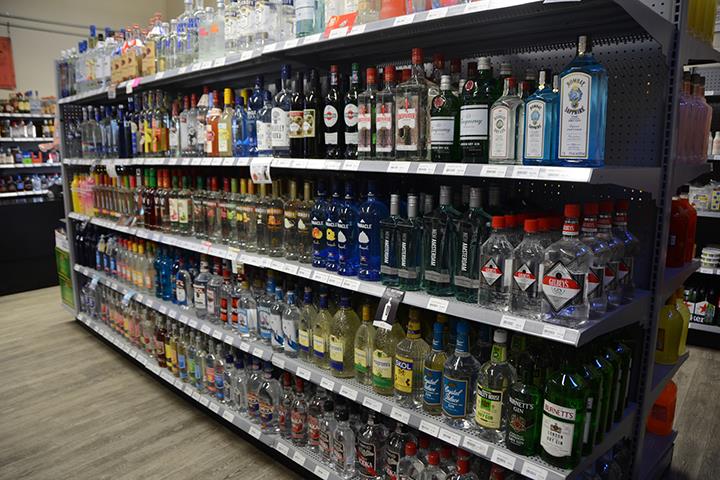
In the liquor store aisle, watch how consumers make choices. Many know the bottle/label/package they came to buy. Those who are trying to make up their minds will spot the eye-candy of an attractive label or bottle. Most read the label to find % ABV and note the price. This data calculates a value index (cost divided by % ABV). Ethanol and marketing sell spirits. As a result, flavors and quality have little to do with choice.
## Depending on Others’ Opinions
Some go to the phone and call a trusted friend or bring up a critic’s website to find out more. Some click on their favorite app and buy (or not) by the rating. If the ethanol value proposition wasn’t a large enough purchasing incentive, spirits buyers may consult someone else to help them justify the purchase.
Placed in perspective, spirits are priced higher than wine on average, so disappointments with spirits can be more costly. Additionally, general knowledge may be greater among wine drinkers than spirits drinkers because the invisible nose-numbing ethanol barrier limits the average spirits drinker’s ability to evaluate and build a smell library.
## **Critics, Bloggers, and Authors Also Have Problems with Popular Glassware**
Why would you think the critic has a better nose for your personal preferences than you do? At the level of nose numbing that occurs from tulip-shaped glasses, very few critics and evaluators are endowed with good noses. Most are in business. Most do not understand basic science. Therefore, few are actually qualified to give advice. Consequently, it’s all up to you to develop your own sensory.
You need to find the good guys. We prefer those who taste blind, using triangle testing, and verifying more than once in different orders. Those few evaluators who do understand the effects of ethanol work hard to keep the ethanol cloud from affecting their notes. In their absence, learn enough to do it yourself.
## Replace Non-functional, Popular Glassware
Common excuses not to change include: “I believe the smell of ethanol belongs,” “I have a good nose and ethanol doesn’t bother me,” and “Everyone else drinks from tulips.” Tolerating ethanol from tulips is essentially placing the importance of ethanol ahead of discovering or actually applying your personal preferences when purchasing. [How NEAT works](https://theneatglass.com/how-it-works/ "How NEAT works").
Sorry Charlie, you had a good nose until you snorted ethanol. Every time ethanol molecules attach to cilia, the olfactory receptor neuron is rendered useless due to trigeminal irritation.
## Are Competition Awards any Indication of Quality?
No one is immune. Spirits competitions have glassware problems, too. Many competitions gather revenues rather than providing comprehensive notes. Judging issues include flight size (pushing six or more samples in 45 minutes with numbed noses) and personal bias. Distillers whose product is last in a flight have a disadvantage because noses are already numbed.
NEAT is the official judging glass of over 40 major international competitions annually. NEAT lets you have it both ways: evaluate at the rim, or if you miss the ethanol, stick your nose in. Tulips give you no option. Inadvertently, it becomes a race to detect and identify flavor against your nose getting numb. Your worst enemy might be your glass.
**Note: [Enrolled NEATNEWS subscribers](https://theneatglass.com/neat-news/) are entitled to 10% discount on all purchases and free shipping over $55 for as long as you are enrolled. Coupon code: ILUVNEAT**
**Bio: George F Manska, CR&D, Arsilica, Inc.**
**Qualifications:** Published sensory science researcher, entrepreneur. BSME, NEAT glass co-inventor.
**Mission:** Replace myth and misinformation with scientific truth through consumer education.
**Comments Welcome – Contact:** george@arsilica.com, phone 702.332.7305.
**More Information:** [www.theneatglass.com/shop](http://www.theneatglass.com/shop)
PDF
Print
Share
[Email](#)

The NEAT Glass (CSO) Corporate Strategy Officer, inventor and entrepreneur, (CRD) Chief Research and Development Arsilica, Inc.
[See Full Bio](https://theneatglass.com/author/georgearsilica-com/)
[Facebook](https://www.facebook.com/theneatglass/) [Instagram](https://www.instagram.com/theneatglass/) [TikTok](https://www.tiktok.com/@theneatglass.com) [Pinterest](https://www.pinterest.com/TheNEATglass/) [YouTube](https://www.youtube.com/@TheNEATGlassChannel) [LinkedIn](https://www.linkedin.com/in/theneatglass) [Tumblr](https://www.tumblr.com/the-neat-glass)
**Categories:** The NEAT Newsletter
---
### [How to Become a Better, Serious Evaluator](https://theneatglass.com/become-better-serious-evaluator/)
**Published:** May 2, 2023
**Author:** The NEAT Glass
**Content:**
## How to Become a Better, Serious Evaluator
The serious evaluator is much different than an amateur enthusiast. The serious evaluator delves into all things regarding a favorite spirit to better learn its history, processes, flavors and nuances. Amateurs, although they may not readily admit it, drink for the social aspect and the ethanol buzz. Amateurs see the serious evaluator as a group they want to belong to, but are seldom willing to put in the effort, work, and study necessary to become proficient.
## How to Get Serious About Spirits
The task to become better knowledgeable about all things spirits is actually a somewhat difficult, time-consuming process. It begins with the desire to learn, by reading books on everything about your favorite type of spirit. It continues by associating and discussing them with respected tasters. Finally, it culminates in developing one’s ability to detect and identify flavors and their sources with serious, studious intent. Discover those particular spirits most satisfying to your personal taste.
We will never be able to motivate you to take the step to being a better evaluator, but we can provide you with a tool that makes the tasting, detection, identification, and evaluation of flavors meaningful in your quest.
## Glass: The First Step to Becoming a Better Evaluator
The [development of the NEAT glass](https://theneatglass.com/the-best-spirits-glass/) began in 2002 as the result of a mistake in a glassblowing class. This large-rim-flared, mouthblown glass “mistake” was created while learning the art of glassblowing. While shaping the vessel on the punty, the instructor added a flare to a sample which was overwhelmingly large, something we had never seen in a spirits glass before. When the laughing died down, we decided to save the sample for its own uniqueness. Then, two months later, the opportunity occurred to test it.
## The Revealing Glassware Test
Deciding to try the “mistake,” we poured and sniffed, to discover a remarkable absence of ethanol. Overpowering, pungent ethanol was not on the nose in the center of the rim plane, and only slight traces of ethanol were detected at the rim edge. In amazement, we retrieved our standard tulips to compare them side-by-side; the serious, Aha Moment! Glass shape controls aroma profile. This discovery challenges the way the most drinkers enjoy spirits, and takes the serious evaluator to a new level.
The quest to determine the best size and shape began, and panel testing sessions were used to select better aroma profile delivery over a nearly 10-year span, evaluating over 52 different shapes. The NEAT glass you see today is the empirically determined shape that exhaustive panel testing rendered as the best of the shapes. Cross-tested again and again, the final NEAT glass is the one you see today.
## Evaluator A-B Preference Testing
We formed Arsilica in 2002, dedicated to researching spirit evaluation methodology. Later in the development of the NEAT glass, we conducted many A-B comparison tests to construct profiles of whiskey drinkers through their preferences, comments, and opinions. We released NEAT in 2012 as a well-researched, refined, patented, and manufactured product. In 2018, we published our findings in a peer-reviewed [beverage journal paper ](https://www.mdpi.com/2306-5710/4/4/93)which validated our scientific approach and presented the collected data.
## Testing Conclusions of the A-B Comparisons
Confidence level of 2,914 tests, 2Ϭ (97.5%), nationwide testing. Male preferences 87.1 preferred the no-ethanol NEAT glass, and 98.3% of females preferred the no-ethanol NEAT glass. From this we discovered a striking difference in ethanol tolerance on the olfactory. The common tulip glass creates a gender equity problem, in that it exacerbates ethanol irritation much more in women than in men.
Interesting and noteworthy, there is a much deeper issue than gender equity. Among all the1,830 men we tested, their comments after the test uncovered a deep-seated attitude which is divides the mindset of the whiskey drinker into two major camps.
## Hidden Motivations Separate Casual from the Serious Evaluator
Curiously, the male evaluator segment tested who preferred the NEAT glass said they still would continue to use the iconic tulip. Considering the fact that they liked the NEAT glass better in a side-by-side comparison, it is curiously odd that they would choose a path that was clearly inferior to evaluation and discovery. Their comments placed their priorities as being much different than female participant’s priorities.
Males see spirits (especially whiskey) tasting as a social, fraternal, bonding experience line-on-line similar to a group of sports fans. As sports fans they relish and wear their favorite team logos on caps, shirts and paraphernalia. As drinkers, they relish the iconic Glencairn tulip glass as a revered badge of membership in a fraternity they consider unique and as an extension of their identity.
They believe their choices separate them from others, but not so much that there is no camaraderie as they seek out other fans who worship their favorite team. Similarly, they seek others who hold their reverence for spirits, in particular whiskey. Notwithstanding, the same applies to Gin, Rum, Tequila drinkers, as evidenced by the clubs available to join. However, the psychological reasons apparently run much deeper, and may point to the attitude toward ethanol which
## Two Basic Types of Drinkers, Casual and Serious
- **Knowledge and Exploration:** Casual spirits drinkers have a limited understanding of whiskey types and may stick to well-known or higher priced brands, while serious aficionados invest time in studying production methods, regions, and distilleries. As a matter of fact, the casuals are more averse to reading and education, placing social aspects first, believing the better spirits cost more or have the most expensive looking bottles.
- **Tasting Experience:** Casual drinkers may enjoy their favorite for its flavors, often mixing it with water, ice, soda, etc. Serious connoisseurs view spirits tasting as a total, neat, sensory experience. As a result, they tend to analyze the appearance, aromas, mouthfeel, and finish. Correspondingly they avoid water, ice, and mixes.
- **Collection and Investment:** Casual drinkers purchase for immediate consumption, whereas serious connoisseurs build curated collections and invest in limited editions. For the most part, they have determined either that the collected bottle fits their tastes or their friends’ taste, or it is a low production bottle which has value to its scarcity. Better is materialistic.
Mention of NEAT in whiskey circles sparks controversy, yet NEAT needs no vindication because it performs a specific, functional purpose. NEAT unmasks and frees spirits’ hidden aromas from pungent ethanol for better detection, identification, evaluation, and enjoyment. Simply put, these subjects are the primary concerns of serious drinkers. However, they are rejected by the vast numbers of casual drinkers who stick by their iconic tulip because it means identification. “Everyone else uses it, so it must be the right glass.”

## Separating Casual Whiskey Drinkers from Serious Whiskey Drinkers
We have meticulously examined the reactions of drinkers at whiskey tasting events. Casual drinkers can be further divided into four types: 1) Those seeking the highest ABV to satisfy their personal definition of quality or value, 2) Those seeking the oldest expression, 3) Those who love the label or bottle, and 4) Those on an ego trip to be first in their crowd to own and taste a new release. On the other hand, serious drinkers ask about barrel choices, inspirations. They evaluate to quantify the effects of special attributes on their personal tastes and preferences. “Do I like it?” or “Does it Fit my standards well enough that I need to buy it?”
## Summary
For the serious spirits drinker, it is not about the ethanol, just the opposite. It is about a much deeper subject with a large learning curve. However, the real, but generally undiscussed issue is about a traditional glass blocking the way to learning. Transform from a casual enthusiast to a serious whiskey aficionado.
Could decades of drinking high ABV spirits from tiny rim glasses have changed drinkers’ expectations to accept high ethanol over flavor and craft? Is the industry capable of teaching a more beneficial approach, getting more, impassioned customer involvement? Get a head start on your own education with a serious whiskey lover’s professional diagnostic tool – NEAT.
**Bio: George F Manska, CR&D, Arsilica, Inc.**
**Qualifications:** Published sensory science researcher. BSME, NEAT glass co-inventor
**Mission:** Replace myth and misinformation with scientific truth through consumer education.
**Contact:** george@arsilica.com
**More Information:** [www.theneatglass.com/shop](http://www.theneatglass.com/shop)

The NEAT Glass (CSO) Corporate Strategy Officer, inventor and entrepreneur, (CRD) Chief Research and Development Arsilica, Inc.
[See Full Bio](https://theneatglass.com/author/georgearsilica-com/)
[Facebook](https://www.facebook.com/theneatglass/) [Instagram](https://www.instagram.com/theneatglass/) [TikTok](https://www.tiktok.com/@theneatglass.com) [Pinterest](https://www.pinterest.com/TheNEATglass/) [YouTube](https://www.youtube.com/@TheNEATGlassChannel) [LinkedIn](https://www.linkedin.com/in/theneatglass) [Tumblr](https://www.tumblr.com/the-neat-glass)
**Categories:** The NEAT Newsletter
---
### [Barrel Age and ABV Does Not Indicate Better Quality](https://theneatglass.com/barrel-age-and-abv-quality/)
**Published:** January 22, 2024
**Author:** The NEAT Glass
**Content:**
## Barrel Age and ABV Do Not Indicate Better Quality
Barrel age and higher % ABV do not indicate higher quality. Having been preconditioned to high ABV (alcohol by volume) through the decades by using the tulip shape as a spirits tasting glass, the general drinking public has come to believe more ethanol equals higher quality. [Ethanol destroys aroma detection.](https://www.mdpi.com/2306-5710/10/4/116 "Ethanol destroys aroma detection.")
Additionally, barrel age carries the same erroneous message. Longer aged spirits costs more, longer must be better, and therefore both contribute to better quality. Sadly, many pundits, authors, and critics in the spirits industry repeat the same misleading diatribe. As in politics, constant repetition creates personal “truths” that people cling to even when new ideas or scientific evidence challenge them.
First, let’s discuss the sometimes misleading word “proof.”
## ABV vs Proof: How Proof Came to Be Proof
Proof can denote the approximate alcohol content of any spirit, although people commonly associate it with whiskey, and the concept originated with rum. For the purpose of validation, sailors came up with two methods to be sure they weren’t being scammed out of the ethanol content of their daily tot o’ rum as ship officers would dilute to stretch stores; (1) add gunpowder and ignite with a magnifying glass or (2) load it into a pistol and fire. If the magnifier ignited the rum, or the rum fired the gun, sailors considered it strong enough to meet the standard and declared it “proofed.”
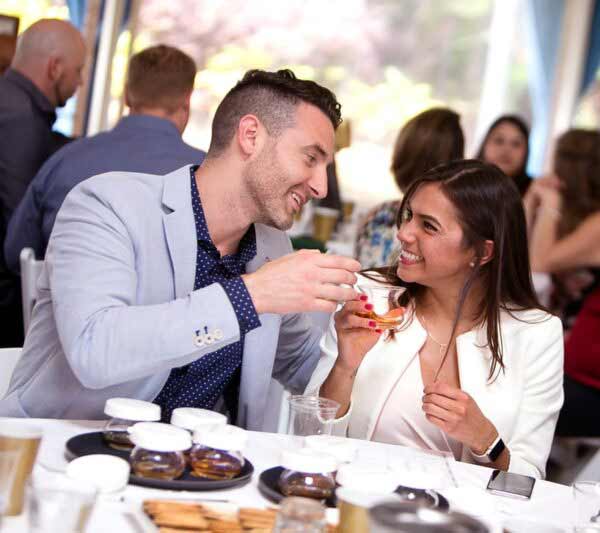English authorities applied proof to spirits as early as the 16th century to determine the taxation rate. By 1816, English authorities measured the specific gravity of spirits with a hydrometer and defined 100 proof as 57.15% ABV. If 57.15% was 100 proof, wouldn’t 200 proof be 114.30% alcohol? Those who struggled with decimal points decided that 200 proof would equal 100% ABV, and the industry now accepts that standard. After all, how can anything be over 100% pure? Happy to finally clear that up, or not.
## Proof is Archaic, We Now Use ABV
**What’s Going On?** Most distillers replaced proof with ABV on their labels, and average human sensory is capable of noting differences of roughly 2% in ABV. An error of 14.3%ABV? Proof is obviously not a usable scale of measurement to discuss degrees of human sensory detection. In the name of sensory science, we will use % ABV (alcohol by volume) instead of the questionable “proof” designation. Many spirits drinkers drink, but don’t know things. Read about [the best spirits glass](https://theneatglass.com/the-best-spirits-glass/ "the best spirits glass")

As a result, the accepted Goldilocks (not too hot, not too cold) version of alcohol content for a distillation to be called spirit is 40% ABV but, most importantly, it is not specifically regulated and more a case of general acceptance. Yet, most drinkers do not understand what ABV actually represents. Here is a guide:
## Different ABV for Different Reasons
**Directly from a pot still**, the spirit can be 60-80%ABV. **Column stills** can produce as high as 95% ABV spirits. **Barrel Entry Proof:** The alcohol content at which distilled spirits are placed into barrels for aging.
1. Some opt for lower proof for slower aging or to produce lower ABV when bottled.
2. Middle Range (around 115-120 Proof / 57.5-60% ABV): Creates a balanced interaction between spirit and wood.
3. High End (125 Proof / 62.5% ABV): Faster aging, more robust and intense spirit. In addition, cask Strengths are bottled directly from the cask without proofing down with water. Arguably 50 – 85% ABV
## Story Telling and Pseudo-Science Language
In the name of sensory science, we will use % ABV (alcohol by volume) instead of the questionable “proof” designation. Many spirits drinkers drink, but don’t know things. After all, that’s what we do, we drink and we know things (borrowed from the Game of Thrones and R. R. Martin’s *A Song of Ice and Fire*).
## Barrel Age, Falsely Thought to Indicate Quality
Among uninformed drinkers, barrel age often substitutes for an informed judgment of quality. A larger age statement suggests rarity, greater expense, and superior craftsmanship, so many consumers assume that an older whiskey must taste better than a younger one.
Producers and marketers reinforce this belief through prominent age declarations, limited releases, premium packaging, and higher prices. As a result, buyers recognize the number on the label as a status signal without understanding the spirit’s balance, aroma, texture, or production quality.
Age, however, measures time in wood, not excellence. Maturation can soften harsh compounds, add color, and contribute desirable flavors, but excessive barrel exposure can also overwhelm the distillate with tannins, bitterness, dryness, or dominant oak character. Climate, barrel condition, warehouse location, spirit composition, and the distiller’s intended style all shape the result.
## Barrel Age is Time Only, not Quality
A well-made younger whiskey may offer greater balance, complexity, and vitality than an older whiskey that spent too much time in the barrel. Informed drinkers evaluate the finished spirit rather than treating age as a quality grade. For the most part, however,climate, barrel condition, warehouse location, spirit composition, and the distiller’s intended style all shape the result.
## Summary
Now you know more things. % ABV is a measure of ethanol content. Barrel age is the time the spirit spent in the barrel. Nothing else applies, look for quality in craftsmanship of the distiller, not what is on the label.
Stop drinking out of glassware that shoves ethanol up your nose. The NEAT glass dissipates ethanol giving you better access to your favorite spirit. Be Tyrion Lannister – learn and know things, it improves the experience and empowers you to make better decisions. Accordingly, you can learn more science by reading this [Journal paper](https://www.mdpi.com/2306-5710/10/4/116 "Journal paper") on ethanol vs odor detection.
**Note: [Enrolled NEATNEWS subscribers](https://theneatglass.com/neat-news/) are entitled to 10% discount on all purchases and free shipping over $55. Coupon code: ILUVNEAT**
**Bio: George F Manska, CR&D, Arsilica, Inc.**
**Qualifications:** Published sensory science researcher. BSME, NEAT glass co-inventor.
**Mission:** Replace myth and misinformation with scientific truth through consumer education.
PDF
Print
Share
[Email](#)

The NEAT Glass (CSO) Corporate Strategy Officer, inventor and entrepreneur, (CRD) Chief Research and Development Arsilica, Inc.
[See Full Bio](https://theneatglass.com/author/georgearsilica-com/)
[Facebook](https://www.facebook.com/theneatglass/) [Instagram](https://www.instagram.com/theneatglass/) [TikTok](https://www.tiktok.com/@theneatglass.com) [Pinterest](https://www.pinterest.com/TheNEATglass/) [YouTube](https://www.youtube.com/@TheNEATGlassChannel) [LinkedIn](https://www.linkedin.com/in/theneatglass) [Tumblr](https://www.tumblr.com/the-neat-glass)
**Categories:** The NEAT Newsletter
---
### [Unexpected New Changes are Welcomed to the Spirits Industry](https://theneatglass.com/unexpected-new-changes-welcomed/)
**Published:** February 16, 2024
**Author:** The NEAT Glass
**Content:**
## Unexpected New Changes are Welcomed to the Spirits Industry
Unexpected, new changes are coming to the spirits industry. We’ve refocused on a broader profile of the spirits taster and drinker. As a sensory research company since 2002, we have noticed the public’s extreme and unexpected predilection for alcohol, particularly among neat, straight whiskey drinkers. This inevitably results in a lack of recognition of the very spirits they claim as their “favorites.” Tasting blind (no knowledge of brand) from tulip glasses, few can pick their favorite among three samples.
## Unexpected Changes and Consequences
For decades the spirits industry has ignored the effects of pungent, nose-numbing, anesthetic ethanol. Since the NEAT glass came around, more critics are agreeing that it’s time for the popular tulip glass to go. In fact, it seems that the tulip actually contributes to the predilection of alcohol among straight, neat, spirits tasters. Why? Because it shoves the ethanol first, right up into the nostrils, causing pungency and trigeminal nerve irritation.
The consumer has come to expect that the strong ethanol is a flavor characteristic of the spirit. As a result, many spirits tasters erroneously measure a spirits’ quality by the strength of the ethanol vapor.
**The Dumbness of Ethanol:** Once ethanol hits the nose, the vast majority couldn’t care less about the sensory subtleties of the spirit. Over time, they become “label-buyer-status-seekers,” pleased and satisfied by the intake of highly concentrated, pungent, anesthetic, nose-numbing ethanol of the spirit, making choices by rarity, influencers, or memorable advertising. An unexpected outcome.
## **We asked ChatGPT “Where can this obsession with ethanol lead in 3-5 years?”**
**ChatGPT (unedited):** *The current trend in spirits tasting emphasizes high ethanol content, often facilitated by tulip-shaped glasses that concentrate aromas. This preference can overshadow the appreciation of a spirit’s nuanced aromas and flavors, focusing on the intensity of alcohol over its complex character.*
## Unexpected New Changes and Directions
“The industry is on the cusp of significant change. Shifting preferences toward balance, innovations in glassware, and educational efforts are poised to guide consumers toward a more nuanced understanding of spirits.” (end of ChatGPT response).
Isn’t it about time the industry actually worked hard to get brand loyalty instead of creating stories and packaging which entice consumers to buy rather than gravitate to their own personal preferences? Imagine the market diversity and offerings if spirits distributors and distillers concentrated on flavors, rather than depending on ethanol to muddle the senses. Also, muddled senses allow marketers to replace the personal preferences with emotional and status appeal. How long will consumers put up with it?
Indications are it may be sooner than we think, and the first step is to stop using a wine glass designed for 22%ABV to taste 40% ABV spirits.
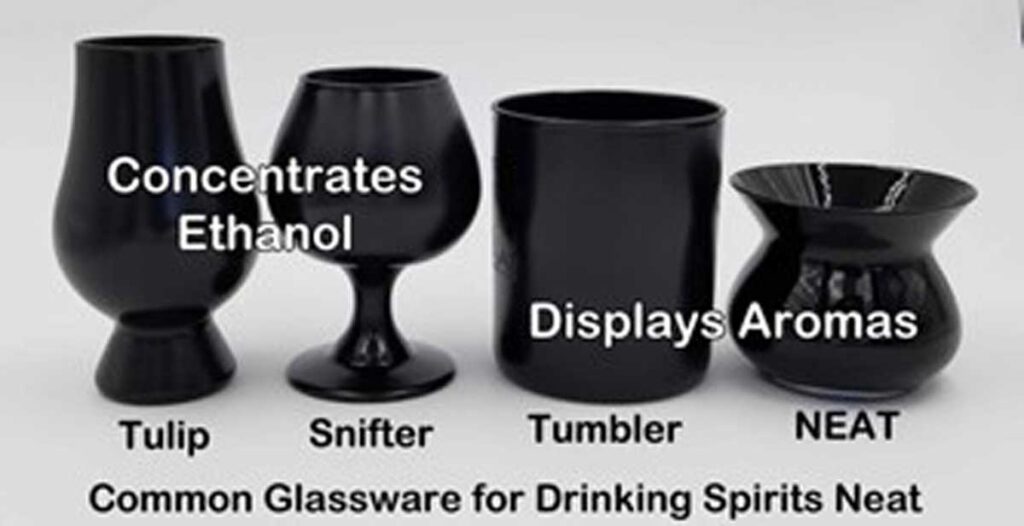
Do pungent ethanol aromas belong to the spirit of sensory diagnostics? We say **NO**, not if you want to smell anything else but ethanol. In the first place, you can’t detect subtle aromas with a nose numbed by tulip-shaped ethanol nose cannons. Secondly, if you change glassware from a tulip concentrator to an ethanol dissipator, then the ethanol disappears. Unexpected flavors emerge.
## Conclusion
It is coming, but not without the realization and efforts of the drinking public. Consumers must realize that they are buying the ethanol and the marketers emotional appeals instead of satisfying their personal preferences. It may be a grass roots movement, but it appears that grass roots approach may be gathering some momentum. [**Choose a better glass**.](https://theneatglass.com/how-it-works/ "Choose a better glass.")
[Scientific Research](https://www.mdpi.com/2306-5710/4/4/93)
PDF
Print
Share
[Email](#)

The NEAT Glass (CSO) Corporate Strategy Officer, inventor and entrepreneur, (CRD) Chief Research and Development Arsilica, Inc.
[See Full Bio](https://theneatglass.com/author/georgearsilica-com/)
[Facebook](https://www.facebook.com/theneatglass/) [Instagram](https://www.instagram.com/theneatglass/) [TikTok](https://www.tiktok.com/@theneatglass.com) [Pinterest](https://www.pinterest.com/TheNEATglass/) [YouTube](https://www.youtube.com/@TheNEATGlassChannel) [LinkedIn](https://www.linkedin.com/in/theneatglass) [Tumblr](https://www.tumblr.com/the-neat-glass)
**Categories:** The NEAT Newsletter
---
### [Raise Your Spirits with a Better Glass - NEAT is the Best Spirits Glass](https://theneatglass.com/raise-your-spirits-in-a-better-glass/)
**Published:** May 12, 2024
**Author:** The NEAT Glass
**Content:**
## Raise Your Spirits with a Better Glass – NEAT is the Best Spirits Glass
It’s all about the glass: Raise your spirits in a better glass. NEAT is the best glass. Many well-informed educators in the industry simply overlook the glass. Is it on purpose, or is it just not considered important? Side-by-side comparison of NEAT and tulips reveal the functionality of NEAT by improving access to all the aromas.
## Wine and Beer Tastings
A number of educators at wine and beer tastings demonstrate an exceptional ability to identify flavors, aromas, and other descriptors. They generally bring extensive knowledge, speak with confidence, and actively contribute to discussions of flavor profiles, drink-ability, and pairings.
Event administrators usually avoid suggesting flavor descriptors before attendees taste the beverages. Instead, they discuss beverage characteristics after the tasting. Attendees may comment on balance, acidity, and mouthfeel, and they readily say, “This wine—or beer—is too hot,” referring to its ethanol content. As seasoned tasters share their knowledge, newcomers learn to associate specific flavors with grains, hops, and grape varieties. Spirits events, particularly whiskey tastings, tell a different story.
## Whiskey Tastings
Whiskey tastings are much different, having less vocal audience participation. Few at a whiskey tasting say, “This whiskey is too hot.” Additionally, there are no comments on balance acidity and very few regarding profiles, drink-ability, pairings, etc. Seasoned tasters sniff the ethanol, nod their heads approvingly, and look around the room to see if others follow suit. As a result, personal satisfaction occurs at discovery of pungent ethanol. The final assurance they received what they came for is the snort of strong ethanol.
The brand ambassador introduces flavor profile prior to tasting, relating carefully chosen, corporate-prepared descriptors as pre-tasting semi-subliminal suggestions. The sales pitch is all about suggestion. Narrators know well that sniffers do not work well once filled with abundant ethanol fumes. Attendee comments are generally “This is good,” or “I like it,” or the highly descriptive “Wow.”
Spirits lovers reading this will say, “Of course it’s different, they are different beverages, they provide different information,” but that is not the whole story. The result of group tastings should be the experience of flavors and aromas and a forum for sensory discussion regardless of beverage. Whiskey (spirits) drinkers should be able to discern flavor profiles. Given the price of spirits, accurate detection of flavors and aromas should be a primary purchasing decision. Sadly, it is not.
Why? At first glance, the levels of anesthetic ethanol in each type of beverage seem to be about the same, so what could it be? In fact, the real culprit is the glassware. Glassware used for each type of beverage manipulates ethanol and flavors to different degrees.
## The Beer Glass
Certain shapes have become identified with specific beers since the medieval era. A few basic styles have survived: the pilsner for lighter beers, the tulip for medium-body beers, and the chalice for stouts, high ethanol, heavy, and highly aromatic beers. Over the centuries, they have gotten it right for most beers, ranging from 3 to 12% ethanol.
However, the public prefers the standard English pub pint glass filled to the rim to ensure a “pour to the rim with no headspace to appreciate aromas. At least, after the first two sips, there is enough headspace to collect aromas to sniff and savor and relatively low levels of anesthetic, ethanol, permit, flavor, and appreciation prior to anesthetization. These drinkers came for a moment of relaxation, not analysis. Serious craft beer drinkers are all about their beer’s flavor, aroma, and taste. Although the glasses could improve, sensory considerations exist, at least to an acceptable degree.
## The Wine Glass
Over the years, these have been narrowed down to three basic shapes:
- Large, wide bowl wine glasses are generally best for reds to appreciate the complexity of a wide variety of flavors and aromas,
- Tulips concentrate narrow aroma profiles of white wines and
- Flutes prevent the quick escape of the bubbles in sparkling wines.
Most wines range from 6% to 17% ethanol. Wine glasses have a distinct headspace to insert the nose and appreciate flavors and aromas, except flutes. Headspace size is generally managed by the pour size. Pours are generally much less than half the volume of the empty glass, allowing adequate headspace for nosing aromas.
Too much olfactory ethanol is disagreeable to most wine drinkers, and they know it interferes with their search for flavor. Serious wine drinkers are all about taste and aroma. Although the glasses could stand some improvement, sensory considerations exist to a higher degree.
## The Spirits Glass
Until recently, spirits drinkers have widely accepted two basic shapes: the iconic tulip and the tumbler. Tulips are most common, an evolutionary descendant of the tiny copita sherry glass. They are characterized by tiny rims too small to insert the nose and small bowl diameters to prevent swirling. Tulips give no choice or possibility of separating pungent, anesthetic, nose-numbing ethanol from the aroma profile. In fact, tulips concentrate headspace ethanol aromas to 65 to 75%. Less than 0.5% are character aromas, the rest being air and water, due to the high volatility of ethanol.
Originally designed for 22% ethanol fortified wines, when tulips are used for spirits, they become an ethanol nose bomb. Also, tulips are frequently referred to as “nose-cannons.” Sensory diagnostics are lingering, but quickly fading two-sniff memories. Even the experts’ opinions are affected by the olfactory ethanol barrier to flavor perception.
## The Tulip Problem
Whiskey glassware is a sensory problem. Tulips are the primary reason whiskey event commentaries end with non-descriptive statements “This stuff is good.” The follow-up “I’ll buy it” is often an obligatory response to the free tasting samples and presentation, seldom about personal preference. Tulips are a driving force behind the whiskey drinkers’ quest for higher ethanol.
Distillers, recognizing a windfall opportunity, created a new “cask strength” market segment for straight, neat whiskey drinkers, reasoning that undiluted spirits directly from the cask are the “purest” and “highest” form of whiskey possible. Assessing flavor and appreciating the drinking experience of cask strengths from a tulip is exponentially more complex than 40% ABV(alcohol by volume) spirits. Why don’t more drinkers know this? Because they are completely unaware of the silent, painless onset of ethanol nose-blindness.
**State of the Art:** In its current state, whiskey evaluation and appreciation is a status participation game designed to replace personal opinion with subliminal buying suggestions.
## The Power of Ethanol over the Consumer
Tulips exist as the most common spirits glass *solely* because whiskey drinkers encourage and unconsciously demand ethanol by prioritizing it over discovery, enjoyment, and discussion. Add to that the tendency to let someone else make your decisions because thinking objectively “hurts your brain.” Gurus, mavens, and competitions guide drinkers only because drinkers confuse ethanol pungency with characteristic aroma and flavor, and many equate high ABV with quality.
The industry is well aware of the effects of tulip glasses. They ignore the ethanol issue because it gives marketing departments opportunities to manipulate those who have a fuzzy connection to the aromas. Brand ambassadors control the narrative, the tulip gives the narrator license to seed the thought process of potential buyers.
Ethanol pungency is exactly the same for all spirits of 40% ABV (escalated for higher ABV) and has absolutely no relationship to character or flavor. Unfortunately, most whiskey drinkers confuse “cask strength” with quality. Since cask-strength spirits cost more, an irrational leap to “more ethanol means better quality” is almost natural.
## Summary
Rise above the marketing madness and bring fun, opinion, sensory perception, and knowledge into the whiskey-tasting experience. It begins with glassware designed to deliver flavor and sensory enjoyment. Upfront anesthetic ethanol quickly numbs the nose to aromas and flavors. Raise you spirits by using a better glass. Use one that dissipates the ethanol.
**Bio: George F Manska, CR&D, Arsilica, Inc.**
**Qualifications:** Published sensory science researcher, entrepreneur. BSME, NEAT glass co-inventor
**Mission:** Replace myth and misinformation with scientific truth through consumer education.
**More Information:** [www.theneatglass.com/shop](http://www.theneatglass.com/shop)
**Note: [Enrolled NEATNEWS subscribers](https://theneatglass.com/neat-news/) are entitled to 10% discount on all purchases and free shipping over $55 for as long as you are enrolled. Coupon code: ILUVNEAT**
PDF
Print
Share
[Email](#)

The NEAT Glass (CSO) Corporate Strategy Officer, inventor and entrepreneur, (CRD) Chief Research and Development Arsilica, Inc.
[See Full Bio](https://theneatglass.com/author/georgearsilica-com/)
[Facebook](https://www.facebook.com/theneatglass/) [Instagram](https://www.instagram.com/theneatglass/) [TikTok](https://www.tiktok.com/@theneatglass.com) [Pinterest](https://www.pinterest.com/TheNEATglass/) [YouTube](https://www.youtube.com/@TheNEATGlassChannel) [LinkedIn](https://www.linkedin.com/in/theneatglass) [Tumblr](https://www.tumblr.com/the-neat-glass)
**Categories:** The NEAT Newsletter
---
### [Cynical Tasters Will Never Admit to Poor Sensory Perception](https://theneatglass.com/cynical-tasters-poor-sensory-perception/)
**Published:** November 13, 2023
**Author:** The NEAT Glass
**Content:**
## **Cynical Tasters Will Never Admit to Poor Olfactory Sensory Perception**
There are three basic categories of poor sensory perception in the olfactory: (1) Ego and an inflated predisposition to one’s personal expertise, (2) attitude toward learning, and (3) lack of knowledge. We can help with (3), the rest is up to you.
Many tasting attendees arrive with an arrogant, cynical “show me” attitude. Given the social conditioning of constant marketing bombardment, cynical attitude has become an accepted norm. Inherent in the cynical attitude is a deeper question, “I long to know more, so give me something useful, even though I don’t believe you can, because no one ever does.”
As much as cynicism cries out for learning, it also dares the tasting seminar leader to overcome the attendee’s reluctance to learn. “Force me to learn” is not a great scenario for either. Approaching a tasting with a different attitude can alter the outcome. “I am here to learn and to weigh truthful substance which may be offered. I retain the right to decide whether I accept it.”
Couple the tasters’ attitudes with a “first-position” concept of their accumulated knowledge, and a refusal to admit their sensory abilities could use some improvement, and we have the self-created Godzilla of tasting attendees. Their olfactory smells what ever they want it to smell.
Back to the third reason, basic knowledge is important. Even experts often unknowingly succumb to the deceiving olfactory effects of ethanol. Understanding how [ethanol destroys aroma detection](https://www.mdpi.com/2306-5710/10/4/116 "ethanol destroys aroma detection") will help change cynical attitudes.
Here are a few facts which are a given whenever tasting high ABV spirits. Poor sensory perception also exists due to the nature of the substance we are tasting and evaluating. Don’t take anything personally, open your mind, and realize ethanol s\*\*t happens, even to the best, and often. The key is to recognize it.
## **The Silent Enemy of Sensory Enjoyment – Olfactory Fatigue**
**What is poor sensory perception?** Olfactory fatigue, also called olfactory adaptation also referred to as nose-blindness, is a phenomenon in which olfactory receptors decrease in sensitivity due to prolonged odorant exposure. Accordingly, this results in the inability to perceive, differentiate, or identify aromas.
Olfactory fatigue is a dynamic, adaptive, protective mechanism which prevents sensory overload from continuous exposure, and enhances perception of new aromas. As a result, the olfactory system adapts to constant background odors while maintaining sensitivity to new or changing odors, while constantly on the vigil to detect potential dangers (fire, poison) or opportunities (Gram’s apple pie). [How NEAT works.](https://theneatglass.com/how-it-works/ "How NEAT works.")
## **Mechanisms of Olfactory Fatigue** – A Different Poor Sensory Perception
- **Receptor Desensitization:** Olfactory receptors in the nasal epithelium detect specific odor molecules. Consequently, prolonged or repeated exposure to the same odorant results in receptors become less responsive to that specific odor.
- **Neural Adaptation:** Signal transmitting sensory neurons become less responsive to the same odor signal over time. Because of this, you won’t get a repeat of some aromas after repeated sniffing.
- **Central Processing:** As brain receives repetitive olfactory odor signals, it re-prioritizes to focus on changing sensory information, contributing to the perception of reduced sensitivity.
- **Peripheral Factors:** Depletion of neurotransmitters and refreshing nasal epithelium mucous layer.
## **Signs of Olfactory Fatigue:** Perception Disappears
Ethanol (alcohol) is an anesthetic and numbs olfactory receptors. Olfactory fatigue occurs without awareness, is painless and gradual, with no warning signs. It’s seldom discussed at tastings, and few know it exists, even though we have all experienced it. Few are concerned, “I never noticed it. If I don’t know it’s there, it’s not an issue.” Many deny, “My nose is good, I’ve been drinking (type of spirit) for a long time and never bothered me.” Three questions indicate you are most likely in some stage of olfactory fatigue: Why don’t I smell anything? Why can’t I identify this aroma? Why does every sample smell the same? In this case, poor sensory perception is not a personal fault.
**Memory Distracts:** Of course, the next question asked is “It’s (type of spirit, e.g. bourbon). What should I smell?” Experiential memory comes to the rescue by recalling your last (name of spirit type) tasting and the attending aromas, and you begin to search for them. Now you are no longer evaluating the sample in front of you, but attempting to validate a spirit you are familiar with while nosing a new, different spirit.
## **Ignorance and Denial is Proportional to ABV:**
High ABV (alcohol by volume) of spirits (40%+), is too much nose-numbing, pungent, anesthetic for the human olfactory to handle. Nevertheless, wine tasters also have frequent bouts of olfactory fatigue.
However, spirits drinkers are another story, as machismo permeates whiskey clubs, clouding objectivity, punctuated by the fact that four times the alcohol is present in spirits as opposed to red wine. As a result, spirits drinkers are reluctant to admit they have an aroma detection problem when it occurs, even when tasting cask strength spirits. In addition, few believe the issue is glassware. Perception is compromised through acceptance of tradition over scientific fact.
Does olfactory fatigue occur in spirits drinkers? You bet it does, on steroids. Most drinkers think it has to be there. Glassware makes the difference. [Choose a better glass.](http://www.theneatglass.com)

These factors strongly suggest that spirits, with their higher ABV and concentrated aromas, lead to olfactory fatigue. Note that olfactory fatigue and volatile compounds go hand-in-hand. As a rule, more volatile compounds = more numbing of ORNs (olfactory neuron receptors), lead to quicker onset. Accordingly, the chart clearly points to ethanol as the most volatile culprit.
## **How do we avoid olfactory fatigue and enhance olfactory perception?**
- Stop using tulip glasses, they shove concentrated ethanol up your nose, obscuring aromas and flavors. Use a tumbler, or better still, a glass designed to avoid olfactory fatigue such as NEAT. Drinking 40% ABV spirits from a tulip or copita glass designed for 22% fortified wine creates a nose-bomb.
- Walk away, go outside, get a fresh breath of air, don’t smoke, blow your nose, don’t return for 4 minutes. After all, the only way to reset your nose is to allow the mucous layer to replace and wash the ethanol molecules away.
- Forget about coffee bean myths, smelling your armpit or the crook of your arm, and smelling salts. Finally, nothing but time away from the exposure will allow the mucous layer on the epithelium to reset.
- Check your attitude.
Did you come to a tasting to drink and criticize, or to enjoy and learn the nuances the distillers created in their spirits? Discipline and an open-rimmed glass will enhance the experience. Ultimately, the NEAT glass will provide added insight to your spirits. Conversely, you will not learn much from continuing to use tulips. After all, concentrated ethanol is not flavor. Openness and a pro-learning attitude wins. Most poor sensory perception is correctable. Check out the [independent research](https://sensationresearch.com/wp-content/uploads/2020/01/Glass-Vessel-Aroma-DA-Study-Sept-2019.pdf "independent research") glass comparison.
**Bio: George F Manska, CR&D, Arsilica, Inc.**
**Qualifications:** Published sensory science researcher, entrepreneur. BSME, NEAT glass co-inventor.
**Mission:** Replace myth and misinformation with scientific truth through consumer education.
**Comments Welcome – Contact:** george@arsilica.com, phone 702.332.7305.
**More Information:** [www.theneatglass.com](http://www.theneatglass.com).
PDF
Print
Share
[Email](#)

The NEAT Glass (CSO) Corporate Strategy Officer, inventor and entrepreneur, (CRD) Chief Research and Development Arsilica, Inc.
[See Full Bio](https://theneatglass.com/author/georgearsilica-com/)
[Facebook](https://www.facebook.com/theneatglass/) [Instagram](https://www.instagram.com/theneatglass/) [TikTok](https://www.tiktok.com/@theneatglass.com) [Pinterest](https://www.pinterest.com/TheNEATglass/) [YouTube](https://www.youtube.com/@TheNEATGlassChannel) [LinkedIn](https://www.linkedin.com/in/theneatglass) [Tumblr](https://www.tumblr.com/the-neat-glass)
**Categories:** The NEAT Newsletter
---
### [Sense of Smell - Discovering the Best Spirits Evaluation Perspective](https://theneatglass.com/sense-of-smell-evaluation/)
**Published:** April 27, 2022
**Author:** The NEAT Glass
**Content:**
## Sense of Smell – Discovering the Best Spirits Evaluation Perspective
We generally take our sense of smell for granted. We have no idea or concern about how weak or powerful it is. The best spirits evaluation is performed in a logical manner with repeatable methodology. By categorizing and organizing a workable system to describe smells and flavors we have a dependable, usable standard for evaluation purposes. This organization is necessary to standardize the way we knowingly describe flavors and aromas and involves a discipline of language and vocabulary as well as developing a working knowledge of how we biologically smell and taste.
**Aroma:** Human perception of molecules emanating from food or beverage detected by human olfactory receptors.
**Flavor:** The Wikipedia definition of flavor is sufficient for the scope of our discussions. *Flavor is the sensory impression of food or other substances, and is determined primarily by the chemical senses of taste and smell. The “trigeminal senses”, which detect chemical irritants in the mouth and throat, as well as temperature and texture, are also important to the overall gestalt of flavor perception.*
## The Flavor Equation: Putting Sensory in Perspective
We have only **five tastes**: sweet, sour, salty, bitter, and umami (discussion later). There are thousands of aromas recognizable and detectable by the human sense of smell (olfactory). There are hundreds of mouthfeels. Generally accepted guidelines for the composition of Flavor in spirits. Note that the majority of contribution is our sense of smell.
## **Flavor = Aroma (90%) + Taste (5%) + Mouthfeel (5%)**
Surprisingly, the flavor is mostly aroma, not taste. Let’s sensory sample a raspberry. Simply put, we do not taste raspberries. We smell raspberry molecules, taste sweet, and feel fuzzy, and acidic mouthfeel of the raspberry on the palate and the inside of the cheeks. However, one should remember that taste identifies only the sweet part of the raspberry flavor.
***Stop confusing mouthfeel with taste.*** ***Stop confusing smell with taste.***

WE use our sense of smell in two ways. If we smelled the raspberry before popping it in our mouths we sampled ortho-nasal aromas which means through the nostrils to the olfactory receptors bypassing the oral cavity. Once the raspberry is chewed, flavorful beads broken, and mixed with digestive saliva, aromas find the olfactory bulb once more through the pharyngeal opening at the back of the throat These are retro-nasal aromas.
## Sense of Smell (olfactory) has an Emotional, Circumstantial Connection
Information from the nose, tongue, and chemo-sensors located all around the inside of the mouth arrive at the brain in a single packet, mostly through the trigeminal nerve for identification. If raspberries are in the brain’s memory bank, the Aha! The moment is when you recognize Raspberry. If not, the brain will automatically create a “smell-library” reference for future access awaiting the next raspberry.
Your sensory Library consists of many components. Your memory records every experience, including the actual circumstances surrounding each event in which you notice a smell or taste. Emotions are a part of the smell and taste package. Your background, cultural and social influences and your education and even your pre-natal experiences play a part in your sensory catalog. Your sense of smell and taste are intricate and involved
Human odor detection is now known to be much more complex now than originally thought. Every person has a combination of emotion, visual perception, sounds, colors, skin feel, and awareness that accompanies every perceived flavor. Bob’s recollection of Grandma’s apple pie is very different from Susan’s; during the discussion, they are close, yet on further discussion, there are perceptive differences. We can’t control it, can’t turn sensory on or off. Therefore, everything we sense becomes inextricably associated with our experiential definition of a flavor or aroma.
## Sense of Smell: What is “Finish”
We use the term finish to designate retro-nasal aromas as well as the sensory information from taste and mouthfeel (hot, minty, metallic, acidic, oily, etc.). Finish is the whole enchilada: taste, smell, and mouthfeel from inside the oral cavity. The finish should carry more weight when evaluated. This diagram is a cross-section of the olfactory cavity showing ortho and retro-pharyngeal paths. The second diagram is a section of the olfactory bulb and sensors.

There are two ways to smell. Retro-nasal is using the nasal passages only. It uses the pharyngeal opening at the back of the throat to funnel aromas up to the posterior of the olfactory bulb in the nasal cavity. Retro-nasal is also called “finish.” The olfactory gustatory, and mouthfeel receptors transmit all signals to together to make up the entire taste and smell signal package
## The Vocabulary Lexicon
Discrepancies in definitions of flavors are why professional evaluation panels must agree upon vocabulary before evaluation. This assures fresh and uniform identification names to keep panel members on the same page, thus boosting the confidence level (believability and repeatability) of the total evaluation. As a result, Bob and Susan’s separate apple pies become a uniform agreement and subtleties of personal experience can be discounted for panel consensus.
## Sense of Smell: Valid Sources are Important
Listening to critics to guide wine and spirits purchases often ends in costly regret, similar to buying popular labels and chasing high ratings. Following the piper often leads to deep disappointment. You are unique, formulate your opinions; it’s all about you. Arm yourself through studied knowledge and personal perception. Achieving true satisfaction is a personal responsibility; learn, learn, learn, read, read, read, smell, smell, smell, taste, taste, taste. [Learn how the best spirits glass ever was designed.](https://theneatglass.com/the-best-spirits-glass/ "Learn how the best spirits glass ever was designed.") [Our peer-reviewed journal paper describes the science.](https://www.mdpi.com/2306-5710/4/4/93 "Our peer reviewed journal paper describes the science.")
## Summary
Your sense of smell is your lifeline to experiences in life. Cherish it, develop it, use it. Do something different. Stop listening to the self-styled critic/bloggers. Study the science. Choose vetted sources that you can believe in. Participate in tastings, offer your opinions, listen to the experts, and above all, keep you student hat on. Study the science, disregard prurient marketing and buy what *YOU* like, not what the marketers suggest. As a result, your accuracy will improve, your buying decisions will be spot on.

The NEAT Glass (CSO) Corporate Strategy Officer, inventor and entrepreneur, (CRD) Chief Research and Development Arsilica, Inc.
[See Full Bio](https://theneatglass.com/author/georgearsilica-com/)
[Facebook](https://www.facebook.com/theneatglass/) [Instagram](https://www.instagram.com/theneatglass/) [TikTok](https://www.tiktok.com/@theneatglass.com) [Pinterest](https://www.pinterest.com/TheNEATglass/) [YouTube](https://www.youtube.com/@TheNEATGlassChannel) [LinkedIn](https://www.linkedin.com/in/theneatglass) [Tumblr](https://www.tumblr.com/the-neat-glass)
**Categories:** Academy
---
### [New Concept: Diffusing Ethanol to Improve Test Results](https://theneatglass.com/new-concept-diffusing-ethanol-to-improve-test-results/)
**Published:** August 19, 2026
**Author:** The NEAT Glass
**Content:**
## New Concept: Diffusing Ethanol to Improve Test Results
Engineers at Arsilica Inc. have discovered a new concept in spirits evaluation. Diffusing ethanol releases more intense aromas and flavors from any spirit. Furthermore, this discovery will change spirit evaluations drastically. As a result, evaluations will be more accurate, repeatable, and complete, factors which improve test results. Those subtle aromas previously hidden by nose-numbing ethanol will now appear.
## State of the Art of Spirits Evaluation
Within the spirits industry, particularly in scotch whisky, game-changing personalities emerged. They made major contributions to the tasting and evaluation of spirits. Michael Jackson and Jim Murray may be the most definitive early pioneers in reporting sensory characteristics of scotch. Richard Paterson leads in scotch whisky education. Much of the presently accepted evaluation methodology for spirits comes from their publications and seminars. During this period, little was ever done to improve test results. Those who introduce a new concept were not acknowledged by the old guard, state-of-the-art.
These pioneers had no exposure to sensory science. It later evolved into an established discipline used by many companies to validate their spirits products. Their intuition and judgment have guided the spirits industry for decades. The industry owes them for their profound influence on public taste preferences.
Their spirit vessel of choice was the copita. The copita was borrowed from Spanish sherry, a fortified wine, in the late 1700s. Later came the Glencairn, an admitted derivative of the copita. It is now considered a standard tool among spirits drinkers. This view rests on its iconic identification badge for spirit enthusiasts. None of them would appreciate the concept of diffusing ethanol.
## New Concept to Improve Test Results
Our presentations cover how common spirits glass designs function. They will likely provoke those entrenched in the tulip and snifter camps. Additionally, the goal is to inform, not inflame. Diffusing ethanol is not a new issue among evaluators. Pointing to glassware as the major source is bold and unprecedented. It will upset those who resist change, doubt science, or prefer their current glass. Eighteen years of research confirm glassware design contributes to ethanol anesthesia (nose-blindness). We can engineer glass shapes into a solution.
A discovery in 2002 changed the dynamics of glass design for spirits evaluation. Applying engineering and physics to modify glass design eliminates ethanol nose burn and anesthesia. Adding a neck to the glass forces the molecules to converge rapidly. This is the same occurrence for all tulips, copitas, and snifters with convergent sides and small rim plane areas. The congestion of molecular collisions at a copita rim is about the same as at the neck of the engineered glass. However, what happens after the molecules diffuse out of the neck concentration is the game changer.
Designing a controlled expansion space above the neck regulates containment. As aromas diffuse through the neck, they align by molecular weight and dispersion velocity. They also reflect molecular complexity, such as long-chain esters. In addition, a large flared, straight rim horizontally constrains the expansion space.
## Diffusing Ethanol is Key to Aroma Detection
Arsilica, Inc perfected this discovery over 10 years of research. The result was the NEAT glass release in 2012. Introducing a controlled, gradual expansion into the diffusion space manipulates aroma diffusion. Correspondingly, this provides a distinct advantage for spirits evaluators by reducing nose-numbing ethanol exposure. In fact, diffusing ethanol molecules moves them away from the aroma detection area.
Since 2013, over 30 major competitions use NEAT as their official judging glass. There has not been any ethanol anesthesia, olfactory fatigue, or nose-blindness during fast-paced competition judging. Enter the new concept of diffusing ethanol. As of mid-2020, many medals have been awarded to spirits judged and evaluated in NEAT. NEAT has proven to be a viable alternative to the three most common glass shapes by detecting and identifying more aromas, significantly reducing ethanol concentration, and placing the nose in a position to begin orderly aroma detection.
## New Concept: How Diffusing Ethanol Improves Aroma
Small rim areas concentrate ethanol, especially if those areas are smaller than the area of the liquid surface in the bowl. Evaporating aromas are forced upward by the constant evaporation of more molecules, and the lighter aromas move the quickest, crowding the tiny rim area and filling any available space to escape the glass through the narrow opening.

## Two Glass Shapes Come Together
**By taking the most useful portion of each design** (convergent sides and divergent sides), we created a new shape with a large bowl for swirling and a neck to concentrate the abundant aromas released through swirling. The neck concentrates and stimulates molecular collisions which increases molecular velocities. Instead of dissipating molecules into the atmosphere randomly (as with tulip, copita, and snifter shapes), we add a large divergent rim, similar to a cocktail glass to control dispersions as the molecules continue their upward direction. The new concept involves taking the best of both.
In the space between the neck and the top rim, the controlled expansion provides a path for lighter ethanol to quickly make its way to the rim edge, and the heavier character aromas dissipate slower, to be detected by the nose without the presence of nose-numbing ethanol. A key design relationship is the neck cross-sectional area, to the upper rim edge cross-sectional area, as this ratio, as well as the rim plane height above the neck, controls the exact dissipation of available aromas.

## Short and Fat is Better than Tall and Skinny
In a previous presentation, we determined that shorter glasses pick up more aromas. Using a typical evaporation curve of a heavier aroma, we can see that shorter heights can increase the opportunity to detect character aromas. In this instance, the area of highest concentration is at the rim of the tulip glass, and the neck of the NEAT glass. The reduction in height allows more aromas to reach the neck for further dissipation to the rim plane. Regarding the following chart, it is easy to see how the new concept can improve evaluation test results.

**A major complaint of tulip glasses** is the restricted, small area rim which prevents the nose from entering the aroma cloud. Designing the rim plane large enough to allow the nostrils to access the center of the expanded aroma cloud maximizes the opportunity to pick up more aromas. By designing the glass to fit the average nose, we find that placing the lips on the glass rim positions the nose automatically in the center of the rim plane. Part of the new concept is simple ergonomics.

## Who Gets the Most Aromas and Improves Evaluation Test Results?
When all of these issues are dealt with, the result is a short glass to pick up more aromas, a fat and wide bowl to enhance swirling, a large area to accommodate the nose, and ethanol is separated from the character aromas and dispersed from detection while analyzing character aromas.

A little engineering, common sense, and focused attention to the laws of physics can go a long way toward enhancing personal satisfaction and improving spirits buying and collecting. Do we think this is the ultimate in glassware design? For now, it is by far the superior tasting, nosing, and evaluation glass, but we never underestimate the power of science-based discovery as we continue to encourage new ideas and search for better ways to improve the evaluation and enjoyment of all spirits.
## Accepting The New Concept
For decades after the introduction of refrigerators, automobiles, and the cooking range, doubters and those who cling to tradition chose to be loyal to the iceman, horses, and woodstoves. Getting used to new ideas is hard for some, and no doubt the NEAT glass is experiencing the same resistance from those unwilling to quickly embrace change. To summarize, it is all part of the process of evolution as science and discovery replace the myths and all contrived devices of the past which left room for improvement.
## Why Diffusing Ethanol may not be Very Popular
The spirits consumer-drinker loves his ethanol. He paid for it. The pungent smell of ethanol tells him it is there. That conditioned acceptance of ethanol automatically places the spirit aromas and flavors in a distant second place in his mind. It is much less important than the reassuring sniff of ethanol. He may never discover what is hiding in his drink and that bottle he paid dearly for.
## Summary
The new concept of diffusing ethanol away from the nose exposes all aromas, both good and bad, and puts the evaluator in the driver’s seat by prioritizing aromas and personal quality assessment over-reliance on suggestive advertising. Nothing can hide from approval or disapproval, placing the evaluator in control to [discover and choose personal flavor nuances using an engineered glass as a decision-making tool.](https://theneatglass.com/shop/ "discover and choose personal flavor nuances using an engineered glass as a decision-making tool.") See how **[independent research shows the NEAT glass is superior to all others.](https://sensationresearch.com/wp-content/uploads/2020/01/Glass-Vessel-Aroma-DA-Study-Sept-2019.pdf "independent research shows the NEAT glass is superior to all others.")**
Subscribers will get 15% off discount codes and other specials

The NEAT Glass (CSO) Corporate Strategy Officer, inventor and entrepreneur, (CRD) Chief Research and Development Arsilica, Inc.
[See Full Bio](https://theneatglass.com/author/georgearsilica-com/)
[Facebook](https://www.facebook.com/theneatglass/) [Instagram](https://www.instagram.com/theneatglass/) [TikTok](https://www.tiktok.com/@theneatglass.com) [Pinterest](https://www.pinterest.com/TheNEATglass/) [YouTube](https://www.youtube.com/@TheNEATGlassChannel) [LinkedIn](https://www.linkedin.com/in/theneatglass) [Tumblr](https://www.tumblr.com/the-neat-glass)
**Categories:** Academy
---
### [Truth, Science: The Path to Better Understanding](https://theneatglass.com/truth-understanding-science-best/)
**Published:** May 6, 2022
**Author:** The NEAT Glass
**Content:**
## Using a Functional Glass is the Key to Understanding Spirits
Forever, truth and science have withstood the test of time. The path to better understanding is based on those two. However, in the spirits industry, science has only recently stepped in with sensory science. We knew that the common tulip glass is the culprit which robs us of accurate evaluation. We, Arsilica, Inc. have introduced the concept of glass geometry to shape aroma delivery for sensory evaluation. In addition, we believe that every spirits evaluator needs a grasp on understanding the basic science.
It is time to discard the old crutches of make-do’s, supposition, and myth. We must entrench science as a solid basis for truth in sensory evaluation of spirits. It has become so with wine, is coming so with beer, and finally, it is here for spirits.
## Today’s Accepted but Non-functional Spirits Glass Geometry
For decades the tulip glass, also called copita, has been used as a spirit nosing and tasting glass. Originally borrowed from Spanish sherry, it earned the name “dock glass.” It was used at the wharf to seal the deal as buyers tasted goods to verify quality prior to payment. It was adopted and promoted as the identifying icon of the whisky industry. However, and unfortunately its design is all wrong when it comes to understanding nosing, tasting, and sensory science.
The high ethanol in spirits, renders the tulip glass non-functional for detecting aromas due the tulip’s high concentration of ethanol. Three sniffs and it’s all over. In addition, tulip glasses are not friendly to women’s more sensitive olfactory. However, using a tulip glass designed for 20% ABV sherry with 40%+ ABV spirits creates a nose bomb destroying your sense of smell. Likewise, understanding this concept yields better results.

## Two Centuries of Tulip Glassware Designed for 20% ABV Spanish Sherry
Keeping the same design parameters to maintain iconic identity with the scotch whisky industry does not come without consequence. 40% abv spirits have too much alcohol for such a small glass, burning the nose and numbing the sense of smell. As a result, tulip glasses concentrate alcohol, mask character aromas, and are too tall for the nose to detect complex aromas and quality.
Glass manufacturers mistakenly assume that the spirits industry understands the science of nosing and evaluation, so they keep the same non-functional tulip shapes. This perpetuates high ethanol concentration quickly numbing olfactory senses. Not daring to be different, the glass industry resigned itself to mediocrity of style, ignoring science, function, and the opportunity for innovation.
## Truth: Tulip Glasses Concentrate Ethanol and Funnel it to the Nose
Not really new news, since American cocktail glass designers in the 1930’s knew USA booze quality was horrible, and divergent rims would dissipate aromas of poorly made spirits. The alcohol cloud formed by tulip shapes increases difficulty of detecting specific aromas, much less, understanding their significance. Therefore, keeping the tulip was an easy choice. Sadly, it’s the truth.
What’s so bad about alcohol? Simple. It’s an anesthetic which numbs more human olfactory sensors with every sniff. Many drinkers mistakenly believe more alcohol means higher quality. Could that be why cask strength spirits are popular?
The tulip creates a cloud of nose-numbing ethanol forcing the evaluator to hunt for aromas while sniffing more nose-numbing ethanol. Not to mention that detection of all subtle aromas prior to olfactory desensitization becomes impossible with ethanol olfactory fatigue. Understanding the effect of ethanol is key to better tasting and evaluation
## Science Creates a New Glass from the Best of Both Shapes
The divergent glass dissipates aromas, and large convergent glass promotes swirling and evaporation yet concentrates aromas. Placing the divergent flared rim above the convergent rim creates a “neck” in the design, which is key to separating ethanol from character aromas. (Graham’s Law of Diffusion for the curious). Understanding how diffusion works clarifies why lighter molecules move faster.
The neck begins the separation process and controlled divergence dissipates volatile alcohol to the outer rim away from the nose enhancing detectability of character aromas. Obviously, character aromas tell you what you are drinking; bourbon, scotch whisky, rum, gin, or even vodka, as well as inform you of the truth in spirit quality.
The best of both worlds, aromas squeeze through the neck orifice and diffuse naturally, controlled by the flare angle and height of the rim above the neck. As a result, nose-numbing ethanol separates from the slower moving character aromas (congeners).

## Truth about Tall Glasses: Many Aromas Never Reach the Rim for Detection
Each different aroma is a chemical compound with a unique molecular mass. That means that gravity, as well as molecular shape affects larger mass aromas differently than smaller mass, simple shape aromas like alcohol. The closer your nose is to the liquid surface, the more aromas you smell. As a matter of fact, this basic truth is important for detecting *all* the spirit’s subtle aromas. The neck of the NEAT spirits glass is less than half the distance to the rim of a tulip glass, providing more complex character aromas to display above the neck for evaluation.
The taller the glass, the further away the nose is from the liquid surface, which is the source of all evaporating aromas.

## Truth: Science Separates, Displays Aromas for Better Detection, sans Ethanol
Real science displays *all* aromas in the NEAT spirits glass, allowing quick and easy detection of the subtleties the distiller intended. No more hunting for aromas that become difficult to identify through the ethanol. Diagram shows where in the rim plane you can detect specific aromas in a typical whisk(e)y.
Some make misleading statements regarding fluid dynamics, which has nothing to do with aroma detection, “inventing” their own brand of science. We marvel at the use of blatantly misleading, false information on “tongue maps” and unintelligible references to bio-mimicry to sell glasses by twisting science and the truth to imply function.
## Tulip Glass Aromas are a Guessing Game – No Guessing With NEAT
Truth is, the NEAT spirits glass was designed to stop “aroma hunting” and excessive sniffing that comes with all tulip glass shapes. More sniffing in the tulip glass causes quick alcohol nose numbing. With the NEAT spirits glass, its easy. Start in the center of the rim plane where there is no nose-numbing alcohol. NEAT spirits glass displays *all* character aromas from center to rim edge.
The NEAT Spirits glass surpasses tulip glasses functionally, so you taste the truth and positively determine spirit quality. NEAT is designed by science for the discerning professional, collector or aficionado, and enhances enjoyment for the average drinker. In addition, no other glass provides a convenient “locator” to begin sniffing aromas without nose-numbing ethanol getting in the way.
## NEAT is the Ultimate Spirits Glass – Designed by Science
NEAT spirits glass does everything better than tulip glasses. Science built a better glass, changing the way the world drinks. Most major spirits judging competitions choose NEAT as their official spirits judging glass. No more nose-numbing or pungent burn in the nostrils. Sensitive noses and professionals love NEAT and the truth and understanding in its aroma presentation.
If you are an incurable sniff-aholic, and love strong alcohol, stick your nose further into the glass to get the blast of pain and nose numbing you crave. Together with the pain, it will destroy your sense of smell. Looking back, wouldn’t you rather use a spirits glass that gives you options, displays aromas, shows true quality and protects your sniffer?
The worst side effect of tulip glasses is their gender exclusivity. Concentrating ethanol is disagreeable to the more sensitive female nose and can even be painful. Ever wonder why there are so few women in whiskey clubs and attending spirits events? Peer pressure and a “good-ole-boys” fraternal atmosphere inadvertently excludes ladies who don’t want to drink from tulip glasses.
## Truth: Gender Equity is a Benefit of the NEAT Glass
It’s time to get smart and bring sensitive noses into the appreciation of spirits, and the ladies have a lot to offer through better sensory awareness and understanding.
## Sensory Science Research Report
MDPI Beverage Journal published a significant [research report](https://www.mdpi.com/2306-5710/4/4/93) on November 22, 2018, regarding scientific research which led to design and development of the NEAT glass. Peer-reviewed by olfactory science researchers, this report validates the superiority and suitability of the NEAT glass for evaluation and drinking enjoyment. Additionally, it highlights major problems associated with beverage industry support for tulip and snifter-style glassware. Of course, myth, tradition, and misleading marketing eventually give way to science, truth, function, and deeper understanding of our sensory capabilities. More science and truth [HERE](https://theneatglass.com/how-it-works/).
Check it out, Sensation Research performed an independent study of [NEAT vs Glencairn vs Snifter](https://sensationresearch.com/wp-content/uploads/2020/01/Glass-Vessel-Aroma-DA-Study-Sept-2019.pdf "NEAT vs Glencairn vs Snifter").

The NEAT Glass (CSO) Corporate Strategy Officer, inventor and entrepreneur, (CRD) Chief Research and Development Arsilica, Inc.
[See Full Bio](https://theneatglass.com/author/georgearsilica-com/)
[Facebook](https://www.facebook.com/theneatglass/) [Instagram](https://www.instagram.com/theneatglass/) [TikTok](https://www.tiktok.com/@theneatglass.com) [Pinterest](https://www.pinterest.com/TheNEATglass/) [YouTube](https://www.youtube.com/@TheNEATGlassChannel) [LinkedIn](https://www.linkedin.com/in/theneatglass) [Tumblr](https://www.tumblr.com/the-neat-glass)
**Categories:** Academy
---
### [Sources of Poor Quality are More Important than the Flaws](https://theneatglass.com/sources-of-poor-quality-flaws/)
**Published:** April 29, 2022
**Author:** The NEAT Glass
**Content:**
## Sources of Poor Quality are More Important than the Flaws
## They are Quality Flaws, but What is Their Source?
Discovering flaws and faults of poor quality spirits is important; however, their source is even more important. We can prevent flaws and faults by addressing their source. We may ask, “What’s that horrible smell? Flaws in odors may include descriptions such as nail polish, kerosene, tri-chlor, dead rodent, rotten eggs, and vomit. We cannot fix or avoid flaws and faults if their sources are unknown.
We will explore sources of certain poor quality flaws in the spirit. The discussion includes revulsive aromas and their possible causes. The cause of flaws in spirits is a complex subject. This presentation is a simple overview. Researchers have authored numerous books, in-depth studies, and journal articles on each of these poor quality problems. The [NEAT](https://theneatglass.com/the-best-spirits-glass/ "NEAT") glass helps identify poor quality flaws and their sources. flaws and their sources.
Raising awareness regarding the difficulties in producing high-quality spirits and to providing clues to the evaluator for recognition is important. Alan Gordon, CEO and co-founder of Aroma Academy supplied this material:
## **Discovering Poor Quality, Flaws, and Faults in Spirits**
In developing flavor sensory skills, it is useful to categorize descriptors into two broad categories: Positive and Negative.
## Understanding **positive flavor attributes** is vital for:
- **product development**, where companies are creating and developing interesting flavor profiles that differentiate them from the competition, and
- **production** **quality control** focuses on ensuring the consistency of flavor profile from batch to batch.
However, detecting and identifying **negative flavor attributes (or ‘Faults’)** is also fundamental in both these phases. This need is obvious in Spirits production. No company wants to produce faulty products for cost and reputational reasons. Therefore, early fault identification is vital. Perhaps less well understood is the fact that understanding Faults is also key in the creation and development phase as companies strive to develop robust products and processes that have the lowest probability of developing flavor Fault types.
## **What is a Fault and where do they come from?**
Let us first take a step back and ask the question – What is a poor quality fault? Context determines the evaluation. A smoky note may be positive in one spirit type yet a fault in another if it does not fit the profile.
Part of the challenge in drinks development and production is that the potential sources of Faults are myriad and can be both internally and externally generated. Sources listed as;
- Raw Materials
- Processing
- Storage
- Maturation
- Degradation
- Contamination
A broad subset of Spirits Faults/Defects is common to wines and beers. In spirits, the additional potential areas such as distillation and longer-term cask maturation must also be considered as a source of poor quality. Faults in Spirits production, are related to internal processing or external and contamination related.
## **Processing: Poor Quality in Fermentation**? Find the Source
Fermentation and the impact of defective or incorrectly processed raw materials or yeast can give rise to many fermentation-related issues. Although less high profile than in wine or beer, the impact of yeast type and processing is also significant in the flavor profile of spirits.
Established distillers develop their own bespoke in-house yeast of choice over many years called distiller’s yeast. Specialist yeast companies develop and produce distiller’s yeast. In each case, the objective is the same, which is to ensure consistency of output and avoid poor quality.
However, several producers – particularly craft distillers – are advocates of the use of wild yeast which can provide a multitude of different and varied flavor elements allowing increased brand differentiation – although this also provides the downside risk of more potential unpredictability with the danger of the creation of possible flavor faults. The wrong yeast can easily be the source of a flaw.
Potential faults that must be monitored, include the excess presence of acids such as isovaleric acid which makes its presence known with a distinct cheesy or even vomit type aroma/flavor note, or volatile phenols such as 4-ethylphenol providing aroma/flavor notes described as reminiscent of anything from leather to a barnyard!
## **Processing: Poor Quality in Distillation**
Most people are familiar with the concept of the distillation cut where Spirits distillers aim to capture the heart of the distillation and eliminate the unwanted heads and tails. Distillers and QC staff must be trained to detect and identify the aromas/flavors of these unwanted elements and monitor for potential aromas/flavor faults. The head faults include excess acetaldehyde (with its volatile vaguely apple-like fruity aromas), acetone, methanol. Heads can also include ethyl acetate, with its classic solventy aroma.
**Acetaldehyde**
The unwanted heavier notes from the tails represent the final elements of the distillate low in ethanol and high in unwanted components. Accordingly, tails include alcohols such as butyl alcohol, amyl alcohol, and other elements such as furfural with its mix of flavor notes including almond and caramel.
**Butanol**
Another key element of the distillation process is the removal of excess sulfur compounds – typically by providing exposure to an appropriate level of copper. Excess sulfur can manifest itself in many ways in the aroma/flavor profile with unwanted notes ranging from excessive vegetable (such as overcooked cabbage) to garlic/onion-type notes or even burnt rubber.
## **Processing: Poor Quality in Maturation**
Cask maturation creates additional opportunities for faults to develop. Fungi may contaminate the cask, or prolonged maturation may cause the spirit to extract excessive wood flavors. Too much vanilla character, for example, can overpower and unbalance the spirit’s overall flavor profile.
## **External Contamination**
There are many sources of possible contamination from external sources, and we describe a couple of examples below. The quality and consistency of the water typically added to achieve a desired final ABV is often overlooked. Chlorine will distort or overpower the final flavor profile. Geosmin can provide an unwanted dominant earthy profile. The name Geosmin is based on Geo – earth and Osme – odor and typically has the aroma of damp soil.
Finally, we highlight is the issue of corked spirits. This is typically less of a poor quality problem in the world of Spirits as in Wine – where it has been a massive issue for decades. However, this fault also affects spirits sealed with cork closures. When chlorine—typically from a cleaning product—reacts with certain molds, the reaction can produce TCA (2,4,6-trichloroanisole). Although TCA commonly develops in corks, contaminated packaging, pallets, and other materials can also introduce it.
**TCA**
The resulting Fault is detected as a musty wet newspaper/damp cloth aroma/flavor which is not only unpleasant in its own right but also has the effect of attenuating the overall flavor profile. It should be noted that if this Fault finds its way into drinks production facilities it is notoriously difficult to eliminate.
## **Summary**
Potential poor quality faults in spirits are many and varied and may appear from many possible sources. The list above describes only a few. Finding the source can help solve the problem.
Aroma Academy provides comprehensive sets of Faults Standards Kits and Sensory Faults Training to allow familiarization with typical drink Faults. In addition, we also facilitate the development of the necessary skills for their detection, identification, and articulation.
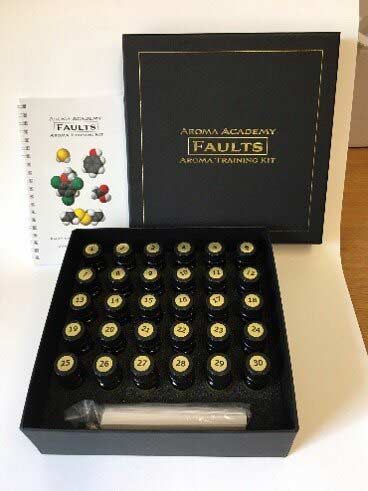Identifying the fault allows evaluators to determine its source and take corrective and preventive action, whether the cause involves raw materials, processing, maturation, or external contamination.
Buyers, retail staff, professional bartenders, industry professionals, and a growing community of spirits enthusiasts benefit from understanding common fault types. Although this knowledge gives them greater insight into the world of spirits, it also strengthens their ability to evaluate quality. Detecting faults and flaws depends heavily on using properly designed diagnostic glassware, such as the [NEAT](https://theneatglass.com/how-it-works/ "NEAT") glass.
[SHOP](http://www.theneatglass.com/)

The NEAT Glass (CSO) Corporate Strategy Officer, inventor and entrepreneur, (CRD) Chief Research and Development Arsilica, Inc.
[See Full Bio](https://theneatglass.com/author/georgearsilica-com/)
[Facebook](https://www.facebook.com/theneatglass/) [Instagram](https://www.instagram.com/theneatglass/) [TikTok](https://www.tiktok.com/@theneatglass.com) [Pinterest](https://www.pinterest.com/TheNEATglass/) [YouTube](https://www.youtube.com/@TheNEATGlassChannel) [LinkedIn](https://www.linkedin.com/in/theneatglass) [Tumblr](https://www.tumblr.com/the-neat-glass)
**Categories:** Academy
**Tags:** Academy
---
### [Which Spirits Evaluation and Rating System is Better?](https://theneatglass.com/spirits-scoring-and-rating-system/)
**Published:** April 29, 2022
**Author:** The NEAT Glass
**Content:**
## Which Spirits Evaluation and Rating System is Better?
Which spirit evaluation and rating system is better is controversial to say the least. There are literally hundreds of rating systems. Which one to use is largely a matter of utility, personal preference, and accuracy. The earlier commercial business cycle of wine was the birthplace of the rating system. Spirits rating systems evolved from wine.
SIPawards2017
Complete books are written about a single scoring system. The purpose of this presentation is to provide a general overview of systems in general, their usefulness. You decide how important it is to you as an evaluator, collector, or consumer.
## How did Spirits Evaluation and Rating Systems Evolve?
In their purest form, rating systems are all about providing the consumer, with a numerical guide to quality. If consumers have a “quality” rating they can trust and weigh against store prices. Additionally, they can make informed decisions on cost vs quality. In a world with hundreds more spirits available than ten years ago, consumers need a suitable, standardized system.
The original intent of rating, evaluation and scoring systems was to guide the consumer. They opened the door for novices to become noted evaluators, trusted to provide useful value-related information. In the 1950s, the payola scandal (influential rock-and-roll record promotion kickbacks) led to the downfall of several famous music icons. The public has linked rating systems to the possibility of prurient interests, bribes, and public distrust.
True or not, rumors and accusations are common in the spirits industry. Therefore, one should question the integrity of those who fling around rating numbers without explanation. Evaluators should clearly define and methodically explain the rating process, including how they calculate the numerical scores.
## Rating Practices can Depend on an Internal Store Marketing System
Some large alcohol beverage retail chains employ their own rating systems to promote relatively unknown “house” brands. These are brands in which they have substantial investment, are low-cost-high-profit. Perfumers, cigar critics, beer enthusiasts, brewers, olive oil producers, aroma and flavoring manufacturers, spice producers, and many other industries use a wide range of rating systems. Retailers often display these ratings at the point of sale to signal quality and encourage impulse purchases.
## The First Rating System was Good, Better, Best
Critics using a 5-point system started scoring ½ points. Obviously, a 10-point system was needed, then the 20-point system. Finally, the 100-point system evolved.
When evaluators apply rating systems consistently and with a clear purpose, they can build credibility and provide useful guidance to consumers. Spirits evaluators originally adapted their scoring systems from wine evaluation. Most European evaluators traditionally used the 20-point system, and many continue to use it today.
## Judgement of Paris Used a 20-Point Rating System
In 1976, British wine merchant Steven Spurrier organized the Judgment of Paris, which established California wines as world-class competitors and drew consumer attention to systematic wine evaluation. Evaluators commonly used the 20-point scale until Robert Parker popularized the 100-point scale through *The Wine Advocate*.
## Enter the Robert Parker Rating System
From Wikipedia: Robert Parker (wine critic), article reference numbers deleted, the following best explains the 100-point system:
**“Parker’s 100-point rating system.** One of the most influential and controversial features of Parker’s wine criticism is his 100-point rating system. Parker invented it with his friend Victor Morgenroth. He designed the system to counter what he believed to be confusing or inflated ratings by other wine writers. Eventually, he accused many of a conflict of interest, as they often had financial interest in wines they rated.
The scale is [now widely imitated in other publications (such as *Wine Spectator*)](https://drinkmemag.com/wset-on-wine-and-spirit-scoring "now widely imitated in other publications (such as Wine Spectator)"). The rating system scores wine from 50 to 100 points by evaluating its color, appearance, aroma, bouquet, flavor, finish, overall quality, and potential. Because the scale begins at 50, it provides 51 possible scores rather than 100. Critics such as Jancis Robinson question numerical rating systems because wine tasting involves subjective judgments, and a wine’s age and tasting conditions can influence its score. Nevertheless, American reviewers widely use similar 100-point systems. [Jancis Robinson](https://en.wikipedia.org/wiki/Jancis_Robinson) and [Clive Coates](https://en.wikipedia.org/wiki/Clive_Coates), still prefer a 20-point system.
## Wider Adoption of the Parker Rating System
North American retailers often display Parker’s wine scores on printed shelf cards. However, Parker advises buyers to read the accompanying tasting notes to determine whether a wine’s style matches their preferences. He states on his website:
Scores, however, do not reveal the important facts about wine. The written commentary that accompanies the ratings is a better source of information regarding the wine’s style and personality, its relative quality vis-à-vis its peers, and its value and aging potential than any score could ever indicate. — *Robert M. Parker Jr., The Wine Advocate Rating System*
No scoring system is perfect, but a system that provides flexibility in scores, if applied by the same taster without prejudice, can quantify different levels of wine quality and provide the reader with one professional’s judgment. However, there can never be any substitute for your palate nor any better education than tasting the wine yourself.— *Robert M. Parker Jr., The Wine Advocate Rating System*
Parker argues that he scores wines on how much pleasure they give him. He, and others, have said that it is the obscurity, corruption, and other problems of [the appellation system that made his consumer-oriented approach necessary](https://en.wikipedia.org/wiki/Appellation "the appellation system that made his consumer-oriented approach necessary").”
## Delving into the Parker System
Controversial, detractors try to discredit the Parker 100-point system by stating that a score of 50 could be kerosene, water, or panther piss. However, Parker’s basic 100-point system is widely adopted throughout the spirits and wine industry today. It is precise, with enough room within 50 points to adequately describe a wine or spirit.
A few unexpected results of Parker-ization are (1) a Parker 100-point score has a fourfold effect on prices and enhances sales, (2) wine-making styles in Bordeaux split, with many adopting California-inspired techniques to bring wine to the market sooner. However, many stuck to the styles that made them famous for over a century. Parker Power is not the fault of the scoring system itself.
Professional sensory evaluators generally avoid numerical ratings. Instead, they identify aromas and measure their intensity, leaving consumers to judge overall quality according to personal preference. This distinction shows that scoring systems primarily serve as commercial guides for consumers rather than objective instruments of sensory analysis.
## Competitions are Another Case Entirely
Many use a scoring system that is based on 100 points, with attendant medals awarded if a spirit rating falls within a certain range. It is the range that qualifies for each level that is different among many competitions. Many more competitions do not disclose a rating and do not use a rating to assign medals, but rather depend on the consensus of the judging panel. Nearly all competitions use proprietary score sheets, and most are not willing to share their methods with others. How this can affect ratings is up to you as a consumer and potential evaluator.
## The IWSC Spirits Rating and Evaluation System
[**In the IWSC (International World Spirits Competition), the following describes the levels of awarding of medals**](https://iwsc.net/spirits/judging-process "In the IWSC (International World Spirits Competition), the following describes the levels of awarding of medals")
***Gold Outstanding (98-100)*** An outstanding spirit with a naturally exceptional balance, complexity, and power. An example that immediately sets itself apart from others in the category.
***Gold (95-100)*** An excellent spirit with an exceptional balance and rare and complex flavors. An example that stands out against its peers.
***Silver (90-94)*** An accomplished spirit with good balance, strong character, and good complexity. A classic example of its style or variety.
***Bronze (85-89)*** A perfectly well-made spirit that provides an enjoyable drinking experience. A good reflection of the category style
## The USA Spirits Ratings
[From the USA Spirits ratings, judging criteria are described as follows](https://usaspiritsratings.com/en/judging-process-247.htm "From the USA Spirits ratings, , judging criteria is described as follows"): To win a USA Spirits Ratings award you will need to score highly in all three areas of our judging criteria. USA Spirits Ratings will be decided based on the following judging formula: Quality Score (Q) + Value Score (V) + Package Score (P) = USA Spirits Ratings Score. A separate weighted score will be given for each of the three parts of the judging process (Quality gets twice the weight). Scores are calculated with other team judges for the same product. Finally, a score out of 100 will determine prize awards. All scores on a 100;
1. *Quality Score is marked out of 100*
2. *Value Score is marked out of 100*
3. *Package Score is marked out of 100*
*Gold:* to receive a Gold medal you need to score 90 or over. *Silver:* you need to score between 80-89. *Bronze:* you need to score between 70-79.
## The WSET Spirits Rating System
WSET has become a leading provider of wine and spirits education and certification and applies a thorough, systematic approach to tasting. Its *Candidate Assessment Guide, Part 2: Tasting* explains how WSET approaches wine and spirits evaluation and offers valuable lessons through its methodical, carefully structured procedures. WSET has also developed a widely accepted lexicon that enables evaluators to describe wine and spirits aromas and flavors accurately—a necessity for thorough evaluation.
## Media Notes on Spirits Rating Systems
[The publication Drink Me, provides the following description](https://www.drinkmemag.com/wset-on-wine-and-spirit-scoring "The publication Drink Me, provides the following description"): “Scoring systems, specifically the 100-point system, date back to the 1980s. Remember that evaluators use scores to rank a wine’s perceived quality among comparable wines; the scores do not describe its style or predict whether it will suit an individual palate. Scoring has reshaped how consumers perceive and purchase wine. While wine and beer evaluations are rather honest, the scoring system on the spirits front is younger in its development. Evaluators are qualified individuals who possess skills and knowledge. Some believe the spirits side needs more transparency.”
Different rating sheets weigh different aspects of the sensory experience very differently. Within a single competition event, there may be a rating sheet that is different for each general spirit type. A few examples of simplistic sheets are found in Google Images and Pinterest.
## Rating Systems are Still Changing
The rating of spirits is in its infancy and is nearly as diverse as the number of spirits judging events themselves. As scoring and rating evolve, procedures will change and evolve, as will vocabularies. In this presentation, we have endeavored to discuss a few ideas for consideration by (1) those who depend on the numbers to make buying decisions and (2) those who would be evaluators with a systematic approach to organizing their ratings and evaluations.
Maturity and time will perfect the rating and scoring systems, and so far, we believe, as do many others, that WSET has the best handle on achieving a useful and informative diagnosis which is well on its way to becoming the new standard in wine and spirits ratings.
Most bloggers, critics, and authors don’t use a system, and write about the attributes and faults of the spirit without a rating. Their ratings are not rigorous, since they are not numerical. The lack of a numerical score leaves much to opinion and personal taste.
Some may find evaluations of this type to be useful, but if you want to make a business or a career of spirits evaluations, either adopting or devising a useful system with rules that you can understand and live by will be the key to consistency. If ratings are a serious consideration for your spirits purchases, be very careful who you listen to and accept as your ratings “guru.”
The important takeaway as an evaluator: (1) learn how different systems work, (2) decide whether you want to use a scoring system, and (3) determine which system fits what you would like to accomplish. Using a scoring system can add discipline and consistency to your evaluation endeavors. Otherwise, you are just another opinionated blogger.
## Rating Systems: The Consumer Takeaways
Don’t fall into the trap of “the higher the number the better the spirit.” Many rating systems lack a rational approach and may be only a gross number assignment without a methodical process to arrive at that number. Research and investigate your sources carefully, follow those who you believe have a solid methodology and rationale for rating. Never fail to develop your sense of rated quality vs. price whether you are a collector or just want to enhance your understanding. Don’t be a label worshipper and realize that scarcity and low-volume production do not necessarily make a great spirit. You be the judge, rational, fair, and unbiased, using your developed sensory abilities to evaluate.
Takeaway for the future of evaluation: There is no easy way to knowledge. Read, learn, practice, or fuggedaboudit and become (1) a target for those who make money from ignorance and laziness, or (2) a wannabee name dropper and label worshipper. I like it or I don’t like it is not evaluation. Shortly, the spirit authors, critics, and bloggers popular today who do not use a scoring system and do not understand simple science will disappear, replaced by those who can integrate the entire spectrum of disciplined evaluation and science to provide a truly meaningful guide to the consumer.
In addition, the evaluation and rating glass must be designed for sensory evaluation to guarantee accurate rating and evaluation scores. **[NEAT](https://theneatglass.com/how-it-works/)** is the first and only sensory designed glass ever.

The NEAT Glass (CSO) Corporate Strategy Officer, inventor and entrepreneur, (CRD) Chief Research and Development Arsilica, Inc.
[See Full Bio](https://theneatglass.com/author/georgearsilica-com/)
[Facebook](https://www.facebook.com/theneatglass/) [Instagram](https://www.instagram.com/theneatglass/) [TikTok](https://www.tiktok.com/@theneatglass.com) [Pinterest](https://www.pinterest.com/TheNEATglass/) [YouTube](https://www.youtube.com/@TheNEATGlassChannel) [LinkedIn](https://www.linkedin.com/in/theneatglass) [Tumblr](https://www.tumblr.com/the-neat-glass)
**Categories:** Academy
**Tags:** Academy
---
### [A Practical Evaluation Method for Every Spirit Lover](https://theneatglass.com/aroma-academy-evaluation-method/)
**Published:** April 29, 2022
**Author:** The NEAT Glass
**Content:**
## A Practical Evaluation Method for Every Spirit Lover
Over the past decades, **The Aroma Academy**, **UK** has pursued a better evaluation method. We aim to establish a diagnostics discipline. It will create a universal language with clear, uniform views of spirits’ character for all tasters. Worldwide, others acknowledge and echo The Aroma Academy’s efforts. One proponent of uniformity is located in Scotland, UK. SATS, Scent & Aroma Technology Systems, and is also known as The Aroma Academy.
Echoing similar views as Arsilica, Inc, **The Aroma Academy**, **UK** provides complete evaluation method education with training classes in diagnostic methods and procedures and the descriptive verbiage and vocabulary which are absolutely necessary to applied spirits evaluation. Supplementing their training, they have developed and produced character aroma kits to train serious evaluators to a high level of proficiency in aroma detection and identification. Their association with top spirits producers and educators is proof enough of their acceptance within the industry as a reputable source for evaluation products and training. [ Explore their informative website.](https://www.aroma-academy.co.uk/ " Explore their informative website.")
## Additionally, Alan Gordon, CEO of The Aroma Academy, UK and SATS, outlines a professional evaluation method. (Guest Article)
### **Introduction**
You bring your spirits glass to your nose and you enjoy the bouquet of the myriad aromas. You take a sip, swirl the flavorsome liquid in your mouth and swallow. The aromas and the flavors are so familiar, but how would you describe them? You know them! You recognize them! However, you cannot name them!
This is a problem that we encounter all over the world and is a scenario that is so common that, at the Aroma Academy, we have developed a term for it – we call it **The Word Problem™** – and it represents the many moments when your brain is met with aroma or flavor signals that are very familiar and, yet, cannot be identified!
On reflection, this problem should not be a surprise as very few people ever give any consideration to their Sense of Smell, their appreciation of flavor, or undertake any training related to sensory ability. So, most people go through the same chaotic process when they nose or sample a spirit. They recognize a familiar aroma or flavor, cannot identify it and then proceed to randomly search their memory bank to attempt to recollect – usually in vain – some past event when they think that they may have encountered it before.
At the Aroma Academy, we aim to solve **The Word Problem™** via a systematic and scientific approach which is actually very simple in concept and execution, yet, as with so many simple approaches, so rarely implemented.
### **Methodology**
We have three key elements to our Sensory Skills development evaluation method; (1) Vocabulary, (2) Anchoring the vocabulary to standards, (3) Articulation.
With the methodology focused on the development of Aroma Recognition and grounded in the fact that **the vast majority of the Flavor experience comes via the Sense of Smell** – both ortho-nasal and retro-nasal – with additional contributions from the Sense of Taste, the Trigeminal Sense and the linked descriptor mouthfeel.’
### **Choice of Descriptor/Evaluation Vocabulary**
It cannot be emphasised too strongly, that familiarization with the key Vocabulary terms for a drinks category is one of the foundation stones in the development of Sensory Skills and associated evaluation capability. The whole topic of Vocabulary is a key focus of our Sensory Training where we explore vocabulary terms, descriptors, groupings and tools for different drinks categories.
### **Development of Aroma Standards**
Additionally, regardless of the Vocabulary Scheme, it is important to close the loop by having Standards that cover the terms. This is important for many reasons. Each person may interpret a Vocabulary term differently. Many readers may not have encountered an aroma or flavor referenced by a term. The presence of Aroma Standards enables us to make the following practical, unequivocal statement.
At the Aroma Academy, developing the aroma standards has driven most of our product development work. The standards should possess stability and repeatability. They must align with the alcohol beverage category and mirror the vocabulary term. The evaluation method enables sensory familiarization with the category standards. It occurs without interference from the stinging, numbing effect of concentrated alcohol.
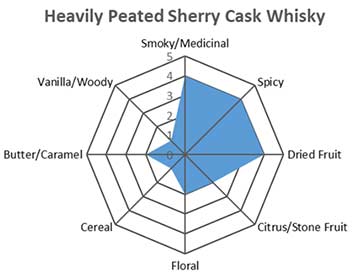### **The Individuality of Sensory Ability**
No exploration of the development of Sensory Skills would be complete without reference to the individuality of Sensory Ability.’ It is not possible to review this subject in detail here, but there must be cognizance regarding this topic. Everyone is wired differently, so individuality adds complexity to the sensory world; sensory skills can be developed to identify flavors. Understanding individual strengths and weaknesses in sensory ability is important for our work with sensory panels. These panels are responsible for quality control in drinks producers. We note with interest that each individual experiences the world differently from everyone else.
### ***Summary Notes regarding Aroma Academy***
Additionally, Aroma Academy provides a series of Aroma Standards Sets. Additionally, Sensory Training programs and Competency/Testing Systems focus on the drinks industry. In addition, Sensory Training outlines a step-by-step method to develop aroma and flavor recognition skills. Most product development concentrates on stable, repeatable Standards for drinks like Whisky and Wine; moreover, it collaborates with industry experts. Many leading companies are in our customer base. They are active in aroma marketing in addition to our Sensory products and programs.
Additionally, Alan Gordon, is CEO and Co-Founder of Aroma Academy, UK
## Summary: The Evaluation Method
The evaluation method involves study but will produce uniform repeatable evaluations of all spirits and they can be discussed in a universal language which ensures that experts and drinkers will have similar ideas of what to expect in every spirit based a proven methodology which echoes the regimen of true sensory science. Thank you, Alan, for your diligence in a field necessary to bring the industry into a new era of scientific reason and evaluation. Accordingly, Arsilica, Inc. supports your efforts. [How NEAT works](https://theneatglass.com/how-it-works/ "How NEAT works")

The NEAT Glass (CSO) Corporate Strategy Officer, inventor and entrepreneur, (CRD) Chief Research and Development Arsilica, Inc.
[See Full Bio](https://theneatglass.com/author/georgearsilica-com/)
[Facebook](https://www.facebook.com/theneatglass/) [Instagram](https://www.instagram.com/theneatglass/) [TikTok](https://www.tiktok.com/@theneatglass.com) [Pinterest](https://www.pinterest.com/TheNEATglass/) [YouTube](https://www.youtube.com/@TheNEATGlassChannel) [LinkedIn](https://www.linkedin.com/in/theneatglass) [Tumblr](https://www.tumblr.com/the-neat-glass)
**Categories:** Academy
---
### [Gender Equity is Important to Accurate Spirit Evaluation](https://theneatglass.com/gender-equity-in-evaluation/)
**Published:** April 29, 2022
**Author:** The NEAT Glass
**Content:**
## Gender Equity is Important to Accurate Spirit Evaluation
This may be the most controversial presentation from the NEAT Spirit Academy. Why? Many people confuse gender equity with gender equality, and few understand gender equity well. Discussion always raises the ire of a few of those who belong to the “fraternal order of macho whisky drinkers.” Many cannot distinguish the difference between equity and equality.
The spirits’ industry is also in general denial that an inequity could even exist. Worse, is the attitude toward female evaluation proficiency in the industry and the general public.
## What is Gender Equity
According to the United Nations Educational, Scientific and Cultural Organization (UNESDOC): “**Gender equality**, equality between men and women…does not mean that women and men have to become the same, but that their rights, responsibilities and opportunities will not depend on whether they were born male or female. **Gender equity** is fair treatment for men and women according to their respective needs. This may include equal treatment or treatment that is different, but which is considered equivalent in terms of rights, benefits, obligations, and opportunities.”
## Different Build, Different Biology
Different genders have different physiologists, dimensions, *needs*, and senses. To those familiar with developing a product from concept to market, gender equity is the key to a product’s success. A product or procedure cannot provide the best solution when it favors the physiological traits of one sex. This is especially when its dominant users impose it as the standard for everyone.
Designers who build products around one group’s characteristics may limit another group’s abilities. Industries create inequity when they adopt those products universally without considering physiological differences. By making equitable performance a priority from the beginning, companies can serve broader markets and avoid preventable revenue losses.
## For Example; Many Fields Exhibit Gender Bias
Here are some examples to present the concept of equity:
- “One size fits all” the keyboard design for an octave span on the piano is based on a larger man’s hand. (Rachmaninoff, Horowitz, Schnaber, Rubinstein, Cortot, Richter, Lipatti, Gould, Van Cliburn, no female piano virtuosos in this group, could there be a reason? What if pianos were designed for slender and/or short fingers?).
- Some voice-recognition systems process lower-pitched voices with fewer errors than higher-pitched voices. Developers can correct this disparity with existing technology yet move slowly to provide equally accurate recognition across the full vocal range.
- Most automotive crash tests are conducted with dummies of male weights and proportions, placing women at risk of less protection from safety devices designed without consideration for female physiology. This includes shoulder straps, side airbags, steering column adjustments, brake pedal reaches, etc. (the automotive industry is getting better at this as lawsuit awards climb)
- Pregnant women still have to get out and shop and should be included in the use of handicapped parking (OK, add a few more blue signs, single pregnant moms-to-be still have to do their shopping even at 9 months in).
- Men generally prefer cooler indoor temperatures than women, with some research indicating an average difference of about 5°F. Because men have historically dominated engineering and building-management roles, workplace temperature standards often reflect male thermal preferences. Women consequently report more discomfort in overly cool workplaces. This difference demonstrates that one temperature does not suit everyone, but building managers can establish a more equitable compromise. Skew temperatures to the workforce gender population in different areas).
## Raising Gender Equity Awareness
At first glance, none of these issues will seem the least bit important to most males, and even border on frivolous, but the fact is, that inequity issues exist everywhere from tool design to cell phone hand size to car seats. Why are we pointing them out? It’s not a rant, politics, or industry bashing, it is all about raising awareness that many products and procedures in our lives, are less than perfect and taken for granted, yet are gender handicaps that could be corrected.
## Popular Glassware and Gender Inequity
Specifically, in nosing and evaluation, we believe glassware is another example that displays the lack of gender equity. On average, women demonstrate greater olfactory sensitivity than men. Yet the spirits industry and traditionally male drinking clubs often overlook both this physiological difference and the underlying barriers that limit women’s equal participation. The female nose is much more sensitive to numbing by concentrated ethanol. This is an elephant in the room, conveniently avoided with forethought, totally ignored, carefully tip-toed around during discussions, or dismissed as unimportant.
By confronting the elephant in the room and implementing meaningful changes, the spirits industry can broaden its perspective, expand the market, and elevate knowledge above superficial, mythical, and biased traditions. Including rather than overlooking women will unlock one of the industry’s greatest opportunities for future growth. Industry influencers have this opportunity directly under their noses, yet many ignore it to protect familiar but scientifically unsupported practices.
## Science Exposes Gender Differences
Much scientific research has been published in peer-reviewed journal papers since the early 1950s which prove beyond a doubt that females in general possess more sensitive olfactory than males:
- Lower aroma detection thresholds (lower ppm concentrations at which aromas are detected)
- Lower aroma discrimination levels (lower concentrations at which differentiation between two detected aromas can be identified)
- Lower aroma identification thresholds (lower ppm concentrations at which the aroma can be correctly identified)
Physically, female olfactory superiority is no surprise, since Oliver-Pintero published a peer-reviewed journal paper in 2014, based upon an isotope fractionator count of olfactory receptors in the dissected corpses of males and females. The data, with 95% confidence level, establishes that females on average possess 43% more olfactory receptors than males. More receptors = higher sensitivity = better female olfactory performance than males.
## Independent Testing
Scores in the UPSIT (University of Pennsylvania Smell Identification Test) are higher for females than males. Aspiring evaluators can use the University of Pennsylvania Smell Identification Test (UPSIT) to assess their olfactory abilities. Search online for “UPSIT” or purchase the test through Sensonics International. Although UPSIT does not focus specifically on alcoholic beverages, it provides an economical starting point for measuring aroma-identification ability across a broad range of odors. It also establishes a useful baseline for training and refining the sense of smell.
## Gender Perception
There are additional indications which lend credence to female olfactory superiority.
- The *disgust* emotion describes the female reaction to aromas which threatening their ability to nurture and protect the fetus and children. Test: pour a tulip glass of any spirit 40% ABV or higher. Place it under a female nose with the comment “Smell this to see if you like it.” Then duck quickly to avoid a right hook. Men don’t usually react. Instantaneous disgust emotion is characterized by a physical reaction, a sense of pain, and generally an oral comment of disgust.
- Repeated exposure (olfactory induction) to ethanol (and other compounds) lowers the female detection threshold, and men’s thresholds do not change. In other words, learning by exposure develops a more acute sensitivity in females. This may be a natural female safeguard reaction that ensures self-protection, procreation, and future generation safety.
Both of points are indicative that women have a higher degree of discrimination of ingestible compounds and a higher social respect for ethanol than men. As well, they have a lower tolerance level (also proven fact). [NEAT combats gender equity](https://theneatglass.com/how-it-works/ "NEAT combats gender equity").
## A Gender Equity Case Study
Between 2010 and 2015, Arsilica, Inc. conducted A/B comparisons of the NEAT glass and a tulip glass at 17 spirits events. In 2,914 recorded trials, participants evaluated the same spirit from both glasses. Approximately 13% of male participants preferred concentrated ethanol at the nose, with a standard deviation of 2.23%. Fewer than 2% of female participants preferred it, with a standard deviation of 1.37%. The two-standard-deviation ranges showed a clear sex-related difference in preference. This supports—but does not independently prove—that women respond more sensitively to concentrated, pungent ethanol vapor. A significant number of females refused to test, stating they had no desire to sniff from the tulip glass.
**Important scientific distinction:** A preference test measures what participants prefer, not their sensory detection thresholds. Therefore, the results support an association between sex and ethanol preference or aversion; they cannot, by themselves, confirm that women possess greater physiological sensitivity. A controlled threshold-detection study would be necessary to establish that conclusion.
[See the entire study. Many expressed sharp pain from sniffing](https://www.mdpi.com/2306-5710/4/4/93 "See the entire study. Many expressed sharp pain from sniffing"). We assume those participants were not familiar at all with sniffing strong ethanol.
## Social Aspects of Gender Equity
For many members, whiskey clubs and blogs have become a social feel good, same gender, fraternal camaraderie without the presence of female influences. Some, rampant with sexist jokes and comments, are more about brand adoration than serious evaluation. From the female comments in the simple AB test described above, one can infer that the peer pressure to drink from tulips may turn the prospect of membership in spirits clubs off for females. Why not encourage female membership in spirits clubs? The added sensitivity and diversity would add depth to group tastings.
## Social Club Remedies
Dump the myths, snobbery, and peer pressure. Stop expecting every member to use the same glass, abandon the “good-old-boy-jock” culture, and actively welcome more women. Everyone will have more fun, and the men may learn something beyond properly pronouncing Scotch whisky brand names. Many women-only whisky clubs take a different approach from predominantly male clubs, and some have even replaced the tulip with a tumbler.
## Female Adaptation
Many women in the spirits industry—and many men with sensitive noses—have successfully adapted to the iconic tulip glass. As a woman-owned glassware research company, Arsilica, Inc. has monitored spirits competitions, attended spirit-specific events, and conducted numerous panel evaluations during the past 18 years.
## Our Observations on Gender Equity
- Gender inequity exists when tiny rim glasses are used to evaluate, and they quickly cause nose numbing. Frequency is highest in blind tasting multiple samples (flights), females reach ethanol anesthesia (nose blindness) quicker than males
- Females can identify a larger number of aromas than males on average from a given spirit, at concentrations levels below male detectability.
- Most competition judging panels consist of an inequitable percentage of females, usually less than 20%, yet they have superior smell-ability on average
- Examining female judge’s evaluation notes, they tend to detect, describe, and note more aromas and more detail than males
- More sensitive noses of both genders who have become regular competition judges prefer open-rim glasses
- In private conversations with female career industry executives, a surprising number prefer a simple tumbler over tulips yet will not argue with industry-wide accepted values, as the discussion is generally off-point, singles them out as rebellious or non-conformist, and dilutes their effectiveness.
- As discovered in the earlier AB test reference, a large majority of males prefer open-mouth-large-rim-diameter glasses, yet at home, they retreat to the fraternal tulip glass because that’s what their buddies drink from and that’s what they take to the club events.
- There are many notable female noses in the industry who have successfully adapted to the tulip, and faithfully and successfully employ the tulip-developed safeguards against ethanol (wafting, breathe through mouth and nose, don’t swirl, add water). They are much more diligent about using all the safeguards than males. Observe and discover, that most men know these safeguards but do not use them.
## A New Approach
Exceptional noses and adaptable evaluators can develop effective procedures regardless of sex, but why force them to begin at a disadvantage? Open-rimmed diagnostic glassware improves evaluation by removing an obstacle that tulip users must overcome through extensive practice. Even after evaluators learn to avoid concentrated ethanol in a tulip, the glass offers no orderly path for detecting aromas. Instead, they must search randomly through an ethanol-rich vapor cloud that irritates and numbs the nose. Refer to previous presentations. Large rim glasses give the aromas a chance to expand, and naturally reduce ethanol concentration.
## Takeaways for Evaluators:
Recent efforts by many in the spirits industry to achieve gender equality in the spirits industry have been exceptional, yet there is still much left to do to improve gender equity. Accommodate the employment and salary issues of inequality, but go a step further to ensure gender equity, and put superior smell-abilities of women to work. Sensory training and olfactory testing for brand ambassadors should be basic requirements before they are sent to engage with the public. Self-examination of company procedures and practices, internal anonymous questionnaires to female employees, and an unbiased approach may uncover a few surprises within your own organization.
## Summary
If you are serious about nosing and evaluation from the scientific standpoint, we recommend you join the Society of Sensory Professionals and self-educate through the many beverage and sensory peer-review journals available. More about the [NEAT Glass Team](https://theneatglass.com/about/).

The NEAT Glass (CSO) Corporate Strategy Officer, inventor and entrepreneur, (CRD) Chief Research and Development Arsilica, Inc.
[See Full Bio](https://theneatglass.com/author/georgearsilica-com/)
[Facebook](https://www.facebook.com/theneatglass/) [Instagram](https://www.instagram.com/theneatglass/) [TikTok](https://www.tiktok.com/@theneatglass.com) [Pinterest](https://www.pinterest.com/TheNEATglass/) [YouTube](https://www.youtube.com/@TheNEATGlassChannel) [LinkedIn](https://www.linkedin.com/in/theneatglass) [Tumblr](https://www.tumblr.com/the-neat-glass)
**Categories:** Academy
---
### [When You Add Water to Spirits (Almost Never)](https://theneatglass.com/adding-water-to-spirits/)
**Published:** April 29, 2022
**Author:** The NEAT Glass
**Content:**
## Why did Whiskey Invite its Enemy to the Tasting?
“We have met the enemy and they are us – and all our friends.” The whisky industry extended an unwitting “invitation” to the whisky Trojan Horse in the 1960’s, sealing its fate. It will remain until industry leaders wake up to smell the smoke. How do we know? Adding water to whisky is a common practice today, yet few realize how it devastates evaluation.
More to the point, adding water significantly destroys both casual tasting and sensory evaluation. Drinkers have no idea why or how, and all are complicit as long as they ignore the science. We will relate the story chronologically, so everyone can understand how water crept in to replace sensory logic.
## A Clues and Evidence of the Betrayal
Many whisk(e)y drinkers add a little water to their spirit when tasting. Some add a lot of water, and some get very peculiar about counting drops with an eyedropper. Some drinkers believe they use vials of water from the exact same stream the distillery uses for distillation and reduction to maintain pH and minerality.
What’s wrong with this picture? Adding water has become a necessity for most novices, aficionados, professionals, and sensory evaluators alike. If everyone does it can it be a bad thing? The answer is yes.
## How a Simple Decision Changed the Trajectory of Whiskey
### The Historic Timeline Part I
**1700s:** Jerez, Spain. Copita: Tiny, wharf-side “proof-of-quality” tool verifies and seals sherry trade deals, nicknamed “dock glass.” The worldwide distributors of ports and sherries are England, Scotland and the Dutch. The dock glass copita is adopted right along with the fortified wines.
****1800s:**** Copita (tulip) is accepted as popular UK standard household wine/sherry/port glass. Small size perfect for single serving of fortified wines (22% ABV). On the recommendations of the distributors, along with the customs already in place in Europe, the copita becomes the glass of choice.
**1900s:** Tulip quickly becomes scotch lovers’ chosen glass with its convenient serving size, existing design, and widespread availability made possible through sherry and port popularity. Nearly every household who could afford to drink even the cheapest port and sherry, had copitas at the ready.
“Why do we need another glass?” they asked. “Our scotch demographic already has them,” they said. “Copita holds the right amount for a single serving of scotch,” they said. “New designs would take years to gain popularity and would cost more,” they said. Then they invited copita to come to the whisky tasting. “It’s a no-brainer,” they said.
**1900s:** Tulips (copitas) quickly becomes scotch lovers’ chosen glass with its convenient serving size, existing design, and widespread availability made possible through sherry and port popularity.
**1950s**: Scotch, sherry, and tulip (copita) glass gain international acceptance. Malted barley spirits are also distilled in Japan, India, USA, whose drinkers follow scotch protocols. This expansion further enhances the popularity of the “official” tulip glass.
### The Historic Timeline Part II
**1960s:** Scotland hits a roadblock in marketing Scotch to the USA. There was never a problem in Europe, because they have been drinking straight spirits, warm, for centuries. Americans have taken a different turn. Bad booze in the prohibition era was unpalatable. Americans have converted to ice, water, soda, fruit juice mixtures called “cocktails” to escape the horrible taste of illegal alcohol. “Let’s fix this, so we can sell Scotch,” they said.
Industry leaders had the opportunity to step back and take stock of the situation at this point in the timeline. A different glass could have solved the problem. Irrefutable proof: Tumblers were the glass of choice for many bourbon and rye lovers and distillers. Tumblers do not concentrate olfactory ethanol.
We are not sure when evaluators actually adopted these “fixes.” We are convinced they would have been in common practice in England and Scotland prior to the 1960s.
### The “Fixes” Involve Adding Water
However, evaluators developed a standard tasting procedure to reduce the numbing effects of strong ethanol concentrated by the tulip glass. New tasting procedures preserved the now-iconic tulip. Over the decades, “safeguards” against nose-numbing appeared in the ritual of tasting and evaluating whisky and other spirits:
- Waft aromas toward the nose with the free hand to acclimate the nose to the strong burn of ethanol. However, this numbs the nose gradually, avoiding the initial olfactory spike of pungency/pain, it still does not prevent numbing.
- Place the glass in successively closer positions to the nose while sniffing to acclimate. This may avoid the pungency, but it does not stop desensitization of the trigeminal nerve endings
- Breathing simultaneously through nose and open mouth reduces inhalation and the number of ethanol molecules impinging on olfactory nerve endings. However, this method dilutes the sample by funneling aromas to the mouth, inhibiting aroma detection with fewer aroma molecules.
- Recommending “do not swirl” the spirit. Fact: swirling promotes quick evaporation of ethanol which numbs the nose. Swirling releases other aromas needed to detect and determine flavor.
- Do not smell. Taste only. Let the retro-nasal do the aroma detecting (much less effective in detecting aromas than combining with ortho-nasal sniffing). Saliva in the mouth dilutes ethanol palate burn. However, the olfactory aroma sample is less than with the ortho-nasal.
- Add a few drops of water to “open up” the spirit. The impression may “open up” because ethanol burn is less. However, added water shuts down all aromas.
## “Fixes” Including Adding Water are “Crutches” to Enable Tulip Usage
Most drinkers do not care about the quick ethanol effect, as they do not see or feel the onset of olfactory numbing, and readily adopt the “fixes” to follow the leaders and continue using the iconic tulip glasses. Watch the tasters or experience it yourself. You think everything is all right. Your nose stops detecting pungency after the first strong sniff. However, your nose is not working with nearly the same efficiency, you just think it is. Scotch sales flourish in the American market.
### The Historic Timeline Part III
The Glencairn tulip variation derives from the copita, and five Scotch master blenders endorsed it. It became the most widely popular spirits glass ever. Glencairn won Queen’s Awards and serves as an official tasting glass for many leading spirits societies. As a result, glassware manufacturers learned a valuable lesson: any design that departs from the copita or Glencairn will probably fail in the spirits world. Future designers keep the bowl height and diameter as close to the established dimensions as possible to encourage acceptance of minor stylistic changes. How can this possibly be a bad thing?
\#image\_title
The tulip takes the world by storm. Every spirit drinker everywhere is convinced by its wide-spread use, popularity and quick adoption by other spirits, that the tulip-ethanol-nose-cannon is the final word in spirits glassware. Adding water will not fix it.
### The Final betrayal: Your Favorite Tasting Partner is a Problem
The invitation to the party formed a long-term relationship that is difficult to break. It’s like going to bed every night with a partner of 40 years and thinking “I love-hate him/her so much. How did I get here?”
I love my tulip but I don’t smell what everyone else is talking about.
The betrayal leaves everyone stuck with a traditional glass they love, even though it reduces their ability to smell the aromas that drive much of flavor perception. The diagram shows how a tulip glass concentrates ethanol. We have to ask, “If you would pay $100 or more for a choice bottle of whiskey, why wouldn’t you want to experience the flavor you paid for?” Oh yeah—and a $12 glass can deliver it. Comfortable mindsets and habits shamefully interfere with rational priorities. ***Forget adding water.***
## Ancient Chinese Proverb
Three men can make a tiger (repetition can create fact from fantasy). Likewise, two centuries of repetition can make a sherry glass appear scientifically suited to whiskey. To be fair, until recently, even sensory science researchers believed adding water was the only answer. The “fixes” are only contrivances to alleviate ethanol burn. They are evidence enough that the tulip simply does not work as well as we need it to. Science stepped in to late as the alliance was formed.
The scientific community does strange things. They write research papers to describe their findings, but they fail to address practical application in most cases. They write for each other in a language which outsiders cannot understand. The public only finds out about scientific progress when someone on the outside discovers and points it out to everyone. At this point, we at Arsilica, Inc. may be the only supporters of applied glassware science, but only time will tell.
## Science Steps In: About Adding Water
The evidence was too important to accept or ignore, so Arsilica, Inc. designed and released the NEAT glass. NEAT diffuses ethanol and keeps the olfactory neurons and nerve receptors available for detection and identification of aromas.
**The Physical Science of Adding Water to Whisky:** Adding water reduces the ethanol mole fraction at the surface, lowering the surface vapor pressure and reducing the volatile mass transfer across the boundary layer. The perceived opening up results from reduced ethanol vapor and trigeminal olfactory load, not enhanced aroma evaporation. Less of everything evaporated, means less ethanol *and* aromas. The absence of the ethanol is noticed as the greatest effect because ethanol irritation also subsides. Additionally, a second factor is surface tension which resists molecular evaporation. Water has a three times higher surface tension than ethanol.
Evaporation of long-chain character aromas (higher mass) is restricted more by adding water than are ethanol molecules (lowest mass). At high dilutions to 20% ABV, the process is reversed, as a continuum of water and ethanol releases the esters, but masks other aromas, changing the aroma profile. Scotch blenders take heed, this dilution affects your results.
## **The Biological Science of Ethanol on the Olfactory**
Ethanol is a trigeminal nerve irritant which decreases the ability to detect and identify key aromas in spirits. [Studies at University of Illinois](https://www.mdpi.com/2306-5710/10/4/116 "Studies at University of Illinois") prove that ethanol decreases smell-ability.

## Adding Water is the Blender’s “Crutch” to Enable Tulip Usage
In a previous presentation, we discussed the blenders’ preference to dilute their blending samples to 20% ABV to save their noses during the blending process. Most whisky drinkers do not know that the reduction of a spirit of 40%ABV to 20%ABV requires the addition of water *in an amount equal to the amount of spirit being diluted*. This is a 50% dilution. Who drinks it that way? Why blend differently?
In the attempt of the whisky-drinking public to use the same glassware and procedures as many scotch blenders, they have skipped over the significantly high dilution ratio when adding water with an eye dropper to add only a few drops. The higher the ABV of the spirit, the more water would be required to dilute to 20%ABV. If the sample were a 60% ABV spirit, dilution would have to be over 3 ml of water to 1 ml of spirit to achieve 20%ABV. Who drinks it that way? We know of no consumer who adds that much water to their spirit for drinking enjoyment, but it is standard blender practice to save the nose during a long, involved evaluation process. We don’t share that logic.
The problem with diluting to these levels is that it has been proven that dilution to 20% ABV changes the aroma profile of the spirit, and the blenders are a profile that no one understands except the blenders themselves, since most whisky drinkers who add water, only add a few drops. Further information is available in the journal paper cited in the exhibit below.
## What Can I Do Instead of Adding Water?
If your reason is “I like it that way,” so be it, but be open to other approaches. We would really look like a bunch of idiots if we said you can’t have it your way. However, remember that you like it that way because there is less burn. Get a better glass. You are sacrificing too much in flavor by adding water to continue drinking from a tulip. The cute little eye dropper trick is a show for the pretentious. ‘Nuff said.
If your reason to add water is palate burn, change your evaluation procedure. Nose the spirit first in an open-rim glass, then determine your formula for just how much water will alleviate palate burn. Note that when the spirit is introduced into the oral cavity, saliva will quickly begin to dilute the spirit.
Taste the sample from a separate glass in which some of the full-strength spirit has been diluted enough to alleviate sharp palate burn. Keep the sample in your preferred nosing glass for reference back to the nose if needed. An alternative is to take satisfactory notes from the nosing glass and then add water to taste, but that eliminates the possibility of returning to the original nosing sample. [How NEAT Works](https://theneatglass.com/how-it-works/ "How NEAT Works")
## Summary
In summary, tulip glasses concentrate ethanol, and concentrated ethanol impairs your ability to smell. You love your tulip, and you love your whiskey—but which do you love more? A flavorful experience is priceless, and the right glass can transform it. Adding water cannot restore the aromas and flavors that the wrong glass conceals. To recover the full experience, change the glass—not the whiskey.
Understanding and teaching are the key to resolving discussion disputes and combatting ignorance. We are not here to make you feel good. “I like it that way,” is now a statement synonymous with “I am not open to any other ways to enjoy my whiskey (spirit).” We are here to tell you the truth. Do with it whatever you wish.
*One more caution:* There are many companies out there selling water to unsuspecting drinkers which is purported to be the same as the water used to make the spirit. This is not true. Special treatment is given to water prior to distillation, fermentation, maturation, and final proofing. There will be no bottles of that same water. Attempting to match pH and minerality is a guessing game. ***Caveat Emptor.***

The NEAT Glass (CSO) Corporate Strategy Officer, inventor and entrepreneur, (CRD) Chief Research and Development Arsilica, Inc.
[See Full Bio](https://theneatglass.com/author/georgearsilica-com/)
[Facebook](https://www.facebook.com/theneatglass/) [Instagram](https://www.instagram.com/theneatglass/) [TikTok](https://www.tiktok.com/@theneatglass.com) [Pinterest](https://www.pinterest.com/TheNEATglass/) [YouTube](https://www.youtube.com/@TheNEATGlassChannel) [LinkedIn](https://www.linkedin.com/in/theneatglass) [Tumblr](https://www.tumblr.com/the-neat-glass)
**Categories:** Academy
---
### [Truth May Actually be Myth and Misinformation](https://theneatglass.com/truth-myth-misinformation-spirits-evaluation/)
**Published:** April 29, 2022
**Author:** The NEAT Glass
**Content:**
## Truth May Actually be Myth and Misinformation
Identifying the myth and misinformation that pervade evaluation is key to changing the gross misinformation accepted as truth. Gaining useful knowledge involves looking past superficial “quickie” explanations to find true reasons certain things happen.
## Sources of Misinformation
- Misunderstanding science, hasty explanations, and suppositions lead to myth.
- Misunderstanding events and their outcomes lead to myth.
- Myth is born in marketing departments along with marketing science (not the same as real science)
- Myth becomes memes the longer they exist unchallenged.
## Industry Fails as an Educator by not Actively Combatting Misinformation
The spirits industry would do well to examine the new set of priorities held by future drinkers. Younger entry-level spirits drinkers categorically reject marketing nonsense, have a strong sense of community, and readily embrace applied science. As a result, the spirits industry has a rare opportunity to significantly improve industry credibility among new, young consumers. Science connects with younger consumers on a higher level, and if applied properly, enhances enjoyment, improves quality, boosts sales and profits, and builds loyalty.
### Industry Teachers May not do Their Homework
Brand ambassadors fail in their role as educators. They tirelessly repeat myth and mistaken assumptions until they are regarded as truth. The scientific approach to spirits education dispels misconceptions and myth and encourages discovery. Industry wins, consumers win, marketing comes to its senses, and the quality bar is raised throughout the industry.
## Be Active Against Misinformation
Correct others when they misspeak. Fact-check. Journalists tend to create untrue but romantic explanations of how things happen. Fearless, intelligent, and corrective responses can be a motivation to promote fact-checking among journalists. Misinformation creates Myth. Here are a few examples:
## What is Terroir?
Recently, there have been frequent appearances of articles proclaiming the notion of terroir in spirits, particularly scotch. The definition of terroir:
- (Wikipedia) Terroir (/tɛˈrwɑːr/, French: \[tɛʁwaʁ\]; from terre, “land”) is a French term used to describe the environmental factors that affect a crop’s phenotype, including unique environment contexts, farming practices, and a crop’s specific growth habitat. Collectively, these contextual characteristics are said to have a character; terroir also refers to this character.
- (Merriam-Webster) ter·roir \| \\ ˌter-ˈwär \\ ***terroir*:** the combination of factors including soil, climate, and sunlight that gives wine grapes their distinctive character
- (Dictionary.com) terroir \[ter-wahr: *Frenc*h ter-war\] the environmental conditions, especially soil and climate, in which grapes are grown and that give a wine its unique flavor and aroma
- (UK Dictionary) terroir Pronunciation /tɛrˈwɑː/ /interwar/ the complete natural environment in which a particular wine is produced, including factors such as the soil, topography, and climate. *‘Literal-minded fundamentalists love to call terroir the soil and climate of a specific vineyard, but in truth, it’s about husbandry, about sensitivity to place and its careful management so that the best of things can be delivered of it.’*
## Terroir in Wine
Consumers have a vague understanding of terroir. Subsequently, many flavors and aromas which occur in wines are explained away by dumping them into the category of terroir. As a result, terroir is the convenient catch-all for funky, aromas, “It’s terroir, …grapes just don’t smell or taste like that.” Everything which has no name to the evaluator is called terroir. Sloppy “science,” and sloppy evaluation leads to misinformation. The diagram below is a good representation of the character of terroir.
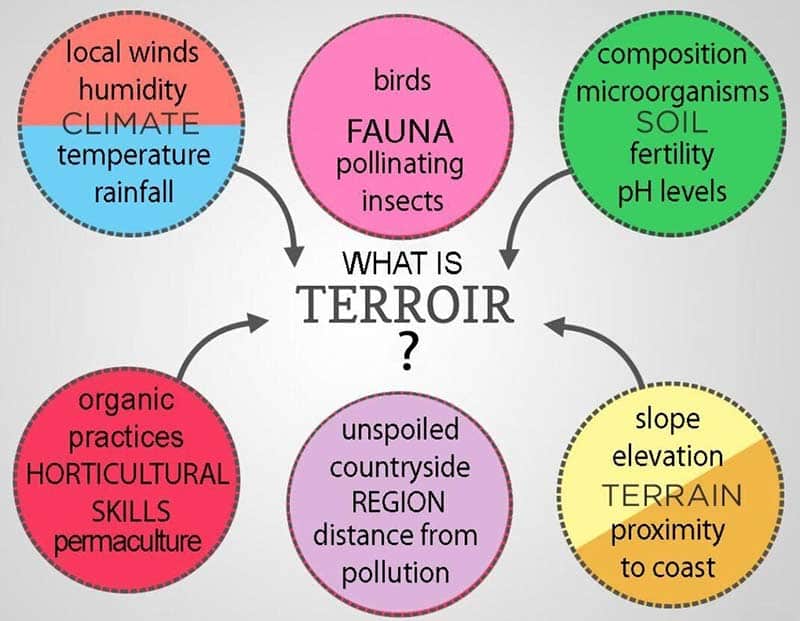
Many terroir-associated aromas arise during fermentation and from the yeast, and many more are added from oak barrels. Some may come from stems and leaves inadvertently left in the crush and fermented along with the fruit. Some may come from the bacteria found in the soil in particular regions or associated with a specific grape varietal. Conversations of terroir seldom exist in white wines, particularly those processed in stainless steel. Human factors of traditional growing and wine making processes within a region influence terroir. Terroir generally seems to come into the evaluator’s conversations more often when discussing oak barrel-aged red wines, where bacterial and fungal aromas grow during the aging process, perhaps leading to the confusion of barrel-associated aromas with regional terroir aromas and flavors.
## Sulfur: Friend or Foe of Terroir?
Barrels are the origination of many aromas ascribed to terroir in wine, some winemakers purify their barrels with a sulfur match (an old Dutch method) to consume the oxygen and slow microbial decomposition. This process is still common in Bordeaux. Most add sulfur dioxide to the macerated grapes or the fermenting must in order to kill natural molds and bacteria transported from the vineyard. This has the side effect of aiding extraction. Producers sometimes add sulfites during racking or blending. Low fermentation temperatures are conducive to bacterial and fungal (spore) growth. Adding sulfites doesn’t correct all aromas and odors, nor does it affect the minerality of the soil which may come through in the wine, yet its application could affect aromas typically ascribed to terroir. The chart below, is indicative of the ongoing research of identifying bacteria as specific to terroir. Much is still unknown in search of the truth.
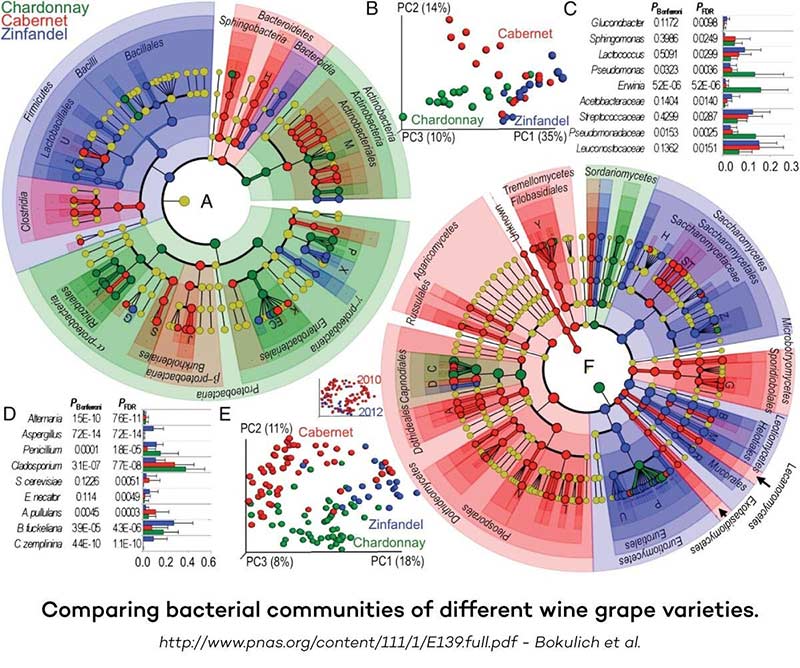
Fermentation of cool-produced white wine is generally under 16°C. Peak red wine fermentation is just over 29°C. However, distillation begins at 78°C, and average is around 93°C. Complete microbicidal sterilization occurs in the 160°C-190°C range. Fungi and yeast are killed in 71°C to 75°C, penicillium is killed at 55°C. Aromas in wine commonly ascribed to terroir are killed at distillation temperatures.
## Myth: Terroir in Spirits
The real killer is the ethanol. In an interesting parallel, hand sanitizers are used at room temperatures and made from both ethanol and methanol because they break down cell membranes, the bacteria die, and dissolve quickly (amphiphilic). If the yield of ethanol from a distillation is around 90+ % its concentration is more than adequate to kill bacteria (CDC says 60%, some now say 90% ethanol is necessary to kill Covid completely). Most of what is commonly described as terroir in wine cannot exist in spirits unless it is added after initial distillation (not terroir, because it did not come from the land or climate but perhaps in the barrel of an aged spirit). Misinformation even causes political turmoil.
How can we discuss or discover a particular terroir in spirits if we do not know where farmers grew the grain? Unlike winemakers, most distillers neither grow their own grain nor know its precise geographic origin. They buy grain from various suppliers and cannot track the climate and soil contributions of a fixed location as a winemaker can with a specific vineyard.
## Would Terroir Ever be Significant?
If we cannot understand, recognize, consistently identify, and trace terroir in spirits to its region of origin, what good is it? Is it really terroir? What could be the terroir characteristics of vodka? Would we know the exact growing area of the grain or potato (or other source)? Could we say that it was characteristic (if we could detect it repeatedly) of all grains from that region? Will we someday sit back and confidently say, “I detect aromas in this vodka that strongly characterize potatoes grown by farmers on the north side of Hill #71 in the Idaho russet potato appellation?” The definition of terroir raises many more questions than its description. Reviewers are desperate for something to write about regardless of the truth.
Terroir in spirits is pushing the envelope of believability and rationale. Science has not yet substantiated its occurrence in spirits. Researchers have not defined or detected terroir in the final distilled products of plums (slivovitz), tangerines (liqueur), lemons (limoncello), agave (tequila), or sugar cane (rum). Producers generally know the sources of these ingredients, whereas they find grain origins nearly impossible to track. Without deeper insight, we see terroir in spirits as myth and misinformation.
## Myth: Salty Sea Air in Scotch
Many tasters of scotch swear by the salty taste of scotches that distillers aged close to the coasts of Islay, Jura, Skye, and Arran, crediting the salty sea air and atmosphere for their characteristic salty taste. Marketing again triumphs as science fails to immediately step in and debunk misinformation and myth.
Distillers age these whisk(e)ys in barrels near the coast, and the air may contain a slight amount of salt, but how did the salt ever enter the barrel? The answer is creative, romantic imagination to support marketing. The barrel is sealed. If salt could get in, scotch could get out, leaking or quickly evaporating (some do, and there is an air interchange, but the salt stays outside the barrel. When one Googles “sea air in scotch,” one finds pictures of scotches that romantic evaluators have reviewed, but no scientific evidence or diagrams explaining how this occurs. Misinformation is also created by those who attempt to fill in the gaps with their own facts.
### Writing it Doesn’t Make a Myth Fact
Plenty of reviews feature distillers who note the characteristic in their Scotch, but researchers have not produced a single piece of scientific evidence that verifies its existence.Then there is the smell of the salt. What is that like? We know it as a taste without a smell. Taste receptors are on the tongue.
## Salty Science
If a cooper constructs the barrel loosely, air could enter, but the Scotch would leak or evaporate quickly. If a cooper constructs the barrel tightly, air can slowly permeate the wood (as it permeates the cork in a wine bottle to oxidize), but salt would be unlikely, if not unable, to pass through the wood or tightly swollen stave seams. The salt crystals would precipitate onto the outer surface of the wood, around the seams, leaving a tiny white line at every seam. That there is a better chance that microbial bacteria would permeate a seam than salt crystals which remain after wet salty water dries up. In truth, the salt is in solution and carried around by the water moisture in the air, not the air itself.
Perhaps if the distiller made the Scotch with salty water, inadvertently washed the barrel with saline water, or added salt to the barrel, the story would be different—but not because the spirit underwent distillation and aging near the coast. One other possibility exists if the distiller exposes the mash to open air during fermentation, but that raises the question: “Can airborne salt survive distillation in a high enough concentration for people to detect it?” Research has uncovered nothing to validate that theory.
## Seaspray
Seaspray (spume) exists as a natural product of the violent churning of waves and wind. Called SSA (sea salt aerosol) it is responsible for a significant degree of heat and moisture exchange between the ocean and the atmosphere. Seaspray bubbles burst at the interface of water and air, rising from crashing waves, commonly leaving light salt deposits on the pier, docks, and buildings close to the wave action and exposed to the weather, but the notion ends there.
Researchers have detected salinity in wines that winemakers produced from grapes grown near the coast, and sea spray could coat harvested grapes and add salinity to the fermenting must. What about the barley in Scotch? Farmers grow some barley on Islay, but Islay distillers also use barley from other regions. Some of the barley could therefore carry salt deposits, but could the salt survive distillation temperatures at concentrations high enough for the tongue to detect? It’s beginning to look like a myth.
## Seaspray Travels
During fierce and prolonged storm conditions, salt spray can travel as much as 25 km within the atmospheric boundary layer, but jet droplets and spumes from normal wave action travel only about 20 cm from the water surface and with the help of storm velocity winds can travel a horizontal distance of around a hundred feet or so. Storm seasons occur in the fall and winter (cool or transitioning temperatures). Barrel seams are tight enough to prevent leakage. During the summer, sea spray consists of 60-90% DOC (dissolved organic carbon), and an additional percentage of dead algal cells and the product of algae blooms, not salt. In truth, do these reviewers smell dead algae and associate it with salt? During winter storms, the salt content is much higher than DOCs.
### Salt Goes to the Ground
Subsequent rain accompanying most storms washes down the salts and DOCs to the ground. Inside the sheltered storage facilities, including those built in the path of winds from the sea, atmosphere salt levels are much lower than those just outside, and the salt still has to get inside the barrel before it settles out of the atmosphere. Again, detectable salt content in a whisky could come from using brackish water or washing a barrel with salt water rather than from the effect of salt spray, but that is not nearly so romantic, idyllic, or picturesque.
## Not through the Barrel
Salt cannot travel through the barrel staves or their seams to combine with the spirit. Additionally, we hear nothing from the experts’ blind tastings which verify the taste of algae, dead fish or seaweed in scotch distilled in coastal areas. If the salt comes from the salty peat burned to provide heat for malting the barley, how did it get to the barley? Truth is science based.
Did crystals of salt from the barley come up through the holes in the malting floor, carried up by rising heat, as the phenolic, smoky flavors did? Seems unlikely, since salt is easily transferred in moisture. Moreover, flame heat dries up moisture entirely. Atmosphere or heat alone will not transfer the very smallest salt crystals. If there was any salt, it may be detected in the ashes of the peat. Most charts that describe the characteristics of different scotch whisky regions speak to the peatiness of these coastal whiskies, yet do not mention saltiness as a flavor characteristic, either taste or smell. The truth is, it looks more like myth.
## Not on the Ship
In the unique case of Jefferson’s Ocean, the distiller has clarified the purpose that barrels are taken to sea. This process has nothing to do with absorbing salt from the sea air. Barrels in the holds of large ships, are actually at a nearly constant temperature, but continued sloshing of the liquid in the barrel due to ocean wave action on the ship aids in hastening aging, with constant re-wetting of the oak in the airspace of the barrel and continuous remixing of oak sugars throughout the barrel’s liquid contents. Shipboard movement frequency is far quicker than stationary aging. Lashed to the top deck, barrel aging gets the added benefit of extreme temperature changes, hastening the aging process, but could they withstand the beating and increased thermal expansion cycling?
Although Jefferson’s Ocean keeps its mash bill secret, we remain confident that it contains high proportions of corn and rye. Bourbon must contain at least 51% corn, and tasters can detect the presence of rye. However, farmers probably did not grow these grains close enough to the seacoast for them to collect brine or sea-foam deposits. One story published in [Beverage Dynamics](https://beveragedynamics.com/2017/08/27/why-age-whiskey-at-sea/ "Beverage Dynamics") in 2017 describes salty tastes.
## Not in the Ship
As an aside, temperature variance measured in the holds of wine-carrying ships to trace heating, shows definitively that temperatures change very little (less than + 3degrees C in the ship’s hold on normal voyages from Europe to the east coast USA, and that dock exposure time, sitting in hot containers in the direct sun, are the absolute worst conditions and a major cause of destroying wines in hot seasons before reaching the store shelves. The truth can be elusive. Researchers proved the fact only after placing temperature recorders inside wine cases at their source.
## Reviewers’ Egos are not Myth: Take Them With a Grain of Salt
Reviewers of Islay and Island Scotches and Jefferson’s Ocean bourbon tend to include references to briny seaweed and salty flavors because they consider such notes obligatory for spirits associated with the sea. They know in advance what they are tasting, and they fear the public would consider any omission of ocean flavors an unforgivable oversight and question their credibility. They think it *ought* to be there. If there were nearby sewage treatment plants or fertilizer factories, how would they describe the flavors of the spirit? Misinformation is detected when critics target an area of knowledge or attack the truth.
Additionally, detecting the salt and brine of the sea seems to be a great opportunity to enhance the taster’s mystique. This is especially true if other reviewers don’t detect that subtlety in the same spirit. It is more about one-upsmanship, “My nose is better than yours.” Prove it through unbiased testing. Taste these spirits in flights with inland spirits, blind, to convince a scientist. Until salty shows up in professional sensory evaluations, salty taste is simply not a proven character of spirits *made or aged near the sea*. Even more like a myth
## Valid Evaluation Testing Fights Misinformation
Perform true double-blind tastings of known seacoast distilled spirits to validate. Tasting participants should not know there are any coastal or island whiskeys in their samples. In addition, researchers should ask the participants to identify any particularly salty tastes during a subsequent tasting of the same whiskeys presented in a different order.The answers from several trials to ensure high confidence should resolve the issue once and for all. Until then, the coastal character is a myth of the romantics.
If participants could detect salt, saline, or brine, more questions would arise. “Where did it come from?” and “Are distillers adding salt or saline to the spirit before barreling?” or “Are they adding salt after aging to create differentiation and inadvertently perpetuating the myth?” Too ridiculous to consider.
## Takeaway: Salty Taste is a Myth
Until scientifically proven otherwise, salt in coastally made spirits *due to the salty sea air*, is still a myth. Some whiskeys may taste saltier than others, but the real question is how it gets there. Researchers have never proven that coastal distilling naturally introduces salt into spirits. Salt form sea air is not a characteristic geographic attribute. Adding salt to a whiskey can reduce bitterness. More questions to ask. “Do the distillers know this, and is it a dark distillers’ practice? What other spirits distilled near the coastlines (besides whiskey) have a salty taste? Is it a character of geographic distillery location?”
## Myth: Regional Characteristics of Scotch
Scotch lovers, in their zeal for embellishing their favorite spirits, tend to create an overall regional flavor profile for Highland, Lowland, Speyside, Campbeltown, and Islay scotch. Dumping all the distilleries of a region together by flavors, mouthfeels, and taste to create a regional template or format of character is not a fair idea. Many distillers choose a different style of distilling. Oversimplifying and generalization are misleading, and create misinformation and myth. Oversimplification obscures the truth and creates misinformation.
### Misinformation regarding Geographical Definitions of Style
- Water is a key difference between distilleries. pH and minerality vary from stream to stream to spring to lake. Differences in these qualities are significant reasons for a wide range of mouth-feel variations between scotches. However, the minerality and pH of water do not change abruptly when arbitrary with politically established or geographic borders.
- Distillers’ practices may be similar in small areas, with some distillers within a region using many of the same practices. Collaboration in sharing techniques with neighbor distillers, is neither region-wide nor border-specific.
- Malt differences create different flavors as well. However, malt is not necessarily regional, and few malting houses are on the same site as the distillery. As a result, price and availability more often decide source rather than flavor characteristics. Highland distilleries can use lowland malt. Would that scotch then exhibit the regional highland flavor?
- The supposition that different regions have different characteristics does not belong in objective evaluation, and it is certainly not the truth. For example, the commonly used “full-bodied whiskies of the highlands” and the “light-bodied characteristics of lowlands.” These characteristics are not the property of any district or region. Any distiller can choose to make any style. Some single distilleries make several styles at the same distillery, regardless of distillery location.
## Maps are Deceiving
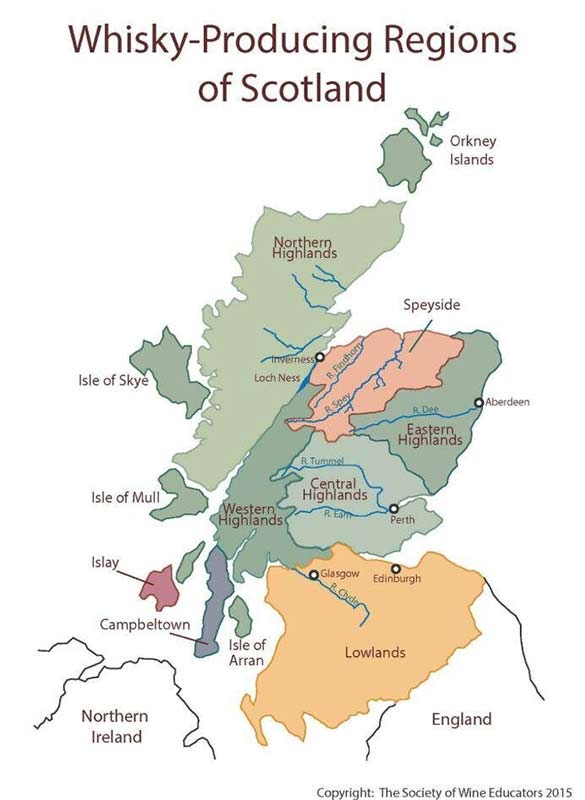Perhaps there is some human urge or trait of a few to classify regardless of fact. If one must artificially bundle spirits by region, first research it. Make a solid contribution by establishing regional boundaries by water characteristics. Hard water ions, like calcium, iron, and magnesium, and pH measurements affect mouthfeel. They may (or may not) contribute to some sort of regionality by intensity (concentration). Assigning aroma and flavor characteristics to a geographic region is ridiculous. It excludes many distillers in the region whose products are atypical. As a result, regional charts and flavor wheels become a source of misinformation and validate myth.
There are simply too many exceptions to fall into the trap of assigning a table of regional characteristics to that region’s products. Let science do the work. Reconstruct it with truth, reason, and forethought. Consider natural resources, rather than convenient geographical borders. Accurate evaluation must never include geographical comment. Predisposed opinions and profile templates cloud objectivity and are unfair.
Sub-regions of scotch are in the map above. Note that the Island scotches are considered to be Highland scotches, making it more difficult to come up with a template of characteristics of Highland scotches.
## Myth: Age and Price = Quality
This gross misstatement is included here because amateur nosers and tasters are culturally trained to believe older is better, and expensive is better. The truth is on the nose and palate. Blind tastings are a sure way to knock down any preformed opinions about quality as it relates to price and age. Too long in the barrel brings up many flaws which smell and taste bad. Evaluators achieve greater objectivity when they do not know which spirit they are evaluating. When a flight consists of three or four samples, retests should occur in different orders. Taste first, look at the price and the label later. Simple people believe that more expensive and longer barrel aging is better, and marketing is their source of truth and knowledge. As a result, the spirit with the flashiest or most relatable ads wins. Marketers know this. Marketing is mostly based on myth and misinformation.
## Myth: Single Malts are Better than Blends
Here again, it is all about snobbery, which distorts truth. Learning the particulars of spirits categories is key to comparing them fairly against their peers. We all have different tastes. Some prefer blends far above single malts and don’t know why (if there is a “why”). The same type of snobbery can apply to single-batch bourbons. Take each category for what it is, and learn the characteristic flavors associated with each category. “Better” varies from individual to individual. Evaluators must understand the characteristics of all spirits and how they are made to judge them properly against their peers.
## Myth: Tulips are the Best Glass for Tasting Spirits
Tulips concentrate ethanol, not aromas. Ethanol is an anesthetic and trigeminal irritant. It reduces the detection and identification of flavors and aromas through irritation and distraction. A glass which shoves concentrated ethanol up the nose cannot be a useful diagnostic tool. Traditionally, the tulip is made for 22% ABV (alcohol by volume) fortified wines sherry and port. The 40% ABV of spirits in a wine glass creates a nose-bomb. Use an open rim glass to allow the ethanol to disperse, and more aromas become detectable and identifiable.
## Summary
Ignore the myth or seek the underlying reasoning of the myth. Always be open to positive proof, especially if has a scientific rationale and experimental validation. Test these myths at home. Don’t be afraid to challenge the “experts.” Take back control of what you like from the industry marketers. Using a scientifically designed glass is the key to understanding why many of these myths exist. Most are the result of an unconditional acceptance of the non-functional tulip. Seek the truth, and use the truth when you evaluate spirits. [Our research can point you in the right direction](https://www.mdpi.com/2306-5710/4/4/93 "Our research can point you in the right direction"), and [independent research validates our findings](https://sensationresearch.com/wp-content/uploads/2020/01/Glass-Vessel-Aroma-DA-Study-Sept-2019.pdf "independent research validates our findings"). See how we arrived at [the final design for NEAT.](https://theneatglass.com/the-best-spirits-glass/ "the final design for NEAT.")

The NEAT Glass (CSO) Corporate Strategy Officer, inventor and entrepreneur, (CRD) Chief Research and Development Arsilica, Inc.
[See Full Bio](https://theneatglass.com/author/georgearsilica-com/)
[Facebook](https://www.facebook.com/theneatglass/) [Instagram](https://www.instagram.com/theneatglass/) [TikTok](https://www.tiktok.com/@theneatglass.com) [Pinterest](https://www.pinterest.com/TheNEATglass/) [YouTube](https://www.youtube.com/@TheNEATGlassChannel) [LinkedIn](https://www.linkedin.com/in/theneatglass) [Tumblr](https://www.tumblr.com/the-neat-glass)
**Categories:** Academy
---
### [Descriptive Vocabulary is the Hallmark of Better Evaluation](https://theneatglass.com/descriptive-vocabulary-hallmark-evaluation/)
**Published:** April 29, 2022
**Author:** The NEAT Glass
**Content:**
## Descriptive Vocabulary is the Hallmark of Better Evaluation
Effective nosing, tasting, and evaluation is dependent on the accuracy of descriptors in written and oral communication. Better evaluation is the result of using careful, descriptive words to uniquely identify flavors. Evaluators’ comments and tasting notes become much more useful to those who read them. The reader can “visualize” flavors in a similar perception. Moreover, careful use of descriptive vocabulary is key to maintaining the commonality of definitions and conveying useful information. As well, vocabulary enables test repeatability among teams, and among team members.
## Building a Strong Memory is Key
Smelling and identifying aromas is not as simple as it seems. Memory closely links to the olfactory system, making it multi-dimensional. Scents and aromas activate the limbic system, which not only detects and processes smells but also regulates emotion and memory. Descriptive words must emulate the emotion as well
## Brain Signals are Transmitted to the Brain
We smell a raspberry. The hippocampus picks up the impulse from the olfactory bulb on its way to the memory bank (olfactory cortex). That is the part of the brain which is vital to recently acquired information storage, emotion and learning. That impulse travels to the amygdala, which supports eating and drinking. That smell/visual/emotional memory may instigate a smile and instant salivation in anticipation of tasting the raspberry,
## Smells can Produce a Variety of Reactions
Other reactions occur with the smell of ipecac or rotting fish, which may instigate vomiting and fear or anger. Smell isn’t simply detection and recognition. Smell invokes a summary of the visual and emotional experiences that occurred during detection, and they are inseparable. Perhaps that link is our innate survival mechanism which prevents us from ingesting poison (the flies dropped dead when they came in contact with that smelly liquid, so I wouldn’t touch it) or avoiding a particular odor associated with an unpleasant event (upset stomach) or motivates us to seek satisfaction from detecting a particular smell (baking, fresh berries, barbecue).
## Every Individual has a Different Concept
Keep in mind that many processes occur simultaneously in the subconscious “back room” of the brain, and it is vastly different for each of us. Evaluators find that agreeing on descriptors to profile a wine or spirit is a major undertaking, since each individual visualizes and emotionalizes an aroma differently and possesses a limited (and different) learned descriptive vocabulary to describe aromas, feelings, and visualizations. As a result, evaluators with small or non-descriptive vocabularies have nothing to say or are at a loss to describe the experience.
## If no one is Wrong, Why Can’t We Agree?
The link between emotion and aroma is a major step in understanding why others describe the same food, spirit, or wine differently. They didn’t describe it wrong. They are right, as are all individual perceptions, which personally belong to each of us. Disagreement in flavor and aromas is usually a misunderstanding of terms and requires deeper discussion to reach an agreement. Descriptive vocabularies minimize disagreement.
## **Connotation and Denotation:**
The same word can have two entirely different shades of meaning.
- Denotation is the literal, direct, or specific meaning of a word, as found in a dictionary
- Connotation is an implied meaning separate from the definition, that embodies a cultural or emotional association
Connotations can carry immediate positive or negative reactions. For example, the word *cheap* implies a bargain (positive, right?) but the connotation is just the opposite, bordering on worthless (negative).
- Denotation: Inexpensive, costs less than other comparables
- Connotation: Not worth the cost at any price, cheaply made, poor value. People have tagged the word cheap with a negative connotation and disdain.
Connotations are often similar across a large portion of the population. The cheap example comes from events or news, sarcasm, or a viral meme. For example, ‘you are really bad’ means ‘I admire your outrageousness (which is good). People create connotations through development, reiteration, and linked memories of events. These factors may steer a word’s connotation away from its denotation and others’ understanding. Much disagreement and “snobbishness” can be sourced to individual differences in connotation which imply an elitist attitude. Descriptive vocabulary should not be personal.
## Time and Agreement Create Standardization
Evaluations improve and become more universal. They provide useful information for others when all parties rely on and use denotations. Thus, these denotations guide conversation and note-writing. The “craft” of evaluation and diagnostics by fallible humans has a protection or safeguard intended to preserve it as meaningful, useful information. It is self-governing. Evaluators must strive to seek truth in the descriptive words and recognize truth as a group mentality important to the craft. Truth must be maintained during discussions, when creating notes and reviews, and when used in casual comments.
One word commonly misused when applied as a descriptor to spirits tastings and evaluations is the adjective *smooth*.
## A Working Example of Descriptive Vocabulary
- Denotation: No one knows exactly what taste, flavor, aroma, or mouth-feel characteristics can be defined by smooth. Common denotations (definitions) of smooth include: having an even and regular surface free of projections. Descriptive words convey deeper, more exact meanings.
- Connotation varies widely: inconsequential, uneventful, simple, or planar, with no link to flavor or aroma. To experienced evaluators, using ‘smooth’ marks amateurs who lack proper descriptive vocabularies, revealing ignorance.
This “smooth” connotation will not go away. Removing it from the vocabulary is prudent. It helps prevent future embarrassment, deserved or not. Someone will eventually call it out, probably in public, and it is not a defensible position.
## Know Your Definitions
**Confusing Definition of Terms:** Definitions are the soul of evaluation. A common confusion in spirits and wine evaluation occurs between the terms taste, aroma, and flavor.
- Taste occurs only on the tongue and there are only five (sweet, sour, salty, bitter, umami) nothing more, nothing less.
- Aroma occurs only in the olfactory cavity (ortho-nasally or retro-nasally) and there are thousands of aromas
- The flavor is a combination of aroma (90%), taste (5%) and mouthfeel (5%) generally
- Mouthfeel is a chemosensory characteristic. It may be one of hundreds perceivable by humans, such as metallic, oily, minty, acidic, hot, or cold. These descriptors are not classified as aromas or tastes.
The most common descriptive vocabulary mistake is using taste to describe flavor. Previously, we do not taste raspberries; we smell raspberries. We taste sweet, and our mouth detects the tiny hairs and the slightly acidic character. That total information packet of all signals is a single flavor perception sent to the brain. The olfactory cortex searches for an identification match in the flavor database.
## Cultural Differences in Structure and Vocabulary
Cultural Differences: Different cultures have different definitions of taste. The Occidental definition of taste (western, European, North American) is usually used. It describes the spirits of those geographic origins, focusing on sweet, sour, salty, bitter, and umami. Many mouthfeel characteristics in Western cultures are classified as tastes in other cultures. Medical and sensory science has largely adopted Western definitions of taste and aroma. However, evaluators with culturally dissimilar definitions of taste should not be criticized. The Chinese regard spiciness or pungency as a basic taste. Pungency from ethanol, capsaicin, piperine, gingerol, and allyl isothiocyanate (horseradish) are chemesthesis examples. Chemesthesis is not considered taste in the occidental technical sense. However, it is taste to Southeast Asian, African, Hungarian, Mexican, and Peruvian cultures (to name only a few).
When tasting international spirits, consider vocabulary words that are used to describe spirit characteristics within the culture surrounding the spirit. These words vary widely from Western culture by country. Sake, Okolehao, and Baiju are just a few popular beverages that have their descriptive terms used by their native evaluators. Cultural differences may seem inconsequential. However, awareness is a solid asset when reading international tasting notes. It helps when discussing with evaluators from other countries.
## Experiential Memory ties Sensory to Emotion
Experiential memory plays an important part in our recollection of smell. Grandma’s apple pie has a positive emotional connotation for those who recall it;
The pervasive smell of baked apple, caramelized sugar, nutmeg, and cinnamon filled the air. Grandma’s radiant smile and warm looks surrounded the table as dessert neared. Her delicate hand patted your shoulder as you forked the first bite, and the vanilla ice cream sat beside it. Inextricably, the complexities work together to create a memory like no one else’s. The perception of that moment in time gets better with each recall. Yes, we do that. We can’t stop it,
We discuss the attributes of the same apple pie recipe shared with Bill, who lives next door. Bill says.”I am not a fan. The smell reminds me of the time a huge cockroach crawled out from its hiding place under the pie. It caused screams and pandemonium, and Grandpa turned over the table when he spied the roach.”
This connotation reflects Bill’s impression of the smell. It could grow nightmarish if tied to his hatred of insects and germophobia. Grandpa’s death, when his head hit the cast-iron stove corner as he turned the table over, worsens it.
The examples are extreme to emphasize the point. Each person has a different experiential memory of the smell of Grandma’s apple pie, some not pleasant. People perceive descriptors differently due to personal experiential memory. Emotional state at the time shapes how memories were formed. We truly have no idea what the other person may be thinking or seeing until the conversation develops to a deeper level.
Furthermore, we embellish the memory with every recall as we internalize new feelings or thoughts about the experience, we add the red sunset through the window in one recall, and sissy’s engagement announcement at the table at the next recall, and so on. We frequently turn visualizations from negative to positive, or vice-versa. Bill, a year later, “Now that I think about it, since Grandma died, I realize the flavor and aromas of that wonderful pie were much more meaningful to me than an insignificant cockroach. Amazingly, after Grandpa died, Grandma’s apple pies just seemed to get better and better.” Our visualization of memories triggered by aromas and scents can transform into whatever we wish, and we absolutely will transform them. Yes, we do that. We can’t stop it.
## A Wine Example
In addition, repetitious tasting and reiterations burn subtle characteristics into memory for accurate identification. Ask anyone who has attended regional blind tastings as a spectator with “hands-on” vintners of Bordeaux, (or any other region) and watched them identify their wines poured from thirty or more random brown bag-covered, foil-less bottles, correctly naming vintages again and again, and also identifying wines from their next-door neighbor’s vineyards.
Wonderment, excitement, loud cheers, and clapping fill the room. It is not magic, although it appears so. Experience, reiteration, keen memory development, and focused concentration during evaluation is the objective and regimen. It is the magnificent realization of human capabilities. Zen. It may be your lifelong desire, so consider it.
## Misleading Descriptions and Fantasy
Artful prose may make for captivating reading when describing wine, spirits, and food, but there’s little to gain for the serious evaluator. Many bloggers and self-styled raters and evaluators use their own published notes to attempt to prove or reinforce their knowledge to others. They flower notes with environmental, emotional, and impressionistic adjectives attempting to instill appreciation or adoration from the reader, and desperately hoping to build a large, loyal following. At this point, the wording and descriptive adjectives provide a conjured visualization that is different for each reader’s perception and contains no useful information. Visualizations of others, real or fantastical are difficult to accept unless lived vicariously or personally experienced.
Many vocabulary and descriptive words are so insidious that the chance of identifying with a reader of the same experience is remote, and therefore they lose credibility as useful information. A few phrases can illustrate the point well:
- “…the sweet aroma of overripe wild mangoes of the west coast of Kauai on a breezy, overcast day…”
- “…musty, fungal, ancient smell of the centuries-old, damp, medieval wine cellar…”
- “…earthy aroma of Romanee-Conti vineyards just after a light rainy drizzle…”
These descriptions mean nothing if not personally experienced, and for those who have not, they conjure dreamy projections and suppositional fantasy rather than convey useful information; proof positive that flowery evaluators should give up writing wine and spirits evaluations and concentrate on novels. These authors most certainly are not as interested in conveying useful information to you as they are obsessed with their flowery prose and eagerness to display carefully constructed panache. Stay away, don’t adopt the philosophies of fakers to the craft. If you are a serious evaluator, these are not your people, they can live without you to slither another day for a different audience.
## The Writer Critics: Is Their Vocabulary Fantasy, Romance, or Drama?
Had the previous Grandma’s apple pie visualizations been included as part of a spirits review, the result would have been instantaneous nausea from a solid evaluator. That kind of stuff should stay in memories, where they belong, or in the products of Hemingway and screenwriters like Clark, Shepherd, and Brown (A Christmas Story). Since they invoke personal fantasy when read, they do not belong in spirits reviews where denotative information is important to believability and relevance.
The problem is writers describe spirits by stretching tasting analogies to unrelated feats like riding motorcycles or skydiving. The latter has recently led to a great loss of respect for a prominent whisky evaluator, icon, and author. Stay on point, and never get full of yourself.
Recall memories have a significant commercial impact. These memories may be exactly why we prefer and purchase a particular wine or spirit. The lemon aromas and flavor of a Dalwhinney scotch, and the raspberry notes of the wines of Mercurey in Burgundy are legendary for invoking purchasing decisions solely to capture their desirable flavor characteristics.
Takeaway #1 – Objectivity and Emotion: We each have a different recollection of particular smells and flavors. KISS (keep it simple, stupid) should be the mantra of evaluation for novices and masters alike. Look for flavors and aromas per se, don’t mix aesthetic, unrelatable phrases and similes with evaluation notes. Unchecked emotions cloud objectivity, be critical and screen them for their effect. After performing the more procedural, unbiased flavor and aroma descriptive diagnostics, there will be time for deep appreciation, savoring, and memory association. Be cognizant, and note both pleasing attributes *and* offensive, detrimental flavors and aromas. Determination, focus, and conscious application of these principles will sharpen the ability to identify aromas and flavors and relate useful information to others. Always consider your sources and validate them. [How NEAT helps.](https://theneatglass.com/how-it-works/ "How NEAT helps.")
## Where to Find the Vocabulary and Descriptive Words for Evaluation
There is no one simple source. Discovery is dependent upon reading, research, and personal investigation. Here are a few suggestions:
- Find and follow trusted and respected professional evaluators, and read their opinions and notes, perhaps while you are tasting the same wine or spirit they are evaluating. Read their websites and friend them. An evaluator or blogger’s fame is not necessarily indicative of honesty, forthrightness, and accuracy. Find mentors who match your altruism. Take note of their vocabulary.
- Stay away from vineyard and distillery website descriptions when looking for characteristics, as they are mostly overblown with snobbishness, novelistic descriptions, “come hither” curb appeal, commercial prurient interest, and little objectivity. Many hire professional writers to embellish what should have been straightforward information and vocabulary regarding product characteristics.
- There are plenty of books written by objective authors who present realistic descriptions. You have to find them.
- Flavor wheels can be a good source of vocabulary and many are put together objectively. Many, however, do not include offensive or negative aromas and flavors. Download or purchase more than one (to appreciate the organization of the presentation) of these wheels, and use them as a reference when evaluating. Compare personal notes with those of experts and pull together an overall, bigger picture of how others describe spirits, including similarities and differences.
- Group tastings and interactive discussions at spirits and wine club meetings, liquor store demonstrations, spirits seminars, and other group gatherings are an important part of developing a vocabulary. Discovering and friending people educated in the craft is your key resource to understanding the subtle nuances of evaluation. Distillers and vintners should also be on the “must-know” list. Don’t be afraid to ask questions to clarify thoughts and agreements or disagreements.
- One can easily become a snob, but it is not worth instilling a negative reaction and the possible loss of friendship of even one person who sees through the ruse and identifies it as snobby, or worse, dishonest. People talk, and negative personality impressions spread like wildfire. What your readers think of you as an evaluator can be your key to success or downfall.
## Flavor Wheels can be Useful: Scrutinize Closely
Innocuous at first glance, there are pitfalls to relying on flavor wheels alone when evaluating spirits. Remember they are two-dimensional and space limited, and so they are rarely complete. Choose carefully, and become intimately familiar with your choices, especially understanding those terms that you may not recognize. Some wheels (or descriptors) may have been invented by those who would sway evaluation. Of course, some are invented by exuberant neophytes who do not have a solid tasting background.
In addition, some wheels may group and sub-group aromas in a manner that seems illogical. Continuity of thought and group placement is easily lost. If using a wheel, at least understand that there may be categories missing. Also, designer intent may have led to the omission of disagreeable aromas important to objectivity. More aroma wheels are better than only one. Google Images has many to choose from for many different spirit categories, these are random examples, not recommendations.
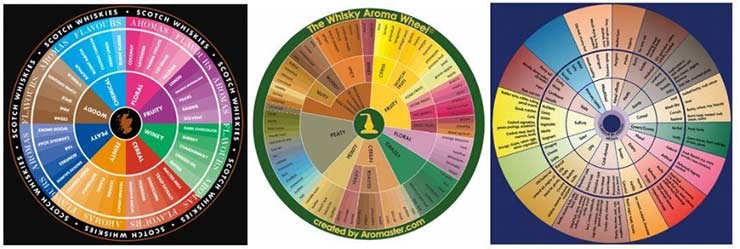
Some beginners pick out a few dominant flavors and immediately get a feeling of accomplishment for a job well done, and completely ignore other subtleties. When that happens, it is just a feel-good game that delivers a small, immediate, fleeting satisfaction disguised as an accomplishment, and will never meet the objective of completely defining the profile of the spirit.
When writing evaluation notes, never rate a spirit unless you can enumerate the reasons it did ***not*** achieve the perfection. The con (against) part of the evaluation experience is as important as the pro (good). Something is not quite right when evaluation notes do not include both sides. In that instance, it could be an indication that the evaluation was bought or planted. In summary; **ATTRIBUTES – DETRIMENTS = RATING**.
## **The Professional Sensory Science Approach to Vocabulary and Descriptive Words:**
Before each evaluation by spirit, the tasting panels convened to establish a usable lexicon vocabulary upon which all could agree. Development of the lexicon was a single day of training, and all sensory attributes were measured on a 150-point scale from “none” to “strong.” This scale was picked vs another arbitrary number, say 100, because a single degree of difference in the higher number of 150 represented a larger measurable and notable difference for the panel.
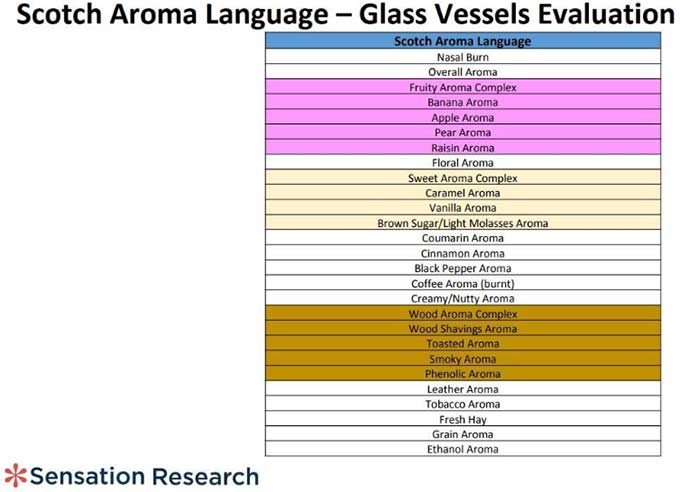Establishing the lexicon is common practice in professional sensory studies, and enhances repeatability and statistical confidence levels in significantly detectable aromas. Focusing on the major aromas present in the spirit and discarding outlier aromas (detected by only one of the 20 panelists), focuses the study on the major differences. A sample vocabulary for the specific scotch used in the evaluation is shown below to illustrate the balance between simplicity and complexity (logical groups and their constituents). Lexicons of the other spirits, tequila, and cognac, are included in the original study.
## Building an Accurate, Descriptive Lexicon and Vocabulary
Note the differences and similarities between words on the scotch flavor wheels and the professional study. Familiarity with standard terminology is extremely important to aroma and flavor identification. Particularly important are the nuances characteristic of each type of spirit. There is no single source of information on the subject, and one must self-educate by reading and comparing to achieve a high degree of competency in evaluation. A good evaluator knows what typical aromas and flavors represent a spirit category (bourbon, gin, rum), or type (single barrel, small batch, blend).
What if the burnt coffee aroma above created a discussion, “It smells like burnt Maxwell House,” and the dissension is “No, it smells like burnt freshly brewed Starbuck’s Italian Roast #22.” Irresolvable, because not more than one person could have enough data or recollection of burned coffee experiences to differentiate the origin. Lexicons substantiate detectable aromas to build confidence in the measurement of their intensity.
## Agreement in the Vocabulary: It’s not a “one-man” Job
Since it is nearly impossible for a single evaluator to establish a complete vocabulary on his/her own for each spirit, it is useful to see the simplicity of aromas and flavors at the professional level and to know that to qualify for the vocabulary list, there must be an agreement of multiple individual evaluators. For the level of usefulness necessary to make informed personal buying decisions, understanding the complexity of aromas and flavors and working towards identifying as many of them as possible is crucial information, is significance readily apparent when finally arriving at the final purchasing decision question, “Do I like it enough to pay the price?”
## Interactive Participation
There are no shortcuts to developing excellence at evaluation, and knowing what you and others are talking about is the key to depth, understanding, and truth in the evaluation process. If you are serious, don’t be the bystander in the group tasting whose first word is “smooth.” Learn to describe by actively participating in discussions. Notice the vocabulary used by other members of the group
Actively participate in discussions and debates about evaluating whatever whiskey is being presented. If you don’t join these conversations with strangers and friends, you will never know how others value your opinions, and you will not develop your own valuable judgments. Search for informative reference materials to jump-start an evaluation education.
## Develop Your Descriptors
Whether you are interested in one spirit or many, learn the categories of your spirit(s) well, and create your list of characteristic taste and aroma descriptors. Write them down, and develop your tasting sheet and rating system. Once you have a format, use it in conjunction with the same procedure for every evaluation. Put your descriptors on your evaluation sheet. You will enhance your knowledge, buy better, and show others how to appreciate.
## The Definition of Evaluation
Evaluation is a craft, a mindset, and a science. Diagnostics must have an objective to provide honest information in a universal language with commonly understood meanings. Evaluation is a craft and a skill. It is all about the Zen of building the mental library, perfecting detectability, and focusing experiential memory. It is knowing what went into the creation of the expression, personal awareness of self, and openness with others. Evaluation improves with practice. Evaluation is supported by a solid base of science. Physics, chemistry, biology, and psychology are necessary fields. The subjective ingredient is the evaluator, YOU, and the subjective must become objective. Be better or be the best.
For reference, a more complete compendium may be found in [Distilled Spirits Sensory Science](https://sensoriumllc.com/ "Distilled Spirits Sensory Science").

The NEAT Glass (CSO) Corporate Strategy Officer, inventor and entrepreneur, (CRD) Chief Research and Development Arsilica, Inc.
[See Full Bio](https://theneatglass.com/author/georgearsilica-com/)
[Facebook](https://www.facebook.com/theneatglass/) [Instagram](https://www.instagram.com/theneatglass/) [TikTok](https://www.tiktok.com/@theneatglass.com) [Pinterest](https://www.pinterest.com/TheNEATglass/) [YouTube](https://www.youtube.com/@TheNEATGlassChannel) [LinkedIn](https://www.linkedin.com/in/theneatglass) [Tumblr](https://www.tumblr.com/the-neat-glass)
**Categories:** Academy
---
### [New Sensory Glass Results in a Better Spirit Test Outcome](https://theneatglass.com/sensory-glass-test-outcome/)
**Published:** April 29, 2022
**Author:** The NEAT Glass
**Content:**
## New Sensory Glass Results in a Better Spirit Test Outcome
NEAT is the new sensory designed glass for sensory spirit test evaluation. Using a glass specifically designed for laboratory testing yields better spirit test outcome. By outcome, we mean that the aromas are much easier to detect and identify. The distiller’s efforts to create complex flavor profiles become readily apparent. The design diffuses nose-numbing ethanol to unmask aromas and nuances.
## Sensory Test Engineering and Design
In other presentations, we discussed science and engineering in great depth. We believe any serious evaluator must understand where aromas can be found in each type of glass. Additionally, effective evaluators must be aware of the overwhelming numbing effects of ethanol, and the risks associated with each type of glass design. Since ethanol anesthesia gives no warning, evaluators can be tricked by experiential memory evaluation into “finding” aromas that are not present in the sample. These findings are the result of our research since 2002. The sensory glass eliminates ethanol nose-blindness.
## Independent Research
In September 2019, Sensation Research in Mason, Ohio conducted a sensory evaluation. The study tested different glasses for aroma intensity and ethanol presence. Here, a few charts compare glasses with scotch as the control beverage, despite the lengthy report. This testing verifies the problems of common glasses and the advantages of the new concept discussed in the previous presentation. The results are similar for Tequila and Cognac. Please note that the sensory-engineered glass is the NEAT glass, a different concept.
The [complete](https://sensationresearch.com/wp-content/uploads/2020/01/Glass-Vessel-Aroma-DA-Study-Sept-2019.pdf "complete") study. We highly recommend you view it to understand how professional sensory evaluation test companies use statistics and scientific methodology. This helps take the guesswork out of evaluation and provides consistent results. Also, see the similarities in results regardless of the control beverage used. Note that the comparison test uses three different control spirits.
## Sensory Glass Independent Study Outcome

## Covering Test Samples
Note the comment about the Sensory Engineered Glass (NEAT glass) dissipating aromas quickly. Additionally, we recommend covering the NEAT glass, as discussed in an earlier presentation. Subsequent testing by Arsilica, Inc. found that after three or more sniffs of 40% ABV control spirits, the evaluator could not identify the spirit in the tulip. In many cases, the evaluator could not identify the spirit in the tulip and snifter. Yet the evaluator still detected distinct character aromas in the Sensory Engineered Glass among eight panelists.
This is where the NEAT sensory glass excels. Other shapes yield more ethanol than character aromas. Again, ethanol plays a significant role in hindering aroma detection. This particular study was later released in 2020 as part of a new peer-reviewed science journal paper to determine when recognizable ethanol anesthesia occurs. Below you will find the glassware used in the Sensation Research independent evaluation.
## Test Vessels Compared with Sensory Glass

## Results of Sensory Test Comparison with Scotch as the Spirit
The following chart shows the intensity of various aromas detected from the control scotch beverage; the yellow boxes indicate the highest in attributes, and the light blue indicates the lowest. Nasal burn and ethanol aroma are by far the lowest in the engineered sensory glass, and the summary indicates that character aromas are higher in the engineered glass. From prior results, the snifter reveals more heavy aromas and volatile ethanol due to the cloud effect, and the weather in the glass increases their intensity more than in the narrow tulip bowl. The tulip fails dismally at displaying subtle character aromas
When the results are displayed in a bar graph, the aromas of each glass are compared side-by-side, and the character aroma attributes of the engineered glass become readily apparent.

## Conclusions from Sensory Glass Independent Test
Hopefully, we have exploded a few myths regarding glassware superiority and demonstrated that approaching glass design by applying common sense and science results in a far superior diagnostic tool and will greatly improve evaluation test outcome. [Read our peer-reviewed research paper.](https://www.mdpi.com/2306-5710/4/4/93 "Read our peer-reviewed research paper.")
Drink from whatever glass you wish, but understand exactly why you prefer it, and be aware of the effects of ethanol on your nose. If you are purchasing expensive, high-end collector spirits, it is wise to understand as much about the spirit as possible. For that, you need a functional and efficient diagnostic glass. We recommend the NEAT sensory glass. [See the complete study using different spirits.](https://sensationresearch.com/wp-content/uploads/2020/01/Glass-Vessel-Aroma-DA-Study-Sept-2019.pdf "See the complete study using different spirits.") Shop for the[ best glass to suit your needs now](https://theneatglass.com/shop/ " best glass to suit your needs now").

The NEAT Glass (CSO) Corporate Strategy Officer, inventor and entrepreneur, (CRD) Chief Research and Development Arsilica, Inc.
[See Full Bio](https://theneatglass.com/author/georgearsilica-com/)
[Facebook](https://www.facebook.com/theneatglass/) [Instagram](https://www.instagram.com/theneatglass/) [TikTok](https://www.tiktok.com/@theneatglass.com) [Pinterest](https://www.pinterest.com/TheNEATglass/) [YouTube](https://www.youtube.com/@TheNEATGlassChannel) [LinkedIn](https://www.linkedin.com/in/theneatglass) [Tumblr](https://www.tumblr.com/the-neat-glass)
**Categories:** Academy
---
### [Choosing the Best Glass - History & Myths of Popular Glassware](https://theneatglass.com/choosing-best-glass/)
**Published:** April 29, 2022
**Author:** The NEAT Glass
**Content:**
## Choosing the Best Glass – History & Myths of Popular Glassware
Choosing the Best Glass: How did the three most common glasses ever become popular? The story illustrates what happens when craft meets science. Industries unfamiliar with scientific methods struggle. They are not ready for a major, yet necessary, change.
Within the spirits industry, known olfactory science has never been a major consideration, and changes in preferred glassware and nosing techniques have been driven by internal motives and established tradition. Discussion on the evolution of nosing evaluation is necessary to understand why so many have relied so long on spirit glass shapes that are functionally inadequate to provide honest evaluation.
## Silently Conditioning the Public not to Smell the Roses
There exists an attitudinal aspect to enhancing sensual enjoyment. Too often, we have other things to do and forsake the development of the senses to gain a little more time to watch sports, surf the internet, comment on social media, or play video games. We train ourselves to take the path of least resistance which often means less work, and often settle for mass-produced products (coffee pods, frozen dinners, or drive-through burgers) rather than seek self-discovery of the aromas, flavors, herbs, and spices that truly deliver personal olfactory and taste satisfaction and enjoyment.
Much like education, the true development of the senses is dependent on personal effort and not simply the thoughtless acceptance of what someone else relates. Finding the right sources and reading is key to education, and choosing the right glass (diagnostic tool) is important to developing a keener sense of smell and enjoyment of spirits. For decades choosing glassware has fallen into thoughtless acceptance, few ever perform side-by-side comparisons, and many believe that the glass is simply a vessel to transfer a beverage from container to mouth or an iconic fraternal membership badge that identifies them with the spirits they prefer to drink.
## It is not all About the Ethanol
Those who do compare, generally miss the point and get caught up in styling and identification (gender, purpose) rather than function. The serious approach to spirits evaluation is about delivering true aroma and flavor from the spirit to the nose and tongue to evaluate. Association of a particular shape to a particular spirit, gender identification (that is a ladies’ glass, I need a man’s glass), or preference based on style or traditional acceptance are all diversions that avoid and obscure true function. When the function is secondary, evaluation and enjoyment both suffer. Choosing the best spirits glass enhances drinking enjoyment as well as the diagnostics of flavor.
Two erroneous assumptions have been around for centuries that govern glassware design, driving glass manufacturers to rely on selling visual style rather than solving the problem of nose-numbing ethanol.
1. **Erroneous Assumption:** Small rim areas collect all the aromas at the nose, preventing any from escaping detection. *Rebuttal: True, but small rims also concentrate and trap nose-numbing ethanol which dominates olfactory receptors and destroys smell-ability.*
2. The aroma molecules mix together in the aroma cloud, and we cannot separate them. So, implementing procedural devices is the only way to combat the effects of nose-numbing ethanol. *Rebuttal: Aromas dissipate at different speeds controlled by their molecular structure (and weight). Careful vessel design can enhance separation. These procedural devices only work for the glass design for which they were implemented.*
## The Snifter: Promoter of Ethanol, not the Best Glass
The worst performer of the three common spirits glass, the Snifter, often called a balloon, was once the fashionable glass of 20th-century spirits drinkers in Europe and Russia. To our knowledge, no one lays claim to the invention of the snifter, yet there are some instances of use as early as the mid-1800s.
We credit Ravenscroft for the technology. Leaded crystal expanded shape possibilities by increasing work time and pliability of glass. This enabled the first manufacture of large and thin bowls that characterize the snifter.
Observers can easily identify Cognac and brandy drinkers by the glass’s unusually large bowl, short stem, and small opening that traps aromas. Many are designed to hold an ounce and a half or so when laid on their side on a level surface; a prophetic position relating to the highly concentrated ethanol captured and delivered to the drinker by the snifter.
## How the Snifter Works
Designed for best swirling and high evaporation. A small opening traps the aromas. These nose bombs were created to get high quickly on ethanol, and nothing more. As previously discussed, the snifter concentrates ethanol and obscures character aromas with overpowering nose-numbing ethanol. Palm warming will release more aromas to the nose that would not normally be evident at room temperature. Some drinkers heat the snifter with a candle to scent more aromas. This sends vaporized ethanol to the nose and can burn the lower lip at the rim if heated too much. A few of the devices used to heat a brandy snifter:
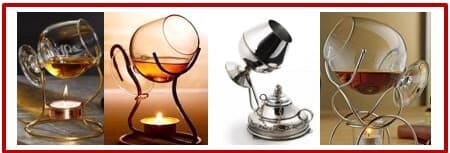
Sniffing concentrated ethanol brings it into the pulmonary alveoli sacs. It is quickly picked up by tiny blood capillaries and carried to the brain for a much quicker high. This is faster than absorption through the intestinal tract. The respiratory path is the channel of choice for drug “snorters” and spray paint “huffers.” It works quickly.
## Sage Advice on Snifters
Those who are interested in aromas and comparing spirits should stay away from snifters completely. Snifters are the “bong” of spirits, and Cognac, Armagnac, and brandy distillers know better. Snifters deliver a rank disservice to any and every spirit. They favor nose-numbing ethanol and quick intoxication over savoring character aromas and flavors.
## The Tumbler: Also not the Best Glass
To prevent spills, the earliest tumblers had round bottoms that righted the glass when knocked over. The design also kept the drink from being left unfinished when set down. The name dates back to the mid-1600s. Earlier forms of the tumbler, with vertical sides and a thick flat bottom, predate the 1st century BC. Tumblers became the spirit glass of choice in early America because they were readily available. Whiskey lovers saw them grow popular as the preferred whiskey glass when Kentucky distillers commonly recommended them in the mid-1900s. They were large enough to hold ice cubes and branch water to ease nose-numbing and palate burn.
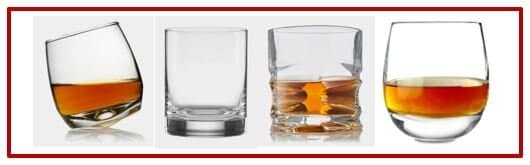
Researchers note that tumblers provide ethanol with a generous escape path. They also avoid the ethanol concentration found in tulip and snifter styles. Of the three common glassware styles, tumblers are by far the preferred spirits evaluation and nosing glasses
## The Tulip or Chimney Nose Cannon is Definitely not the Best Glass
The copita shape is the original design of the widely used tulip glass derivatives and was introduced as a sherry glass by traders importing Spanish sherry to Great Britain. By borrowing the ‘dock’ glass’s shape and size, copita guided transfer acceptance of quality product at the loading dock. It offered the right sherry portion as an after-dinner drink. Sherry’s popularity among England’s landed gentry boosted interest in the glass in England and Scotland. It gained broader appeal among the general populace and became a major rebottled and branded export meeting world demand. [How NEAT works](https://theneatglass.com/how-it-works/ "How NEAT works").
Somewhat connected by the re-purposing of a huge inventory of imported, empty sherry barrels to age scotch, the copita seemed a logical choice for a spirits glass. Small, easy to hold, and suitable for the under-exaggerated “wee” dram, of around an ounce and a half (45ml), acceptance by whisky blenders was the key factor to entrenching the copita as the iconic glass of choice for scotch whisky.
## Glass Makers’ Fear of Design Rejection Hinders Discovery of the Best Glass
The glass evolved into many different styles yet kept many similar key dimensions. Several shapes of the tulip/copita/chimney are shown (note that their rim height, volume capacity, tiny bowl diameters, tall rim heights, and mostly convergent sidewalls are similar and typical of most styles of common spirits glasses). Manufacturers concentrate on evolved style, not function.
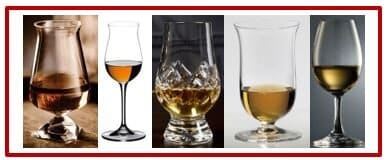
## What the Whisky Blender Should Consider
In whisky drinker logic, one should do what the experts do, and in this case, the experts are the blenders, those closest to the aromas and flavors of the whisky, and responsible for the final profile and product.
There is one small hitch to adopting this logic. Blenders have for decades understood their glass-shape choice. That choice concentrates ethanol and impairs blending due to ethanol anesthesia. So, they dilute to 20% ethanol with water; one ounce of water per ounce of 40% ABV spirit. Rather than changing the glass’s shape, this “fixed” the immediate ethanol problem. Changing to another shape would have absolutely addressed the issue. The original ethanol-concentrating design was the obvious detriment to olfactory sensitivity. Blenders bought another problem by going for the most obvious solution. Excess water dilution creates another diagnostic problem. Blenders still ignore it. A later presentation will discuss the effects of water added to spirits.
Who drinks spirits at 50% dilution (40% ABV down to 20% ABV)? Answer: no one but blenders, and then, only while they blend. In other words, the public, in their search for enjoyment and correctness, has hit a snag. They prefer the whisky industry’s established spirits drinkers’ icon and identification badge, the tulip glass. Using the blenders’ glass in the blenders’ way undermines the tool’s purpose. This approach prevents it from serving as a reliable diagnostic tool. This approach reduces clarity in evaluation. Check the [independent research study](https://sensationresearch.com/wp-content/uploads/2020/01/Glass-Vessel-Aroma-DA-Study-Sept-2019.pdf "independent research study") of glass styles.
## Coming to America
During the ’60s, the great Scotch invasion of America teetered on collapse until stakeholders found a solution. They realized the American palate was unaccustomed to straight whisky, a practice long established in Europe. Prohibition produced poor distillations by hobbyists who ignored head and tail cuts. They used fruit juice, herbs, soda, and flavorings to mask off aromas and flavors in the product. These mixtures originated from garage and basement distillations. As a result, the cocktail was born. After repeal, Americans continued to prefer mixed drinks over straight spirit consumption. Meanwhile, Europeans continued their long, uninterrupted tradition of enjoying straight, no ice, and unmixed spirits.
## The Band-aid “Fix” Ignores the Cause of the Problem
To overcome the American reluctance to drink whisky straight, purveyors designed a formal drinking procedure. This aimed to draw well-to-do Americans into an attractive, elite club of successful businessmen with a rich international membership. A fraternal badge, the iconic copita glass, and later the Glencairn became the member recognition signal. These procedures made the glass more acceptable to many. They assumed the tulip glass was the only option, ignoring other alternatives. These procedures have become the ritualistic ceremony for drinking scotch whisky. They are easily recognizable traits of accomplished scotch drinkers, yet many are not effective (*see italics*):
## The “Fix:” Non-functional Procedures Treat Only the Symptom
- Breathe through mouth and nose simultaneously to avoid inhaling nose-numbing ethanol. *Alleviates initial olfactory pain but delivers smaller air-diluted samples, affecting aroma detection. Ethanol concentration remains high, occupying more olfactory receptors with each consecutive sniff.*
- Do not swirl. *Swirling is the “engine” that propels evaporation. No swirling yields much less evaporation and fewer aromas to evaluate.* A prior presentation outlines swirling.
- Waft. Place the vessel 15–20 cm from the nose, slightly below the nostril level, and wave aromas over the top of the glass toward the nose to avoid pain and numbing. Wafting acclimates the olfactory receptors to prevent the *initial pungency of concentrated ethanol, ethanol lockout continues during sniffing, as ethanol concentration does not change.*
- “Shake hands”. Position the glass about one foot away from the nose while sniffing, subsequently repositioning successively closer while sniffing, until the rim is directly under the *nostrils. Gradual acclimation avoids initial nose burn but does not avoid lockout when sampling from small-rim diameter vessels. Ethanol vapor concentration remains at the same high levels during sampling.*
- Add water to open up the aroma. *Water raises liquid surface tension shutting down evaporation of all aromas, including those important to identification and evaluation. “Opening up” is the perception of relief occurring due to less pungent ethanol on the olfactory receptors.*
## Other Industry Representatives Follow the Blenders’ Mistake
Distillers, spirits educators, and spirits ambassadors missed another opportunity, in hopes that concentrating on the retro-nasal experience as the primary diagnostic could ethanol effects. Instead, they champion the useless procedural devices/methods designed to reinforce ritual and validate the iconic, traditional glass that exacerbates nose-numbing and works against evaluation truth. This showcases the spirits industry’s perceived importance of maintaining the icon at any cost.
## Conclusion: Use the Best Glass
If blenders dilute by 50% because they chose to maintain their inefficient diagnostic tool, and the educators continue to teach the procedural devices developed to make the tulip glass acceptable, when and where does science step in and replace nonsense with fact? Nosing and evaluation credibility and lower spirits quality levels acceptable to the general consumer will continue as long as industry brand ambassadors and representatives continue to endorse tulip/copita as the aroma detection tool, punctuated with the powers of suggestion while hiding the true flavor profile. The consumer will remain sufficiently fooled as they were with the tongue map, hopefully, short term. [NEAT Science](https://www.mdpi.com/2306-5710/4/4/93).
## Summary
Sooner or later tradition gives way to science and function which can benefit a large number of people and improve quality if correctly applied. Stay on the leading edge, read, learn, and educate to get closer to the truth as it continues to evolve through discovery and application.
Choosing the best glass should be based on science and function, not legacy and fraternity. Referring back to our original “Bridge of Asses” as applied to spirits evaluation, perhaps the bridge is personified by glassware choice. We think so and have spent the last 18 years defining, designing, and marketing an alternative solution to the three commonly accepted glassware types for spirits drinkers. See the glass comparison by [Sensation Research](https://sensationresearch.com/wp-content/uploads/2020/01/Glass-Vessel-Aroma-DA-Study-Sept-2019.pdf) to make your choice of preferred glass style for spirits evaluation.

The NEAT Glass (CSO) Corporate Strategy Officer, inventor and entrepreneur, (CRD) Chief Research and Development Arsilica, Inc.
[See Full Bio](https://theneatglass.com/author/georgearsilica-com/)
[Facebook](https://www.facebook.com/theneatglass/) [Instagram](https://www.instagram.com/theneatglass/) [TikTok](https://www.tiktok.com/@theneatglass.com) [Pinterest](https://www.pinterest.com/TheNEATglass/) [YouTube](https://www.youtube.com/@TheNEATGlassChannel) [LinkedIn](https://www.linkedin.com/in/theneatglass) [Tumblr](https://www.tumblr.com/the-neat-glass)
**Categories:** Academy
---
### [New Concept: Diffusing Ethanol to Improve Test Results](https://theneatglass.com/new-concept-diffusing-ethanol-improve-test-results/)
**Published:** April 29, 2022
**Author:** The NEAT Glass
**Content:**
## New Concept: Diffusing Ethanol to Improve Test Results
Engineers at Arsilica Inc. have discovered how diffusing ethanol releases more intense aromas and flavors from any spirit. Furthermore, this discovery will change spirit evaluations and test results drastically. As a result. evaluations will be more accurate, repeatable, and complete. Those subtle aromas previously hidden by nose-numbing ethanol will now appear.
## State of the Art of Spirits Evaluation
Within the spirits industry, particularly in scotch whisky, game-changing personalities emerged. They made major contributions to the tasting and evaluation of spirits. Michael Jackson and Jim Murray may be the most definitive early pioneers in scotch. Moreover, Richard Paterson leads in scotch whisky education. Much of the present state of evaluation for all spirits comes from their publications and seminars.
These pioneers had no exposure to sensory science. It later evolved into an established discipline used by many companies to validate their spirits products. Their intuition and judgment have guided the spirits industry for decades. The industry owes them for their profound influence on public taste preferences.
Their spirit vessel of choice was the copita. The copita was borrowed from Spanish sherry, a fortified wine, in the late 1700s. Later came the Glencairn, an admitted derivative of the copita. It is now considered a standard tool among spirits drinkers. However, this view rests on its iconic identification badge for spirit enthusiasts. None of them would appreciate the concept of diffusing ethanol.
## New Concepts to Improve Test Results
Our presentations cover how common spirits glass designs function. They will likely provoke those entrenched in the tulip and snifter camps. Additionally, the goal is to inform, not inflame. Diffusing ethanol is not a new issue among evaluators. Pointing to glassware as the major source is bold and unprecedented. It will upset those who resist change, doubt science, or prefer their current glass. Eighteen years of research confirm glassware design contributes to ethanol anesthesia (nose-blindness). We can engineer glass shapes into a solution.
A discovery in 2002 changed the dynamics of glass design for spirits evaluation. Applying engineering and physics to modify glass design eliminates ethanol nose burn and anesthesia. Adding a neck to the glass forces the molecules to converge rapidly. This is the same occurrence for all tulips, copitas, and snifters with convergent sides and small rim plane areas. The congestion of molecular collisions at a copita rim is about the same as at the neck of the engineered glass. However, what happens after the molecules diffuse out of the neck concentration is the game changer.
Designing a controlled expansion space above the neck regulates containment. As aromas diffuse through the neck, they align by molecular weight and dispersion velocity. They also reflect molecular complexity, such as long-chain esters. In addition, a large flared, straight rim horizontally constrains the expansion space.
## Diffusing Ethanol is Key to Aroma Detection
Arsilica, Inc perfected this discovery over 10 years of research. The result was the NEAT glass release in 2012. Introducing a controlled, gradual expansion into the diffusion space manipulates aroma diffusion. Correspondingly, this provides a distinct advantage for spirits evaluators by reducing nose-numbing ethanol exposure. In fact, diffusing ethanol molecules moves them away from the aroma detection area.
Since 2013, over 30 major competitions use NEAT as their official judging glass. There has not been any ethanol anesthesia, olfactory fatigue, or nose-blindness during fast-paced competition judging. As of mid-2020, over 120,000 spirits have been judged in official spirits competitions, and over 30,000 quality medals have been awarded to spirits judged and evaluated in the NEAT glass. NEAT has proven to be a viable alternative to the three common glass shapes by detecting and identifying more aromas, significantly reducing ethanol concentration, and placing the nose in a position to begin orderly aroma detection.
## How Diffusing Ethanol Improves Aroma
Small rim areas concentrate ethanol, especially if those areas are smaller than the area of the liquid surface in the bowl. Evaporating aromas are forced upward by the constant evaporation of more molecules, and the lighter aromas move the quickest, crowding the tiny rim area and filling any available space to escape the glass through the narrow opening.

## Two Glass Shapes Come Together
**By taking the most useful portion of each design** (convergent sides and divergent sides), we created a new shape with a large bowl for swirling and a neck to concentrate the abundant aromas released through swirling. The neck concentrates and stimulates molecular collisions which increases molecular velocities. Instead of dissipating molecules into the atmosphere randomly (as with tulip, copita, and snifter shapes), we add a large divergent rim, similar to a cocktail glass to control dispersions as the molecules continue their upward direction.
In the space between the neck and the top rim, the controlled expansion provides a path for lighter ethanol to quickly make its way to the rim edge, and the heavier character aromas dissipate slower, to be detected by the nose without the presence of nose-numbing ethanol. A key design relationship is the neck cross-sectional area, to the upper rim edge cross-sectional area, as this ratio, as well as the rim plane height above the neck, controls the exact dissipation of available aromas.

## Short and Fat is Better than Tall and Skinny
In a previous presentation, we determined that shorter glasses pick up more aromas. Using a typical evaporation curve of a heavier aroma, we can see that shorter heights can increase the opportunity to detect character aromas. In this instance, the area of highest concentration is at the rim of the tulip glass, and the neck of the NEAT glass. The reduction in height allows more aromas to reach the neck for further dissipation to the rim plane.

**A major complaint of tulip glasses** is the restricted, small area rim which prevents the nose from entering the aroma cloud. Designing the rim plane large enough to allow the nostrils to access the center of the expanded aroma cloud maximizes the opportunity to pick up more aromas. By designing the glass to fit the average nose, we find that placing the lips on the glass rim positions the nose automatically in the center of the rim plane. Short and fat improve test results over tall and skinny.

## Who Gets the Most Aromas and Improves Evaluation Test Results?
When all of these issues are dealt with, the result is a short glass to pick up more aromas, a fat and wide bowl to enhance swirling, a large area to accommodate the nose, and ethanol is separated from the character aromas and dispersed from detection while analyzing character aromas.

A little engineering, common sense, and focused attention to the laws of physics can go a long way toward enhancing personal satisfaction and improving spirits buying and collecting. Do we think this is the ultimate in glassware design? For now, it is by far the superior tasting, nosing, and evaluation glass, but we never underestimate the power of science-based discovery as we continue to encourage new ideas and search for better ways to improve the evaluation and enjoyment of all spirits.
## Accepting New Concepts
For decades after the introduction of refrigerators, automobiles, and the cooking range, doubters and those who cling to tradition chose to be loyal to the iceman, horses, and woodstoves. Getting used to new ideas is hard for some, and no doubt the NEAT glass is experiencing the same resistance from those unwilling to quickly embrace change. It is all part of the process of evolution as science and discovery replace the myths and all contrived devices of the past which left room for improvement.
## Why Diffusing Ethanol may not be Very Popular
The spirits consumer-drinker loves his ethanol. He paid for it. The pungent smell of ethanol tells him it is there. That conditioned acceptance of ethanol automatically places the spirit aromas and flavors in a distant second place in his mind. He may never discover what is hiding in his drink and that bottle he paid dearly for.
## Summary
Diffusing ethanol away from the nose exposes all aromas, both good and bad, and puts the evaluator in the driver’s seat by prioritizing aromas and personal quality assessment over-reliance on suggestive advertising. Nothing can hide from approval or disapproval, placing the evaluator in control to [discover and choose personal flavor nuances using an engineered glass as a decision-making tool.](https://theneatglass.com/shop/ "discover and choose personal flavor nuances using an engineered glass as a decision-making tool.") See how **[independent research shows the NEAT glass is superior to all others.](https://sensationresearch.com/wp-content/uploads/2020/01/Glass-Vessel-Aroma-DA-Study-Sept-2019.pdf "independent research shows the NEAT glass is superior to all others.")**

The NEAT Glass (CSO) Corporate Strategy Officer, inventor and entrepreneur, (CRD) Chief Research and Development Arsilica, Inc.
[See Full Bio](https://theneatglass.com/author/georgearsilica-com/)
[Facebook](https://www.facebook.com/theneatglass/) [Instagram](https://www.instagram.com/theneatglass/) [TikTok](https://www.tiktok.com/@theneatglass.com) [Pinterest](https://www.pinterest.com/TheNEATglass/) [YouTube](https://www.youtube.com/@TheNEATGlassChannel) [LinkedIn](https://www.linkedin.com/in/theneatglass) [Tumblr](https://www.tumblr.com/the-neat-glass)
**Categories:** Academy
---
### [Swirling Your Spirit Exposes its Quality](https://theneatglass.com/swirling-myths/)
**Published:** April 27, 2022
**Author:** The NEAT Glass
**Content:**
## Swirling Your Spirit Exposes its Quality
Myth: Swirling is an essential part of the spirits nosing and evaluating process. However, tulip nose-cannon glass users will tell you not to swirl because it releases the ethanol alcohol. For decades, that bit of advice has kept millions of spirits drinkers in the dark about what is really hiding in their glass. If you can’t get the aromas out of the glass, you will never know the quality. As a matter of fact, the uneducated whiskey drinker believes the strong pungency of ethanol *is* the quality. Most drinkers have no idea that swirling also releases *all* aromas. To put it differently, quality is not all good: There is good quality and poor quality.
## No Swirling = No Evaporation = No Smell.
Swirling enhances evaporation by releasing more aromas to the vapor cloud for detection. Practice vigorous swirling to create more evaporation consequently more aromas. Swirling is one more reason why tulip glasses don’t work well when it comes to delivering character aromas and flavors. Notably, they are simply too narrow to swirl well.
## **Swirling Science**
Two scientific principles describe the effect of swirling. The first is boundary layer. Boundary layers form where a liquid meets the atmosphere. Within this very thin region, evaporating molecules accumulate above the surface and create concentration, temperature, and velocity gradients. Diffusion moves vapor through the layer, while air currents and convection carry it into the surrounding atmosphere. Temperature, airflow, surface area, and molecular volatility determine how quickly this exchange occurs.
## Boundary Layer Science
Swirling disrupts the spirit’s boundary layer and spreads a thin liquid film across the glass, greatly increasing the exposed surface area. The motion continuously replaces the saturated air above the liquid with less-saturated air, accelerating the evaporation of ethanol, water, and volatile aroma compounds. Consequently, when swirling stops, vapor accumulates again above the surface and the boundary layer gradually reforms.
## Surface Tension Science
To put the issue in perspective, every liquid has an invisible force at its interface with the atmosphere (air) called surface tension. Additionally, did you ever wonder why a water bug can walk on the surface of the water without falling in? Surface tension keeps the water bug on the water surface. It also keeps aroma molecules in the liquid of a spirit or wine. Accordingly, swirling breaks the surface tension, allows aromas to escape and enhances evaporation. Large drinking glass bowl diameters increase the wetted sidewall area, improve swirling velocity, and release more aromas. Swirling height = more wetted sidewall area = more evaporation. For this reason, we debunk the “don’t swirl spirits” myth.
## Geometry of the Swirl

## **Swirling enhances evaporation in several ways:**
Swirling generates kinetic energy. It increases molecular collisions and molecular velocities. Molecules break the surface tension and escape into the air (evaporating), where the nose can detect them.
- After swirling, the downward flow on the vessel sidewall forms ‘legs’ or tears. These legs are caused by a surface tension gradient between water and ethanol, disrupting surface tension and promoting evaporation. They tend to separate, a phenomenon known as the Gibbs-Marangoni effect.
- Gravity creates vertical shear on vertical vessel sides, disrupting surface tension and improving evaporation as liquid returns to the liquid pool in the glass.
- Thin wetted layers on vessel walls offer a quick path for rebounding molecules. That path helps break surface tension and boosts evaporation. Conversely, a large liquid pool dampens motion and rarely rebounds to test surface tension.
## How Effective Swirling Depends on Glass Shape
Evaporation from thin liquid layers on vessel sidewalls is greater than at the horizontal pooled liquid/air interface. Larger bowl-diameter glasses permit higher swirl velocities. Higher swirl velocities increase the liquid/air interface pressure differential (similar to why water evaporates from a swimming pool much faster on windy days), evaporation layer thickness, and horizontal liquid shear break the surface tension. Larger bowls improve aromas when swirling because of the larger wetted side areas and the higher swirling velocities attainable in larger-diameter bowls. No more myth.
## **The Swirling Myth Spreads to All Alcohol Beverages:**
- **The Myth – Swirling is only for wine:** All spirits, wine, and beer benefit from swirling. Its benefits extend beyond wine, as experienced beer and spirits tasters swirl to encourage aroma evaporation, especially at low fill levels. Winers encouraged spirits drinkers to swirl. The industry imitates wine drinkers through tacit awareness and unconscious adoption.
- **Another Myth – Don’t Swirl Beer:** The standard beer pour is close to the rim top, making it hard to swirl. However, the full pour also means there is no headspace. Beer’s effervescence, caused by CO2 or N2, provides sufficient aroma as the bubbles pop. Swirling is not necessary when the glass is full. A glass less full, will release more aromas with slight swirling. Rotating a tilted glass to wet the inside wall also aids in aroma release. When partially consumed more headspace provides swirling or rotating room. Many beer drinkers think wine drinkers are snobs. They reject portrayals of wine drinking, including stems and swirling. Experienced beer drinkers swirl slowly or rotate their glass at lower beer levels in spite of the decrease in effervescence.
- **The Most Absurd Myth – Don’t swirl spirits:** For decades, the accepted glassware for scotch has been the hard-to-swirl tulip shape. During the scotch resurgence in the ‘60s and ‘70s, ambassadors and educators observed Americans’ intolerance to strong ethanol aromas. This awareness guided their aroma education and tasting guidance. Prohibition (1920-1933) conditioned Americans to adjust their drinks. They mixed soda, fruit juice, and ice with spirits to mask odors. American whiskey drinkers preferred the readily available wide-mouth tumbler, adding water and ice to hide nose-burning ethanol in straight spirits. Scotch ambassadors and educators introduced the tiny-rim tulip-shaped copita, recommended adding only a few drops of water, wafting aromas toward the nose to pre-condition, and warning drinkers not to swirl, all of which will diminish nose burn. Scotch sales skyrocketed. Swirling in large bowl-diameter glassware enhances aromas (see exhibit).
- **The Inconsequential Myth – Swirl clockwise in the northern hemisphere, counter-clockwise in the southern:** Unnecessary overthinking. Swirling delivers aromas regardless of direction. It’s all about swirling velocities fast enough to break surface tension. Vigorous swirling is better. Right-handed drinkers tend to swirl counterclockwise, and left-handed drinkers tend to swirl clockwise. Do what works best wherever you may be. The Coriolis effect has nothing to do with the effectiveness of swirling. Myth is created by those who have nothing else to do.
## **Clues to Improving Swirling through Simple Science:**
Covering the glass while swirling preserves aromas inside. The technique is cumbersome. Covering will fill the headspace with a higher concentration of aroma molecules until they reach the maximum evaporation possible. This state is called equilibrium. The same number of aroma molecules evaporate as are returned to the liquid, and the vapor cloud in the headspace is fully saturated with aromas. Equilibrium is as good as it gets for displaying aromas, as significantly more aromas are available to smell. Covering during swirling keeps aromas in the glass, ready for detection when uncovered just under the nose. Remove and sniff quickly to get maximum effect.
## **The Big Cover-up:**
In the past, many critics have disdained the use of small glass covers during tastings of expensive spirits as snobbish. Covers provide two advantages: (1) prevent aromas of many different spirits from polluting the atmosphere and confusing evaluators, and (2) provide time for reaching equilibrium before tasting. This is smart, not snobbish. When Arsilica, Inc. began capping tasting samples in 2013, many labeled it snobbish. Today, most professional competitions still cover samples. Serious spirits tasters may use glass caps which must be thoroughly cleaned, or disposable sanitary paper caps of the type commonly used in hotel rooms. Moreover, the glass risk is accidental breakage and ingesting glass shards.
## **The “Legs” Myth Regarding Nosing and Tasting**
**“Legs” indicate body and complexity:** Nothing could be further from the truth. Legs or tears are mass transfer at the interface between two fluids caused by a surface tension gradient. They are also called the Gibbs-Marangoni effect. Legs are ethanol separating from water when the spirit or wine is draining down the inside wall of the glass, legs or tears do not indicate quality, sweetness, or “body.” Do not confuse the Marangoni effect with viscosity, which is a measurement of pourability or “thickness” of a liquid. The difference, a syrup is viscous; spirits and wine have tears or legs. Surface adhesion, temperature, humidity, barometric pressure, alcohol concentration (ABV), soap residue, cleanliness, glass quality, and the presence of a dishwasher anti-spot coating affect the appearance of legs or tears. Legs contain no useful evaluation information.
# The Tongue Map Myth
**Tongue Map Lie:** The most widely spread myth regarding tasting and nosing is the tongue map, which erroneously ascribes different tastes to different areas of the tongue. Proven wrong since 1974 (see exhibit), a major glassware manufacturer implies validity to the erroneous tongue map to boost sales of wine glasses for each major varietal of grape. Compounding this mistake, many sommelier courses have identified this marketing ploy as science and continue to teach false ideas regarding glassware design effectiveness. Not only is the tongue map myth deceptive, but it is also commonly accepted among many spirits drinkers.
Stay away from seminars that preach that different glassware delivers the beverage to different parts of the tongue, which changes taste. The goal is to influence attendees’ perceptions through suggestion. Consider the physical delivery of a beverage from vessel to mouth; all vessels are placed upon the lower lip, past the lower front teeth when drinking to prevent spilling. Taste is the same regardless of vessel type. Lingual (tongue) contact inside the mouth is not affected by outside-the-mouth vessel shape. Myth busted
## **Myth – The ISO Spirits Glass:**
There is no ISO spirits glass and never has been. Spirits evaluation has evolved through the efforts of a few concerned pioneers who decided to convey their interest and high appreciation of spirits to others, yet they possessed little knowledge of applied science. They intended to bring some semblance of order to tasting, evaluating, and classifying liquors and spirits, and they adopted the historic tiny rim copita “dock glass” as their preferred standard for nosing and tasting. Glassware manufacturers refused to distinguish themselves from competitors by daring to make perhaps unacceptable style changes to a widely accepted shape identity.
In 1977, the ISO (International Standards Organization) adopted a wine glass standard specification, ISO 3591. In a move to improve sales, glassware manufacturers raced to be first to get ISO wine glasses to the public, filling an overreaction to a perceived demand to standardize. As the feeding frenzy for wine glass sales leveled off, glassware marketers quickly discovered the similarity in size and shape of the standard glass to the traditional copita commonly used in spirits tasting. To create the appearance of embracing the science implied by an ISO standard, manufacturers employed creative marketing, taking it upon themselves to label the copita as an ISO Spirits glass (see exhibit).
Over the years, the **ISO 3591** has been abandoned by most wine evaluators in favor of larger bowl vessels which provide larger headspace, allowing the nose to be inserted beyond the vessel rim, yet the standard has not been revised. The original copita from the 1700s was designed for 20% ABV fortified wine (sherry) and no doubt contributed heavily to the shape of the standard as established in 1977. Glass manufacturers’ marketing ploy to increase sales, augmented by the public’s wide and unquestioned acceptance of copita and tulips as acceptable spirits tasting, and nosing glasses have created a mistaken impression that has seduced spirits drinkers into believing the copita is the official ISO spirits vessel standard. Myth busted.
## **Dispelling Myth Improves Evaluation**
1. One becomes more focused on discovering aroma rather than frivolous, erroneous distractions.
2. Exposing the truth raises the educational level and overall quality of tastings and evaluations.
3. Reading and embracing science, rationale and logic improve evaluator diagnostic capabilities.
## **Establishing the Perspective of the Components of Flavor:**
**Flavor = Aroma (90%) + Taste (5%) + Mouthfeel (5%)**
Taste has little effect on the spirit flavor. Pinch or block the nose shut. Taste an equal amount of whiskey, rum, vodka, tequila, gin, and cognac from the same size and style of glass but randomly presented to you while blindfolded so you have no idea which spirit is being sampled. Try to identify each spirit. The burn of 40%+ alcohol on the palate is present in all spirits. Use a diagnostic glass, not a tulip. As a rule, only minor differences in sweetness, sourness, saltiness, bitterness, and umami are apparent in spirits. There are slight differences in mouthfeel, such as oiliness, astringency, and acidity.
From these clues alone, determining the spirit’s source is nearly impossible. The possible sources include grain, fruit, molasses, sugar cane, herbs, or vegetables. This makes the spirit type uncertain (whiskey, cognac, rum, tequila). The blindfold and uniform glassware eliminate visual and touch (feel) clues as to spirit type and blocking the nose leaves only taste and mouthfeel to evaluate. Taste and mouthfeel differences will not accurately identify spirit type or quality, and aromas become the most important factor. Viewing spirits from a different perspective places the contributions of nose, taste, and mouthfeel in a proper order of magnitude and perspective for the serious evaluator.
## A New Perspective
Distillers create and market different aromas for drinkers by using different distilling techniques, barrel aging, blending, flavoring, or sources (grains, fruits, sugar cane, etc.), see the exhibit. This perspective, considering the extremely high percentage of ethanol (95%+) in spirit aromas, focuses attention on delivery, identification, and perception of the 90% aroma component of flavor as well as handling the problem of overabundant anesthetic ethanol and its detriment to better evaluation.
The evaluation process is all about getting as many character aromas to the nose as possible to accurately detect and evaluate the 90% aroma component of flavor. Taste (5%) and mouthfeel (5%) can only be improved by sloshing the spirit around inside the oral cavity to ensure that most, if not all sensors have been contacted. Once the human olfactory processes and capabilities, and the basic science of evaporation are understood, the next important step is understanding the contributions and hindrances of glassware and how shape controls aroma detection.
## Summary
Sensory science has evolved greatly since the 1960s, in spite of persistent myth. Copita and derivative tulip-shaped glasses were once considered acceptable spirits-tasting glasses. Improved methodology and applied statistics have improved sensory evaluation to achieve a 95% confidence level, much to the satisfaction of those few food and beverage industry companies that utilize professional sensory service companies or create their departments.
Therefore, serious evaluators must begin to determine and rely on facts over repeating disproven myth and erroneous information to be accepted as qualified critics. [See the sensory science approach to choosing the best glass.](https://sensationresearch.com/wp-content/uploads/2020/01/Glass-Vessel-Aroma-DA-Study-Sept-2019.pdf "See the sensory science approach to choosing the best glass.")
State-of-the-art sensory science can evaluate and compare glassware. It reliably determines differences in aroma profiles attributable to glassware size and shape. Evaluators and the spirits industry must rely on science to replace myth with truth and pave the way for better understanding, raising the quality bar, and determining consumer preferences and predictability. [See how we designed the best spirits glass.](https://theneatglass.com/the-best-spirits-glass/ "See how we designed the best spirits glass.")

The NEAT Glass (CSO) Corporate Strategy Officer, inventor and entrepreneur, (CRD) Chief Research and Development Arsilica, Inc.
[See Full Bio](https://theneatglass.com/author/georgearsilica-com/)
[Facebook](https://www.facebook.com/theneatglass/) [Instagram](https://www.instagram.com/theneatglass/) [TikTok](https://www.tiktok.com/@theneatglass.com) [Pinterest](https://www.pinterest.com/TheNEATglass/) [YouTube](https://www.youtube.com/@TheNEATGlassChannel) [LinkedIn](https://www.linkedin.com/in/theneatglass) [Tumblr](https://www.tumblr.com/the-neat-glass)
**Categories:** Academy
---
### [Popular Olfactory Theory and its Relationship to Accurate Test Results](https://theneatglass.com/popular-olfactory-theory-test-results/)
**Published:** April 27, 2022
**Author:** The NEAT Glass
**Content:**
## Popular Olfactory Theory and its Relationship to Accurate Test Results
We seldom consider popular olfactory theory and its relationship to accurate evaluation and accurate test results. Our human sensory biology converts the data from molecular contact with a cilium into descriptive words. The process is both incredible and amazing. The process reveals the frailty and strengths of our olfactory and gustatory systems. As a result, we become aware of our limitations in nosing, tasting, and evaluation. Understanding them improves accurate test results. Olfactory theory has several schools of thought, however, lock and key is the accepted theory.
## Basic Theory of Olfaction
Richard Axel and Linda B. Buck received the Nobel Prize in 2004 for their discoveries of odorant receptor function and organization of the olfactory system. Accordingly, this theory has become the present, popular mainstay of olfactory sensory research. It states that every olfactory receptor is a “lock” and every aroma is a “key.” Additionally, different olfactory receptors detect different families of aroma molecules. It’s the accepted olfactory theory.
When an aroma molecule attaches to a receptor cilium, the receptor sends the smell signal to the brain for recognition. Humans have at least 6 million receptors, some say much higher, 10-20 million. Nose receptors are finite; the first aroma molecule to reach the cilia occupies one until mucous flushes it away. Deeper investigations into olfactory theory are constantly undertaken.
## How the Nose Processes the Molecular Contact
The mucus traps molecules in the epithelium layer. They find a cilium (hair) to which they connect. The celium sends a signal to the ORN. They are said to “bind” with the ORN. The olfactory nerve sends the signal to the brain for interpretation.
## How the Brain Processes the Signal into Conscious Word Description
**Most drinkers have no idea of our complicated data input system and the conversion to conversational words**
The above diagram is a signal flow chart for olfactory (green), taste (red) visceral processing (lavender and light blue) and mouthfeel (purple). Do we not definitely take our sensory for granted? The olfactory is actually the simplest process. The odor signal passes from the olfactory bulb through the olfactory nerve and finally arrives at the primary olfactory cortex. The brain interfaces with our memory of vocabulary and aromas and converts the signal into our conscious language. As an aside, we can see how important it is to establish a good, descriptive vocabulary which has a common ground and understanding between individuals. Communication on the same level is the hallmark of good spirits evaluation and makes a huge contribution to evaluation repeatability and accurate test results.
## Ethanol is the Biggest Threat to Accurate Spirit Evaluation
We will limit the discussion to olfactory in this presentation. Remember that olfactory contributes 90% of the information which describes flavor (mouthfeel and taste are the remaining 10%. Since olfactory is the major component of flavor, and flavor evaluation of spirits is what we are all about, it is appropriate to discuss ethanol (at least 40% of a spirit by volume), its effects on the olfactory system, and its effect on accurate test results.
## How Much Ethanol is there in Spirits?
A 40% ABV (alcohol by volume) spirit evaporates quickly into the atmosphere. Place two (the same shape) glasses one with 1⁄2 oz whisky and one with 1⁄2 oz water on the kitchen counter. After 24 hours the liquid level in the whisky glass is much lower or has disappeared entirely. This is due to the fact that alcohol evaporates first and quickest of any compound in a spirit. It evaporates first because it is a simple molecular shape, the smallest mass molecule of any in the spirit, has a lower surface tension, and a lower boiling point than water, which is almost 60% of the whisky. Ethanol evaporation is occurring while water molecules form hydrogen bonds with each other and are strongly polar.
This is science talk which means alcohol is significantly more volatile than water and evaporates much quicker than water (properties of ethanol and water are shown in the second diagram below).
Moreover, ethanol is the most abundant compound in all spirits, which are bottled at 40%+ ABV (alcohol by volume). Remembering why the nurse rubs your arm with an alcohol (methanol) pad before the needle will help place the sensory effect of ethanol in perspective, most think it’s because methanol and ethanol alcohols are antiseptics (sterilizers), which they most certainly are, but they are also anesthetic (numbing) to human olfactory neuron receptors whether they are on the skin, the tongue (pallet burn or pallet overload), or in the olfactory cavity. Your whisky or rum may have 40% alcohol, 59% water, and 1% other flavors, in its liquid existence, but the collected evaporation cloud of aromas that emanate from a pour of straight spirits at any given moment is more like 95% ethanol, 4% water, and 1% spirit character aroma compounds, due to the high volatility of ethanol.
## Silent Ethanol Destroys Olfactory Without Warning


A high ethanol load quickly dulls olfactory receptors, as vaporized molecules rush to cilia before aroma compounds arrive. The nose is rendered “dumb.”
## Clues to Olfactory Fatigue
Two general statements characterize this condition: ‘Everything smells the same’ and/or ‘I can’t smell anything.’ “Everything smells the same,” and/or “I can’t smell anything.” In the vast majority of cases, this is caused by anesthetic ethanol, and it occurs rapidly in spirits and wine. There are no warning signs and no way of knowing when anesthesia begins. The only cure is to stop sniffing to allow time for recovery. 70% recovery takes 3-4 minutes, and full recovery at least 7 minutes, as the mucous slowly replaces itself on the epithelium (which covers the cilia), washing away the previously attached aroma molecules.
## Olfactory Recovery: The Fallacy of Reset Mechanisms
“Oh, that’s okay, I have my little saucer of coffee beans to sniff whenever I think I am losing my sense of smell.” Danger, Will Robinson! This is only true to those who believe it. Mythical and steeped in traditional yet erroneous thinking, it simply justifies continuing to smell, when symptoms of ethanol anesthesia begin to appear. In the final analysis, the only known procedure to repair ethanol anesthesia is recovery time. Again, the mucous layer must completely replace itself and wash away the molecules attached to the cilia. This myth has been around since the origin of perfumery (Egyptian dynasties?) and has no scientific or factual basis. Coffee beans are pretentious Tomfoolery as are the myths of smelling one’s skin or armpit to regress the nose to neutral. Total BS. All of it. Definitely, waiting is the only way.
## Olfactory System Collapse: Fatigue
The major and frequent complaint of spirits and wine competition judges comes from “nose-blindness,” olfactory fatigue, or ethanol anesthesia. Smelling and tasting many samples in a relatively short period repeatedly exposes olfactory neurons to ethanol and they are anesthetized. There are many other contributors to ethanol anesthesia, such as methods of tasting, as well as glassware shape (to be discussed later). Regardless, the toll of ethanol anesthesia in a spirits judging competition is horrific to the competition’s credibility, and the judges, and monetarily damaging to the innocent entrants.
## Olfactory Auto-compensation: The Role of Experiential Memory
What happens to an evaluation when olfactory ethanol anesthesia occurs? Other senses kick in to save the day and complete the task. Memories of past tastings rise to the forefront as a shopping list from which the evaluator may choose. Memory auto-compensation begs questions: “If this is a whisky, I should smell honey, caramel, and oak.” To compensate for a temporary loss of smell, the brain suggests a solution. It urges the evaluator to consider spirits from previous occasions to aid in solving the identification problem. The result is an evaluation of past experiences replacing the sample in the glass in front of the evaluator. See more science on the [NEAT glass](https://theneatglass.com/how-it-works/ "NEAT glass").
## Scoring is Compromised by Olfactory Fatigue
Judges desperate to fill the trusted role of evaluator, affected by olfactory ethanol anesthesia, keep quiet to avoid detection and failure. They often write down an evaluation of what they want to find, or mimic and nod to others’ suggestions. Few admit to the problem, particularly when competition administrators depend on their reputation, expenses-paid input. Not a good thing for entrant or distiller. The entrant simply wants a fair chance for recognition and paid a $300–$500 entrant fee and sacrificed two bottles and the costs of safe shipping for each entry. Medals can be worth their weight in marketing gold.
When the evaluation is compromised, it’s impossible to know exactly where ethanol anesthesia first occurred. Perhaps the whole flight was compromised as well. Information regarding judging accuracy of the preceding flight also remains unknown.
## Auto-compensation is Misleading
Be aware of the silent enemy and take precautions to preserve evaluation and enjoyment. Limiting olfactory exposure to ethanol is mandatory. Ignorance or denial of ethanol effects hurt your pocketbook and your appreciation of spirit quality.
Auto-compensation aids survival by reacting to a dangerous aroma. However, if ethanol anesthesia is the cause, it defeats the entire evaluation. Ethanol, our trusted and loved friend who occasionally lightens our burden and is a welcome source of elation and escape when used properly, becomes our sworn enemy when we evaluate spirits. An evaluator must develop a heightened and acute awareness that ignored and undetected ethanol aromas will destroy a spirit evaluation quickly and unnoticed.
## **Conclusions** Regarding Ethanol
As a consumer, ratings aid selection of spirits. Relying on ratings means trusting the evaluator. Sources of ratings and tasting notes is high priority. Medals indicate quality, competitions may not use precautions to ensure accurate scores. [Journal paper](https://www.mdpi.com/2306-5710/10/4/116 "Journal paper") on the ethanol affect on aroma detection.
## Ethanol Awareness
• Full enjoyment of straight spirits and wines is available to everyone. Maximum appreciation of both awaits those who understand and practice preventing the onset of olfactory ethanol anesthesia. [See more in an independent research study.](https://sensationresearch.com/wp-content/uploads/2020/01/Glass-Vessel-Aroma-DA-Study-Sept-2019.pdf "See more in an independent research study.")
• We will always encounter self-styled “experts” who profess to know more than those who use logic and science as an integral part of their lives. Stay away! Stay further away from those who claim to evaluate more than 5 spirits in a single sitting. They cannot possibly understand what they are doing, and this behavior is an indication that there are prurient interests at work behind the scenes.[ See more design information.](https://theneatglass.com/the-best-spirits-glass/) Technical journal paper regarding the [ethanol effects on evaluation](https://www.mdpi.com/2306-5710/10/4/116 "ethanol effects on evaluation").
## Summary
Understanding the role of popular olfactory theory in our process of converting the characteristics of an aroma molecule to descriptive, conversational words is truly amazing. By modifying it with “popular” we understand that olfactory and sensory science is subject to change as new discoveries are made. Science puts us closer to understanding the mysteries of the universe, and it can go as deep as our own human bodies. A good, professional evaluator will know how the system works, its limitations and its wondrous abilities, and use it to the advantage of improving accurate test results. Ethanol is the focus of this independent study by [Sensation Research.](https://sensationresearch.com/wp-content/uploads/2020/01/Glass-Vessel-Aroma-DA-Study-Sept-2019.pdf "Sensation Research.")

The NEAT Glass (CSO) Corporate Strategy Officer, inventor and entrepreneur, (CRD) Chief Research and Development Arsilica, Inc.
[See Full Bio](https://theneatglass.com/author/georgearsilica-com/)
[Facebook](https://www.facebook.com/theneatglass/) [Instagram](https://www.instagram.com/theneatglass/) [TikTok](https://www.tiktok.com/@theneatglass.com) [Pinterest](https://www.pinterest.com/TheNEATglass/) [YouTube](https://www.youtube.com/@TheNEATGlassChannel) [LinkedIn](https://www.linkedin.com/in/theneatglass) [Tumblr](https://www.tumblr.com/the-neat-glass)
**Categories:** Academy
---
### [Practical Science Education to Inform the Spirit Lover](https://theneatglass.com/practical-science-education-spirit-lover/)
**Published:** April 27, 2022
**Author:** The NEAT Glass
**Content:**
## Practical Science Education to Inform the Spirit Lover
Between 2002 and 2012, our work developing the NEAT glass immersed us in practical science sensory education and revealed how little the spirit lover understands regarding practical science and its influence on tasting and evaluation. Later on, in 2012, we at Arsilica, Inc. began posting a series of “Truth or Myth” articles for the education of the serious spirit lover and collector and the response was overwhelmingly positive. However, it seemed that more must be done.
## State of the Art – Still Devoid of Practical Science Education
Even today, no one seems to understand basic science and myth run rampant over logical, rational, scientific explanation. Surprisingly, impatient consumers post *DNRTL* on social media (did not read, too long). Thus, it seems no one wants to know anything other than the short answer, right or wrong.
## Ignoring Practical Science Perpetuates Myth
Misinformation fills the gap between perceived knowledge and practical science, undermining a true understanding and enjoyment of every spirit, from whiskey to vodka.
Professional associations, brand ambassadors, critics, authors, educators, and bloggers serve as the spirits industry’s teachers, knowledge custodians, and leaders—for better or worse. Most fail to embrace established scientific facts and inadvertently validate myths as truth, neglecting the responsibilities of education.
Today’s industry leaders prioritize profit. Plain and simple. Without deeper education and scientific grounding, new and more discerning generations will reject emotional marketing appeals and demand products with genuine purpose.
This transformation may unfold rapidly or gradually, depending on how industry leaders recognize and respond to changing buyer motivations, renewed interest in science, stronger community values, and consumers’ pursuit of genuine satisfaction from their purchases. Regardless, we are here to do our part.
## **What can be done? Quality Education**
We love the spirits industry, and we fight misinformation and marketing manipulation by giving drinkers practical knowledge and education. Learn to evaluate spirits critically, confidently, and skillfully, but place your personal preferences first. Still, you earned the money that buys those products, so it is a good idea to understand what you purchased. Without useful sensory knowledge, emotional marketing from powerful spirits companies easily drives costly mistakes. Simply put, did you buy the spirit because you enjoyed it—or because a cute gaucho appeared on the brightly colored label?
We will teach the spirit lover to rely on his/her own judgment based on [true science](https://theneatglass.com/the-best-spirits-glass/ "true science") and actual research. Read our peer reviewed [research report](http://mdpi.com/2306-5710/4/4/93) to see where we are going with our subject matter.
## Education: **Announcing NEAT Spirits Academy**
To supplement sensory education, the week of July 27, 2020, we will post the first presentation on practical application of science to nosing, tasting, and evaluation of spirits containing useful information and exposing deceiving marketing practices. We will add to these as needed to stay timely and up-to-date with new discoveries.
## Goals and Expectations
**Our Goals:** Give consumers, brand ambassadors, industry executives, and bloggers a practical understanding of aroma detection and spirits evaluation. Expose scientifically unsupported myths and misconceptions about aromas and sensory diagnostics. Moreover, we strive to improve spirits appreciation through knowledge, education, lively discussion, and constructive contributions.
**What to expect:** We examine every aspect of nosing, tasting, and evaluating spirits through science and verifiable fact. We treat no belief as sacred and directly challenge misleading marketing and unsupported myths. We welcome comments and disagreement and encourage open dialogue that advances understanding.
## **Rules of Engagement:**
We focus on spirits diagnostics—not praising or criticizing specific brands. Toward that end, we do not permit political arguments, brand or personal attacks, slander, or inappropriate comments. Therefore, everyone may view the content and participate free of charge, without registering or providing personal information. We offer only knowledge, discussion, and interaction. Likewise, if you take spirits seriously, then we invite you to participate.
**Education in Practical Science is of Key Importance to Judge and Spirit Lover Alike**

The NEAT Glass (CSO) Corporate Strategy Officer, inventor and entrepreneur, (CRD) Chief Research and Development Arsilica, Inc.
[See Full Bio](https://theneatglass.com/author/georgearsilica-com/)
[Facebook](https://www.facebook.com/theneatglass/) [Instagram](https://www.instagram.com/theneatglass/) [TikTok](https://www.tiktok.com/@theneatglass.com) [Pinterest](https://www.pinterest.com/TheNEATglass/) [YouTube](https://www.youtube.com/@TheNEATGlassChannel) [LinkedIn](https://www.linkedin.com/in/theneatglass) [Tumblr](https://www.tumblr.com/the-neat-glass)
**Categories:** Academy
---
### [Developing Powerful Techniques for Best Spirit Evaluation](https://theneatglass.com/powerful-techniques-best-evaluation/)
**Published:** April 27, 2022
**Author:** The NEAT Glass
**Content:**
## Developing Powerful Techniques for Best Spirit Evaluation
Few ever discuss techniques when it comes to spirit evaluation. Here, we will touch on the powerful effect of developing a sound, methodical approach to accurate and repeatable evaluations.
Smell is the most underappreciated and neglected sense we have. As we humans evolve, we become less dependent on the natural survival mechanisms of the senses. The ability to locate food and water, and detection of danger or enemies is not as crucial today as it was with Cro-Magnon and Neanderthals of our species, and accordingly the acuity of our sight, smell, and taste sensory perceptions have deteriorated.
## The Need for Technique in Evaluation
We spend big bucks on wine, beer, and spirits, and those efforts can be transformed into deeper satisfaction, appreciation, and understanding with a little practice. We pay for it, why not get full benefit by turning it into a deeper experience? Honing the basic tools of smell and taste enhances personal satisfaction. Seems like hard work at first, but routinely established, becomes second nature, and progressively expands into an exciting Zen-like journey into sensory perception.
Flavor perception is much more than the singular, stark, shallow impression of an aroma or taste, it’s all about how it got there, the accompanying aromas, the terroir, the methods, the fruits and grains. Most importantly, it is the collective efforts of many to produce a distinctive personal satisfaction for the drinker. Learn, read, educate, smell, taste, evaluate, appreciate, and unify all these steps into a single process.
## Background: Human Olfactory in Perspective

Note that humans have the fewest olfactory receptor genes in this comparison. As a result, we have the highest detection thresholds. Also note olfactory to brain size ratio.
**Human superiority in smell? Not by a longshot.** However, we have developed a hedonistic appreciation for many things in life. Among these are beer, wine, and spirits. Well-seasoned and well-prepared cuisine is included, and an occasional good cigar or pipe tobacco completes the list. Likewise, improving appreciation of each depends on how well we develop our sense of smell. As previously discussed, remember that smell is 90% of flavor. Awareness is one of the powerful techniques of evaluation.
## Developing our Smell-ability
How are top evaluators able to detect so many different aromas from their first sniff of that special rum? Practice, practice, practice. Many self-styled evaluator “experts” deal in BS and flowery descriptions and would rather write prose. Truly accomplished sniffers are the poster children of olfactory self-development. They practice constant reiteration and focus on expanding their personal smell-library. Olfactory self-development is similar to the isosceles triangle, also known as Euclid’s Bridge of Asses. Those who do not embrace and practice olfactory self- development will always be the balking donkey never to cross the bridge to understanding. Equally important, many worthwhile books and articles exist (google *developing olfactory*). Also, some basic yet powerful techniques of evaluation are provided here for serious consideration:
## Techniques: Isolated Evaluations
Pour three or four (no more for a single sitting) glasses of similar wine or spirits in exactly the same vessel (more on choosing a dependable glass will be covered in a later presentation). Sit in a dimly lit, comfortable room, ventilated but no strong air currents, no distracting noise, music or conversation. Smell, taste, compare, and take notes.
For this educational test, it’s okay to know what is in each glass and one can learn what to expect from these wines or spirits to make informed buying decisions. Review notes, repeat on a different day, three times, focusing on aroma and taste. Compare notes from each trial. Then, and here is where you check your development, blind a fourth trial. The goal is to check ability to identify the sample. Repeat blind to ensure confidence in identification, and until you get it right. This is one method used by accomplished sniffers to improve wine/spirit identification.
## Techniques: Mouthfeel Identification
Develop your mouth feel identification capabilities: Taste food or drink with nose pinched or plugged, separating smell from taste. Try blindfolded tasting of different beverages to note differences. Water, milk, energy drink, and light wines have more similarities than differences when the olfactory is not in play. The governing balance of mouthfeel is expressed in our general equation: **Flavor = Aroma (90%) + Taste (5%) + Mouthfeel (5%).** This exercise can help to identify and embed mouthfeels and different levels of taste intensity into one’s smell-library.

Note: There are two types of mouthfeel sensations. One is trigeminal only The other is a combination of inputs from trigeminal, mechano-receptive, thermal, and gustatory.
## Techniques: Expanding the Smell Library
Total undistracted focus and attention must be given to EVERYTHING tasted and smelled. Repeatedly smell the coffee, toast, fish market and produce, every single cuisine dish, flowers and forest, gas station, racetrack, barnyard, and doctor’s office. Focus on every smell everywhere. Always smell everything that goes into the mouth, pausing to appreciate subtle characteristics of each smell.
Find and examine what words others are using to describe their evaluation. The importance of being like-minded in the methods, process, descriptions, and vocabulary cannot be underestimated in spirit evaluation. There is a developing “universal” language among good evaluators, using the right words for descriptors is key. For example, mango is simply mango, not the mangos from the west coast of Kauai with the early morning dew. Moreover, one should stay away from the prose writers.
## Techniques: Embedding Flavors into your Memory
Try to imagine each smell, and whatever the visual picture, associate it with the smell. In addition, take note of your emotions. Ask yourself out loud what emotion you are feeling with certain smells, and repeatedly associate it and the visual picture you develop with that smell. Smell isn’t just that first sniff, it is much, much more complex, inextricably intertwined with memory and the other human senses. If a certain smell triggers the hair on your forearm to “stand up,” note it as a characteristic of that smell. Getting the whole picture is important to building your smell-library. The total profile of specific wines or spirits is important to perceiving differences in vineyard, vintage, mash bill (grain content), method.
## More Techniques
Procedures: Completely fill the olfactory cavity with long, light sniffs, not strong inhalations. Slow and focused as though trying to cover every single air space in the olfactory cavity.
Other aids to olfactory enhancement: Exercise stimulates all the senses. Zinc and B12 can defeat hyposmia (impaired sense of smell). Oysters, lentils, sunflower seeds, and pecans all provide zinc.
• Avoid overindulging in foods that stimulate mucous production, smoking, drugs and too much alcohol impair sense of smell. Repeatedly indulging in a single cultural style of cuisine, say heavily spiced and hot, can have an effect on variety and perception of smell. Change the menu, try new things. Explore.
Be Inquisitive: Don’t be afraid to ask the chef if you need to know a certain aroma. Chefs generally love to discuss prep and seasoning, the blend of flavors, emotions, and visual pictures which they created for your enjoyment.
See a good ENT doctor if you think you have a smell issue. Get a reliable referral if at all possible.
## Educate Yourself on Issues that Affect Flavor
For example: Read about the climate problems of the April 2020 Bordeaux hailstorm, and which vineyards it will affect. Read about the new distillery opening in Speyside, what their equipment is and why they are using it. Discover which casks are used in your favorite barrel aged stout. Read about the spirits, wines, and beers you are using in evaluations to understand what each distiller, vintner and brewer is doing to create an experience for you.
## How Does Taste Fit into the Flavor Equation?


We have four basic types of tastebuds. Each does something different. Remembering that taste is only 5% of the flavor equation is creates a proper perspective and balance of taste, mouthfeel, olfactory. Confusing mouthfeel with taste is common. Confusing Aroma with taste is even more common. Notice how you describe things. Correct and discipline yourself to standardize how you perform evaluations, including your own thought processes. Diligence is rewarded with respect.
## Summary
In the first presentation we explained the aroma path through the olfactory. Herein, we have lightly touched on flavor and mouthfeel. In addition, we have given you a few powerful techniques which will raise your bar of spirits evaluation excellence. Best of Luck as you explore the wonderful world of spirits and relate your experiences to others. [**See how NEAT glass design can help build your smell-abilities.**](https://theneatglass.com/the-best-spirits-glass/ "See how NEAT glass design can help build your smell-abilities.") [**Read our peer review journal paper for more science.**](https://www.mdpi.com/2306-5710/4/4/93 "Read our peer review journal paper for more science.")

The NEAT Glass (CSO) Corporate Strategy Officer, inventor and entrepreneur, (CRD) Chief Research and Development Arsilica, Inc.
[See Full Bio](https://theneatglass.com/author/georgearsilica-com/)
[Facebook](https://www.facebook.com/theneatglass/) [Instagram](https://www.instagram.com/theneatglass/) [TikTok](https://www.tiktok.com/@theneatglass.com) [Pinterest](https://www.pinterest.com/TheNEATglass/) [YouTube](https://www.youtube.com/@TheNEATGlassChannel) [LinkedIn](https://www.linkedin.com/in/theneatglass) [Tumblr](https://www.tumblr.com/the-neat-glass)
**Categories:** Academy
---
### [The Amazing, Diverse Personalities of the Spirits Drinker](https://theneatglass.com/amazing-diverse-personalities-whiskey-drinker/)
**Published:** July 7, 2023
**Author:** The NEAT Glass
**Content:**
## Personalities of Group Tasting Attendees
Let’s go a little deeper into the psyche of the spirits drinker, show you how to recognize certain personalities. The next time you go to a liquor store tasting, whiskey club event, or a small gathering, change your perspective. Rather than taking an active part in tasting comments, focus attention on the other tasters, their behavior, and their comments. You will discover much from the back seat including who you can learn from and who would be fun to taste with again. Shamelessly gather contact info during the process. Several sub-types of drinkers can be readily identified:
## Personalities of the **Tasting Narrator/Teacher**
These personalities conduct the tasting, face challenges, drive the story forward, and may relate how they gained personal growth or transformation throughout the story. Good teachers concentrate on educating the audience and relating their story without an overly biased sales pitch.
Although it’s okay to sell, it’s also better to concentrate on specific details regarding the special attributes of each spirit. Moreover, good teachers realize there are only stupid answers, and handle the response to all questions with grace, fact, and openness. Not only is this behavior kind, but it also promotes open discussion and clarifies. Good teachers talk to the drinker on his/her same level.
## Personalities of **The Experts**
Experts may attend tastings; however, they may not take an active part in the education. If an expert other than the narrator is present, chances are the narrator has personal knowledge and may introduce him/her to the audience or ask for advice or comment. Accordingly, look for those with a high level of skill, knowledge, or experience and a comprehensive understanding of the subject matter. They are often sought after for insights, advice, and problem-solving abilities. Finding experts may be difficult until after the presentation, and eavesdropping on others’ interaction then frequently uncovers them. These are good people to get to know after the tasting because you can gain much useful information from them.
## **The Antagonist Personalities**
Antagonists oppose or create conflict for the protagonist in the narrative with frequent interruptions, shouting out questions, or making barely audible sarcastic remarks. There various personalities are abrasive. They drive conflict and tension, are not interested in teaching, and have an ulterior motive for their behavior. Therefore, avoid them.
## The **Attention Seekers**
One common type of antagonist is the attention seeker, who craves and actively seeks attention by drawing focus to themselves. This often occurs through flamboyant actions, dramatic gestures, or loud extroverted behavior. They enjoy being in the spotlight and may go to great lengths to capture attention and admiration. Above all, avoid these time wasters.
## The **Socialites**
The socialite thrives in social settings and actively seeks engagement with others. Business card passers/collectors are skilled networkers and build social connections. Socialites may have extensive social circles, and their presence in social scenes is often notable as is their ability to effortlessly navigate social situations. In whiskey circles, they may know someone you need to know or may know of tastings you may like to attend. Ask. They are as eager to get you into their network as you are to find out what they know.
## The **Label-Men/Status Seekers**
These types have limited their personal knowledge to whichever spirits are the rarest, costliest, or have the most prevalent or most pleasing advertising. Far too many exist in our society, and they always compare whatever they are tasting to what they consider the best; and name-dropping the high buck expressions, even if they have never tasted them.
Since WWII our American culture has exuberantly promoted brand names as status symbols, and those bent on personal success have established respected brands as status symbols and lifetime achievement milestones. Additionally, these brands are further supported by successive generational education. As a result of this shallow approach, we’ll never learn anything of real value from label-man or status-man. Avoid, because he has nothing to offer and continually seeks affirmation and respect.
## **The Wannabee** Personalities
Wannabees desire to be someone or something they are not. They are the needy personalities. They often emulate the qualities, lifestyle, or achievements of a particular person or group by imitating the interests of their role model. Wannabes try to attain status without genuinely embodying associated values. However, these are the fake experts and posers, and at first, may be difficult to separate from attention seekers. It’s useful to note who speaks authoritatively but wrongly on issues you understand well. Avoid.
At the end of the day, we are not psychologists, but we have a pragmatic view of who we should find and form friendships with to develop ourselves, expand our knowledge, and explore different points of view. We selfishly admit that to become serious spirits lovers we must always be the student, continue to seek good teachers, and take advantage of educational opportunities. Overall, remember to be charitable and understanding of others, giving back whenever possible. It builds the spirits drinker community.

## **Summary**
In summary, many times we have watched tasters at events pick up their glass, sniff, and upon detecting the pungent whiff of ethanol, smile smugly, nod heads in approval and drink, swallowing without swirling, savoring, tasting, or checking finish. Not being serious spirits lovers, they crave ethanol and have been conditioned by the preceding decades of the tulip drinker who seeks concentrated ethanol and believes high ethanol is the definition of a great spirit. Avoid them, they are easy to spot.
Finally, look at all the whiskey clubs around on Facebook. The most common questions are “What do you think of this?” or “I got one of the three allocated to my favorite liquor store.” They are not serious spirits drinkers, and most need to realize that “best” is a personal choice, not public consensus. Their personalities are materialistic and self-serving.
**Note: [Enrolled NEATNEWS subscribers](https://theneatglass.com/neat-news/) are entitled to 10% discount on all purchases and free shipping over $55 for as long as you are enrolled. Coupon code: ILUVNEAT**
**Bio: George F Manska, CR&D, Arsilica, Inc.**
**Qualifications:** Published sensory science researcher, entrepreneur. BSME, NEAT glass co-inventor.
**Mission:** Replace myth and misinformation with scientific truth through consumer education.
**Comments Welcome – Contact:** george@arsilica.com, phone 702.332.7305.
**More Information:** [www.theneatglass.com/shop](http://www.theneatglass.com/shop)
PDF
Print
Share
[Email](#)

The NEAT Glass (CSO) Corporate Strategy Officer, inventor and entrepreneur, (CRD) Chief Research and Development Arsilica, Inc.
[See Full Bio](https://theneatglass.com/author/georgearsilica-com/)
[Facebook](https://www.facebook.com/theneatglass/) [Instagram](https://www.instagram.com/theneatglass/) [TikTok](https://www.tiktok.com/@theneatglass.com) [Pinterest](https://www.pinterest.com/TheNEATglass/) [YouTube](https://www.youtube.com/@TheNEATGlassChannel) [LinkedIn](https://www.linkedin.com/in/theneatglass) [Tumblr](https://www.tumblr.com/the-neat-glass)
**Categories:** The NEAT Newsletter
---
### [Secrets of the Stem, Silent, Ingenious Glassware Innovator](https://theneatglass.com/stem-glassware-innovator/)
**Published:** July 13, 2023
**Author:** The NEAT Glass
**Content:**
## Secrets of the Stem, Silent, Ingenious Glassware Innovator
The stem is a silent innovator of the glassware industry. Few know the secrets of how stems influenced the public, the rich, the kings and queens of the world. Why stems? This short history sheds light on how ingenious, stemmed glassware became fashionable throughout Europe, Russia, Great Britain and its colonies. In order to keep with our topic of sensory evaluation, this article is about the effects of visual aesthetics.
## Evolution of the Drinking Vessel
Drinking vessels are as old as man himself. The earliest vessels are cupped hands evolving to folded leaves, coconut shells, animal skulls, seashells, bamboo, carved wood, gourds, animal horns, bark and pitch. Man employed many common, natural materials that could hold liquid. Glass is the material most commonly in use today. However, the reason stems are popular on wine and spirits glasses is not so apparent.
## Ancient Stem Glassware History
Glassmakers first created man-made glass in multiple locations. Syria, Mesopotamia, and Egypt, probably around 3600 years BCE in the form of beads fashioned from sodium carbonate. Later, glassmaking technology flourished in the bronze age (3300-1200 BCE). The prominent manufacturing method was wrapping a molten, ductile cord of glass around a preformed sand core-shape. Even later, artisans tediously ground a hunk or glob of glass into the desired shape. Highly valued, vessel creation involved much time and expert craftsmanship. Glassmakers first created man-made glass in multiple locations. Syria, Mesopotamia, and Egypt, probably around 3600 years BCE in the form of beads fashioned from sodium carbonate.
Later, glassmaking technology flourished in the bronze age (3300-1200 BCE). The prominent manufacturing method was wrapping a molten, ductile cord of glass around a preformed sand core-shape. Even later, artisans tediously ground a hunk or glob of glass into the desired shape. Highly valued, vessel creation involved much time and expert craftsmanship.
## Manufacturing was Secretive
Manufacturing techniques and formulas for glass were guarded secrets of the ancients, with Syria and Cyprus the origin of colorless glass around the 9th century BCE. Later civilizations saw the drinking vessel as a seriously expressive art form combined with a useful purpose. Style and decoration became an important part of glass manufacturing. Early Egyptians discovered that experienced innovator artisan could crush quartz into a fine powder, mix it with plant ash, and cast the mixture into ingots for future melting and shaping.
## Greek and Roman Glassware
The Greeks, however, relied on pottery as their drinking vessel material of choice. Greek potters shaped their first pieces as very wide, shallow bowls with pedestal bases. In time, the stem appeared as a base connector in many shapes. Then, Greek potters connected vessels such as Komast, Krater, and Siana “cups” to their bases with stems. Could Greek and Roman artisans have added stems to their vessels for visual reasons? A visual reason for stems seems far-fetched.
On speculation, one could ponder that ritual or religious reasons behind Greek and Roman glass designs may have been a valid reason for the stem, its purpose to elevate the drink higher. At many intimate gatherings, reclining attendees rested below the level of the center table, where hosts placed the large wine vessel. Could this be reverence to the spiritual inspirations from the wine? Far-fetched, but not entirely impossible.
## Venetian Glass
Venice and its island, Murano, became the center of fine glassware to the royal houses of Europe in the 13th century AD. Glassmakers gathered natural crystal pebbles from the Ticino and Adige Rivers. Then, the pebbles were examined for high clarity, free of veins and cracks, and their ability to “spark” when struck. Murano glass requires very high melting temperatures. As a result, vessels must be formed to shape quickly prior to cooling.
Murano cristallo artisans lengthened stems to allow a grip of at least a thumb and two fingers, resembling the stemmed glassware in use today. Murano glass was the choice of royal tables throughout Europe and Russia, peaking in the 16th and 17th centuries. As a result, Murano glass became the most expensive glass produced anywhere in the world.
## Neo-Modern Glassware Stem History – The Appearance of a Visual Function
Large candle-lit halls with long dining room tables were able to sit 60-plus guests. Electric lighting was non-existent. Therefore, dim candles lit the rooms, and hosts sought more creative ways to improve the lighting. Soon, it became apparent that fine wines and spirits could be further enhanced visually, if stems were taller to catch more candlelight.
At the same time, drinkers could confine greasy fingerprints to the stem, preserving the pristine beauty of a clean, filled glass. Murano glass sparkles with tiny rainbows at the edge of each facet when cut and highly polished, as it has a very high index of refraction. As a result, stemmed Murano glassware was the sign of a very wealthy household.
## Ravenscroft: Stem Innovator and Artisan
George Ravenscroft re-introduced leaded (PbO) crystal, originally a lost process form Assyria. Leaded crystal was extremely affordable, with little difference in appearance from the renowned Venetian glass. The status-seeking middle and business classes became buyers of economic affordable leaded crystal. Later on, George Ravenscroft was also the innovator of Georgian glass. Hollow stems avoided English glass taxation by weight. Georgian glass is the beautiful, long-stemmed ornately decorated glass popular from the late 17th century to the end of the 18th century. Today, in modern lighting conditions, stems still exude a certain elegance, and conveniently still keep fingerprint smears off the bowl, preserving the pristine ruby appearance of a fine vintage claret.
## Leaded Glass Disappearing Act
Leaded glass popularity didn’t last, and many countries have banned its use due to lead poisoning. However, German and Eastern European glass manufacturers (Riedel, Spiegelau, Schott-Zweissel, Stolzle, Rona, and others) have distinguished themselves with strengthening additives, unique stem-pulling techniques, and crystalline glass material to ensure the tradition of the stem continues. Finally, their efforts strive to maintain the high index of refraction. Will the stem ever die? Certainly not in the near future, and some manufacturers offer stems of 12” or more. Truly impressive. Could there be room for another stem innovator?
## Summary
In summary, the coveted stemmed glass became important to royalty and the wealthy because of leaded crystal. Eventually, it provided a common, affordable style of glassware for all. We love and prioritize science, invention, art, and history in that order. Certainly, form follows function in science and design, invention springs from needs, and art is the materialization of the creative mind. Hence, the innovator is king. NEAT has a stem, too. Check out [how the science works](https://theneatglass.com/how-it-works/ "how the science works"). [Independent Research](https://sensationresearch.com/wp-content/uploads/2020/01/Glass-Vessel-Aroma-DA-Study-Sept-2019.pdf "Independent Research") on Glassware.
**Bio: George F Manska, CR&D, Arsilica, Inc.**
**Qualifications:** Published sensory science researcher, entrepreneur. BSME, NEAT glass co-inventor.
**Mission:** Replace myth and misinformation with scientific truth through consumer education.
**Comments Welcome – Contact:** george@arsilica.com, phone 702.332.7305.
**More Information:** [Technical Report—Applying Physics and Sensory Sciences to Spirits Nosing Vessel Design to Improve Evaluation Diagnostics and Drinking Enjoyment](https://www.mdpi.com/2306-5710/4/4/93)
#### About The Author
[The NEAT Glass](https://theneatglass.com/author/georgearsilica-com/)
Discovered and developed Naturally Engineered Aroma Technology (NEAT) to enhance the presentation and perception of spirits by separating the disagreeable, numbing aromas of ethanol alcohol from characteristic spirit essences. NEAT connects human physiology, chemistry, and basic physics to improve glassware design to appeal to the flavor senses of smell and taste.
Glassware today is designed in the styling studio, and marketing is added later to sell the design and insinuate function. Inventor of the NEAT glass. Our mission is to educate the public and industry professional to improve knowledge on nosing and tasting spirits. Scientifically designed glassware exposes all traits of a spirit, good and bad, and raises the bar of excellence by exposing the true quality previously hidden by nose numbing ethanol. We are: Changing the Way the World Drinks. NEAT is the Shape of Flavor, and Form Follows Function. See [Beverage Journal Paper](https://www.mdpi.com/2306-5710/4/4/93) for more science.
PDF
Print
Share
[Email](#)

The NEAT Glass (CSO) Corporate Strategy Officer, inventor and entrepreneur, (CRD) Chief Research and Development Arsilica, Inc.
[See Full Bio](https://theneatglass.com/author/georgearsilica-com/)
[Facebook](https://www.facebook.com/theneatglass/) [Instagram](https://www.instagram.com/theneatglass/) [TikTok](https://www.tiktok.com/@theneatglass.com) [Pinterest](https://www.pinterest.com/TheNEATglass/) [YouTube](https://www.youtube.com/@TheNEATGlassChannel) [LinkedIn](https://www.linkedin.com/in/theneatglass) [Tumblr](https://www.tumblr.com/the-neat-glass)
**Categories:** The NEAT Newsletter
---
### [Your Preferences are More Important than Marketing Claims](https://theneatglass.com/preferences-more-important-than-marketing/)
**Published:** January 26, 2024
**Author:** The NEAT Glass
**Content:**
## Your Preferences are More Important than Marketing Claims
Your preferences matter far more than brand claims and marketing appeals to your emotions and identity. Glassware that concentrates ethanol can distort your perceptions and influence your purchasing decisions. Spirits brands also use suggestion to shape consumer choices. To recognize these influences, step back and examine how sophisticated spirits-marketing operations use suggestion to sell their products.
## Marketing the Brand Visually
Spirits brands definitely invest heavily in branding and packaging. Bottle design, label art, and packaging materials suggest quality, tradition, or uniqueness. Obviously, these moves target consumers’ individuality or role identification. Visual imagery suggests an unsupported connection to quality. For example, taller, slimmer bottles imply premium product and higher alcohol content as well as unique height and position among competitors on the shelf.
## Marketing Through Claims and Suggestion over Personal Preferences
**Storytelling:** • Compelling narratives of history, heritage, and craftsmanship, create emotional connections with consumers and suggest a rich and authentic backstory.
**Twisted Marketing Science/Pseudo-Scientific Language**: Many brands use complex-sounding scientific terminology to describe manufacturing processes. This is intended to suggest a higher level of sophistication or intellect unsupported by science. For example, “proprietary molecular aging,” “scientifically crafted.”
**Flavor Profiling:** Use of terms like “complex chemical interactions,” and “unique molecular composition” imply a scientific production advantage or attempt to legitimize the technical aspect of a specific flavor profile, impressing the consumer as a result.
**Production Techniques:** Terms like special filtration, secret processes, distilled 12 times, imply enhanced product quality.
**Awards/Accolades:** • Awards suggest quality and excellence, which can influence consumer perceptions. To demonstrate, competitions bestow medals, certificates, and praise. In essence, these honors iterate superior competitive position and quality. One should also note that marketing is capable of inventing their own recognition symbols.
**Age Statements:** Prominent display of age implies age and quality go hand-in-hand and older is better, both falsehoods.
**Alcohol Content:** Terms similar to “cask strength” along with high ABV numbers are prominently displayed to imply the consumer gets more value for his money. Higher alcohol implies higher quality. “Direct from the barrel” means the spirit is uncut, in its purest state. As one can see, the consumer is promised more ethanol, creating an ethanol value proposition. Value equates to higher ethanol. Thus, ethanol is synonymous to quality.
## Other Marketing Devices
**Serving Suggestions:** Branders recommend ideal glassware, garnishes, food and cocktail recipes, and serving temperatures, thereupon implying an enhanced overall drinking experience and suggesting a high level of sophistication.
**Food Pairing**: Brands suggest food pairings that complement the flavors of their products. Additionally, some publish recipes to create brand versatility for more occasions.

## More Subtle Marketing Tricks Deflect Personal Preferences
**Misleading Ingredients**: Notably, special ingredients such as spring water, natural grains, imply that the brand is healthier or purer than the competition, therefore establishing brand superiority.
**Limited Editions and Rarity**: As a rule, limited-edition or rare expressions create a sense of exclusivity and urgency among consumers. Limited quantities fuel demand and excitement. How special are those barrel picks?
**Celebrity Endorsements:** Collaboration with celebrities creates a mental association with a lifestyle or personality. Expressly, using celebrities suggests an acquirable image to consumers who admire them
**Tasting Notes and Descriptions**: Detailed tasting notes and flavor descriptions guide consumers. Phrases like “notes of caramel and oak” or “smooth finish” suggest specific flavor profiles and qualities.
**Social Media:** Social media and online reviews play a significant role in suggesting a spirit’s popularity and quality. Positive reviews and user-generated content sway potential buyers
**Atmosphere/Experience**: Portrayal of an “ideal” drinking environment, suggests enjoyment of the spirit in particular settings to enhance the overall experience. For example, a cozy lounge, by the fireplace, at the beach, or first-class seat on the plane.
**Customization/Personalization**: Personalized or customized names or messages on bottles suggest unique and thoughtful gifts, commemorated occasions, or personal indulgences. As a result, the consumer feels the brand is reaching out to communicate with him/her.
**Accessories:** Glassware, shakers, muddling sticks, stirrers, flight boards, bar mats, tasting placemats, koozies, tote bags, thermal cups, sweaters and any number of personalized accessories get the brand name out. As a result, consumers proudly and somewhat unconsciously use logoed items which imply their support of the brand.
## Public Tasting Events
Face-to-face distiller direct-to-consumer is a carefully constructed marketing tool to build loyalty, sales, and repeat business. By placing a face to the brand, tastings introduce the brand ambassador, distiller, or key personality to influence purchasing decisions. As a result, the consumer now has a human to identify with.
We have only scratched the surface. The power of suggestion leverages psychological cues and associations to shape consumer perceptions and influence purchasing decisions. Spirits marketers use a combination of tactics to create compelling narratives around their products. This integration also makes them more appealing to a broad range of consumers with different tastes and preferences, and often targeting specific demographics.
As a matter of fact, readily accept all of this. After all, everybody everywhere is trying to get their hands in our pockets, and that may never change. However, somewhere in the back of the consumer mind, memory of and exposure to all these things adds up to future purchases, not to mention brand loyalty, without a single consideration for science, or truth in marketing claims.
## Summary
In the end, consumers are emotionally distracted in so many ways that the prime reason for the spirits purchase has been forgotten, if not placed way down on the list of priorities. Accordingly, that purpose is originally to discover our personal preferences; desirable sensory experiences in taste, aroma, and finish.
Do spirits buyers know what they are doing? We think not, as many cannot even get beyond the word “smooth” to describe sensory characteristics of their favorite brand. In fact, the well-oiled marketing machine chugs along continuously, motivating our purchases by deflecting our original objective. Ultimately, we have let our personal preferences be sidelined so we can enjoy the show. Then, if we enjoyed the performance, we replace them with show highlights. Marketing depends on it.
**Note: [Enrolled NEATNEWS subscribers](https://theneatglass.com/neat-news/) are entitled to 10% discount on all purchases and free
shipping over $55 for as long as you are enrolled. Coupon code: ILUVNEAT**
**Bio: George F Manska, CR&D, Arsilica, Inc.**
**Qualifications:** Published sensory science researcher, entrepreneur. BSME, NEAT glass co-inventor
**Mission:** Replace myth and misinformation with scientific truth through consumer education.
**Comments Welcome – Contact:** george@arsilica.com, phone 702.332.7305.
**More Information:** [www.theneatglass.com/shop](http://www.theneatglass.com/shop)

The NEAT Glass (CSO) Corporate Strategy Officer, inventor and entrepreneur, (CRD) Chief Research and Development Arsilica, Inc.
[See Full Bio](https://theneatglass.com/author/georgearsilica-com/)
[Facebook](https://www.facebook.com/theneatglass/) [Instagram](https://www.instagram.com/theneatglass/) [TikTok](https://www.tiktok.com/@theneatglass.com) [Pinterest](https://www.pinterest.com/TheNEATglass/) [YouTube](https://www.youtube.com/@TheNEATGlassChannel) [LinkedIn](https://www.linkedin.com/in/theneatglass) [Tumblr](https://www.tumblr.com/the-neat-glass)
**Categories:** The NEAT Newsletter
---
### [Flavor Intensity is the By-product of Great Design](https://theneatglass.com/flavor-intensity-great-design/)
**Published:** July 3, 2024
**Author:** The NEAT Glass
**Content:**
## Flavor Intensity is the By-product of Great Design
Great design is the architect of flavor intensity, and flavor intensity is the by-product of great design. Also, great design in sensory science is about satisfying the objective of improving evaluation. Arsilica, Inc. is dedicated to sensory science research for all alcoholic beverages, spirits, wine, and beer. Since 2002, our mission is to empower spirits lovers with a science-based understanding of spirits evaluation to improve appreciation and enjoyment.
I am Chief of R&D at Arsilica. Sensory research is my life’s passion. My credentials include a BSME, 60 years of product design experience with 20 years in sensory research, and four sensory patents. In addition, I am the author of a published, cited, peer-reviewed beverage open access journal research paper on sensory diagnostics. Also, I have written and published a modern text on distilled spirits sensory science. Needless to say, we take issue when uneducated critics claim tulip glass design is based on science. It most certainly is not.
Applied scientific principles demonstrate that the drinker who uses tulip-style glasses is his own worst enemy when evaluating spirits. During our 20-year history, we have searched extensively for evidence that tulips contribute any measurable benefit. Therefore, we invite anyone to submit scientific evidence that conclusively proves aromas are detected, identified, and analyzed more effectively in the tulip glass design. Unscientific opinion is unacceptable.
## Tulip History and Myths do not support Flavor Intensity
In the 1700s and 1800s, glassmakers designed a tiny copita (little cup) for 22% ABV fortified wines. Sherry traders used it to validate cargo and nicknamed it the “dock glass.” traders carried copitas back to the UK, where they appeared in every household that drank sherry, port, or wine. In the late 1900s scotch sales boomed. Since tulips hold a convenient amount of spirit for a single serving, a different, costly glass was out of the question. A new glass would be time-consuming to develop and gain wide acceptance.
The industry quickly deemed a new glass unnecessary because wine tulips performed double duty for spirits, and created the ethanol “nose-cannon” by pouring 40% ABV spirits into a glass that glassmakers designed for 22% ABV wine. The industry introduced the tulip to support expanding scotch popularity. Science is conspicuously absent.
## The ISO Whiskey (Spirits) Glass Myth: No Flavor Intensity Claims
Early 1980s, the International Standards Organization’s official wine-tasting ISO-3591 standard was twisted by greedy glassware manufacturers. As a result, they named a near exact copy the “ISO whisky glass” to sell more glassware. There is no ISO whiskey glass standard. Glencairn introduced a tulip derivative which captured industry and consumer, fueled by spirits marketers, and “nose-cannons” become the norm. Rum and other spirits drinkers now have borrowed them from scotch, and tulip popularity grew. No science here.
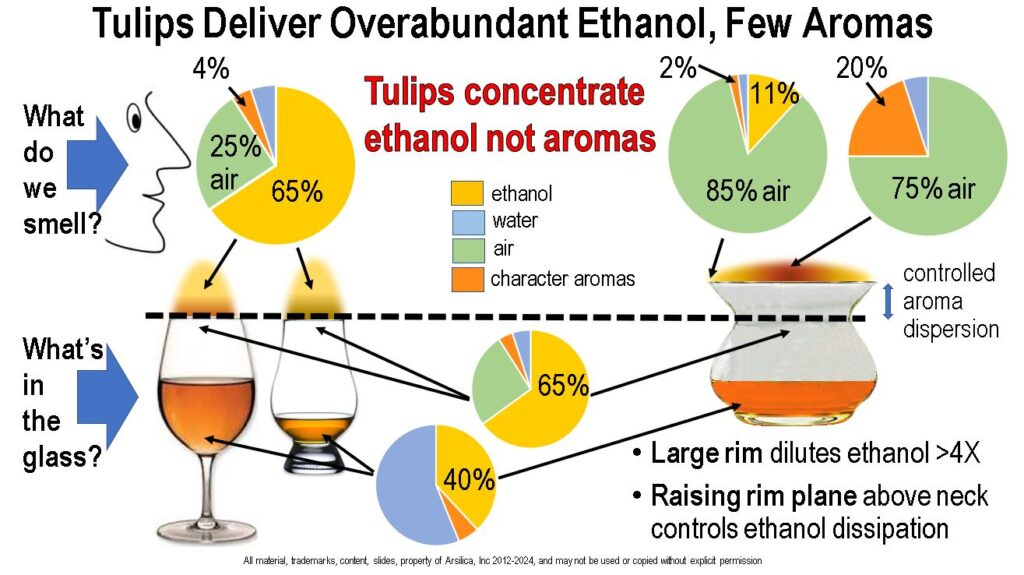
To the untrained, these “fixes” became “science” only because expert marketers, critics, and bloggers have repeatedly said so over the decades. Perhaps science was too busy to analyze how glass shape can control aroma profile until we (Arsilica, Inc. came along). However, when evaluators apply true scientific principles: (1) simultaneous mouth and nose inhaling reduces the olfactory aroma sample, (2) no swirl = few aromas, (3) wafting acclimates pungency, but can’t prevent ethanol numbing, (4) adding water raises surface tension, shuts down *ALL* aroma evaporation, not just ethanol. Tiny rims mask aromas that hide behind concentrated, pungent ethanol. All the “fixes” fail to handle ethanol, the enemy of accurate evaluation. [Science journal paper](https://www.mdpi.com/2306-5710/10/4/116 "Science journal paper") on Ethanol vs Odorant Detection
## Shoulda, Woulda, Coulda Done it Differently
A different glass would have avoided the hoopla and confusion. As opposed to “twisted-marketing science,” “blogger-opinion science,” and “fill-in-the-blank science, true, professional science disciplines (sensory, chemistry, physics, behavioral) dispel myth, disseminate usable knowledge, and reduce the revered critics to just another opinion. We are reminded of a saying attributed to the stoic philosopher Marcus Aurelius, “The opinion of 10,000 men is of no value if none of them knows anything about the subject,”
## The Ethanol Problem is Designed into the Tulip Glass
Medical science classifies highly volatile ethanol as an anesthetic. Medical science classifies highly volatile ethanol as an anesthetic. Drinkers remain unaware because numbness occurs painlessly, while faulty thinking reinforces the belief: “If you can’t see or feel it, it’s not there.” A tulip of 1½ oz of 40% ABV rum contains 65% anesthetic ethanol in the headspace. The rest is air, water, and at the maximum, 0.5% character aromas. Ethanol raises detection, identification, discrimination thresholds, slows response time, blocks signals to olfactory receptor neurons, and ruins accurate evaluation with distracting pungency and trigeminal nerve irritancy. That’s science.
Our studies show that after 4 sniffs of a neutral spirit from a tulip, most aromas become undetected or unidentifiable, and many of those detected cannot be discriminated (e.g. peach from apricot, anise from fennel, etc.).
## **State-of-the-Art**: Flavor Intensity Comes from Great Design
For reasons unknown, a scientific approach to glass design was non-existent until 2002 when Arsilica began to research. Decades of marketing have ensconced tulips as the popular glass shape for industry and consumer, subconsciously training multiple generations to rely on the presence of pungent, anesthetic ethanol at first sniff to validate a spirit.
This sets the stage for high ABV levels (cask strength anyone?) to numb the senses, and hands over purchasing decisions to subliminal, suggestive marketers and vicariously influential videos. Ethanol’s mental fog is the perfect screen for opportunistic, prurient marketing and bogus product claims. Craving and seeking out ethanol when tasting spirits has taken priority over distillers’ craft and art. Tulips have created drinkers, not evaluators. Marketing-stoked popularity may be fun, but it’s not science.
## Conclusion
The facts: short, fat, wide-rim glasses and swirling provide more aromas to sniff and can mitigate ethanol for better evaluation, providing a pathway to enjoy aromas for longer than the quickly fading first-sniff memory. A decade of research by Arsilica led to the introduction of the sensory-engineered NEAT glass in 2012.
Other glasses such as wide-mouth tumblers provide some olfactory ethanol relief as well. To set the record straight, we love ethanol too, but we don’t want it in the way when we are evaluating spirits. Some will argue “It’s part of the spirit,” and rightly so, as are the many subtle aromas you can’t smell through the overpowering, nose-numbing ethanol.
## Find Much More Definitive Flavor Intensity Without Tulips
Tulips may have topped the marketing game, yet scientifically, they fail miserably, working against accurate spirits evaluation. Drinkers encounter a major crossroads on their spiritual journey; (1) stick with the traditional, iconic, unscientific, dysfunctional tulip, or (2) embark on a new experience with a state-of-the-art diagnostic tool. Simply put, you can follow the ethanol-ruled-good-times-tradition-party, or discover the true spirit in your glass. Your glass, your choice.
**Bio: George F Manska, CR&D, Arsilica, Inc.**
**Qualifications:** Published sensory science researcher, and entrepreneur. BSME, NEAT glass co-inventor
**Mission:** Replace myth and misinformation with scientific truth through consumer education.
**Note: [Enrolled NEATNEWS subscribers](https://theneatglass.com/neat-news/) are entitled to 10% discount on all purchases and free shipping over $55 for as long as you are enrolled. Coupon code: ILUVNEAT**
PDF
Print
Share
[Email](#)

The NEAT Glass (CSO) Corporate Strategy Officer, inventor and entrepreneur, (CRD) Chief Research and Development Arsilica, Inc.
[See Full Bio](https://theneatglass.com/author/georgearsilica-com/)
[Facebook](https://www.facebook.com/theneatglass/) [Instagram](https://www.instagram.com/theneatglass/) [TikTok](https://www.tiktok.com/@theneatglass.com) [Pinterest](https://www.pinterest.com/TheNEATglass/) [YouTube](https://www.youtube.com/@TheNEATGlassChannel) [LinkedIn](https://www.linkedin.com/in/theneatglass) [Tumblr](https://www.tumblr.com/the-neat-glass)
**Categories:** The NEAT Newsletter
---
### [Rating Accuracy is the Most Important Objective](https://theneatglass.com/rating-accuracy-most-important/)
**Published:** October 7, 2024
**Author:** The NEAT Glass
**Content:**
## Rating Accuracy is the Most Important Objective
For competitions, rating accuracy must be the most important, primary objective. In general, spirits competitions offer distillers a path to brand recognition and many help consumers make informed decisions. However, there are those who place their highest priority on profits. Consequently, they neglect critical choices of glassware. They also fail to apply a scientific methodology to improve sensory aspects of tasting, quality assessment, and scoring reliability.
## Glassware and Rating Accuracy
We designed the NEAT glass through the rigorous application of physics, chemistry, and sensory science. It offers competitors a major opportunity to improve diagnostic accuracy, ratings, and evaluation. By minimizing interference from pungent, anesthetizing ethanol vapors, NEAT reveals the spirits’ inherent aroma and flavor profiles. Competitions that adopt the NEAT glass evaluate spirits by their inherent qualities rather than perceptions biased by excessive ethanol.
## A Scientific Tool for Rating Assessment
The NEAT glass was specifically developed to improve sensory analysis. As a result, its unique design, with a neck, flared rim, and large bowl, disperses ethanol vapors to prevent masking delicate character aromas. ultimately, this scientific approach improves diagnostic accuracy by eliminating ethanol interference to support consistent, unbiased evaluations.
By contrast, traditional tulip glasses funnel over 65% ethanol vapors directly into the nose. Likewise, ethanol irritates the trigeminal nerve with pungency, dulling the olfactory, and masking subtle but crucial aromas. [**More on sensory science.**](https://www.mdpi.com/2306-5710/4/4/93)
## Ethanol Anesthetics Affects Rating Accuracy
Ethanol’s most problematic characteristic is its anesthetic ability to numb the senses without awareness, particularly when concentrated through narrow-rimmed tulip glasses. Repeated trigeminal irritation from ethanol can numb the senses and produce olfactory fatigue. During flights of five or more spirits, this fatigue can severely impair judges’ ability to identify and detect aromas in later samples, placing entrants near the end of the flight at a critical disadvantage. Judges may score those spirits lower because cumulative ethanol exposure has dulled their senses—not because the spirits contain inherent flaws. The objective should be to minimize ethanol exposure.
NEAT mitigates olfactory fatigue by dispersing anesthetizing ethanol vapors and preserving sensory acuity throughout the judging session. Ultimately, this allows spirits judges to evaluate every spirit fairly and without bias, regardless of its position in the tasting sequence.
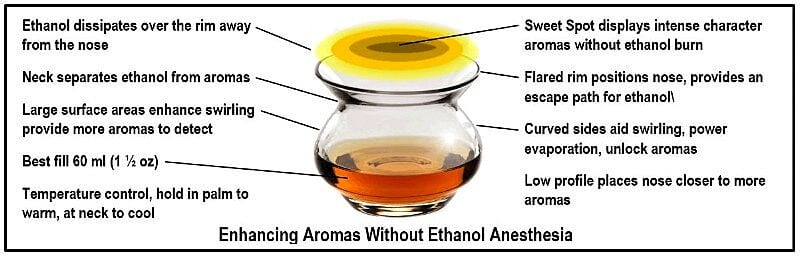
## Ethanol Pungency Works Against Rating Accuracy
The pungency of ethanol distracts the evaluator from focusing on a spirit’s true aromatic profile. Pungency dominates the olfactory experience, concealing more nuanced aromas. By concentrating harsh ethanol vapors, tulips cause discomfort and distort perception. NEAT disperses ethanol vapors away from the nose, reducing this pungency and allowing judges to focus on the authentic aromas of each spirit, resulting in more accurate sensory analysis. Eliminating pungency is a worthwhile objective.
## Sampling Vessel Shape Promotes Rating Accuracy
NEAT’s large-diameter bowl and low-profile design offer substantial improvement to the sensory experience. As a result, the shape allows for more effective swirling, releasing volatile compounds and enhancing flavor perception. Unlike tall tulip glasses, which are difficult to swirl, NEAT’s large bowl design releases more complex aromas through swirling.
Moreover, NEAT’s shorter profile brings the nose closer to the aromas, capturing the full range of compounds lifted by vapor pressure and highly volatile ethanol. Once the ethanol is dispersed by controlled diffusion, judges can assess flavor complexity, mouthfeel, and a comprehensive profile of character. In summary, short and fat deliver aroma, and tall and skinny deliver volatile, anesthetic, pungent ethanol.
## Ensure Rating Consistency and Fairness Leads to Credibility
Consistency is essential in spirits judging, and tulips concentrate ethanol, leading to inconsistent scoring. NEAT allows judges to maintain clarity and consistency throughout the flight. Accordingly, this ensures each spirit is judged on true merits rather than the limitations of tulip glassware; and promotes fairness and accuracy. The primary objective of accuracy is satisfied.
Over 40 major international spirits competitions annually choose NEAT as their official judging and evaluation glass demonstrating commitment to sensory accuracy and fairness, and ensuring scores are based on true flavor/quality.
## Applied Sensory Science Promotes Rating Accuracy
By understanding how human senses interact with ethanol molecules, NEAT researchers optimized the evaluation process by eliminating anesthesia and distracting pungency while enhancing the detection of complex aromas and flavors and delivering reliable results. See peer-reviewed, open-access, research journal paper [Technical Report—Applying Physics and Sensory Sciences to Spirits Nosing Vessel Design to Improve Evaluation Diagnostics and Drinking Enjoyment (mdpi.com)](https://www.mdpi.com/2306-5710/4/4/93).
Independent research comparison confirms the effect of dissipating ethanol. Not surprisingly, wider and shorter glasses are the preferred evaluation tool. [Glass-Vessel-Aroma-DA-Study-Sept-2019.pdf (sensationresearch.com)](https://sensationresearch.com/wp-content/uploads/2020/01/Glass-Vessel-Aroma-DA-Study-Sept-2019.pdf)
## Summary
Spirits competitions often focus on profit rather than accuracy in evaluation. Ratings accuracy must be the primary objective to build credibility. The NEAT glass offers a scientifically reliable solution for those seeking to elevate their judging standards by ensuring every spirit in the competition is evaluated and judged on its true merits. Competitions that adopt NEAT commit to fairness, accuracy, and integrity.
Not only is NEAT preferred by professional judges and competitions who aim for the highest level of sensory precision, but it’s also an invaluable tool for spirits enthusiasts. NEAT enhances enjoyment and understanding as an indispensable vessel to those serious about accurate spirits evaluation and striving for informed purchasing decisions.
PDF
Print
Share
[Email](#)
**Bio: George F Manska, CR&D, Arsilica, Inc.**
**Qualifications:** Published sensory science researcher, and entrepreneur. BSME, NEAT glass co-inventor
**Mission:** Replace myth and misinformation with scientific truth through consumer education.
**Note: [Enrolled NEATNEWS subscribers](https://theneatglass.com/neat-news/) are entitled to a 10% discount on all purchases and free shipping over $55 for as long as you are enrolled. Coupon code: ILUVNEAT**
#### About The Author
[The NEAT Glass](https://theneatglass.com/author/georgearsilica-com/)
Discovered and developed Naturally Engineered Aroma Technology (NEAT) to enhance the presentation and perception of spirits by separating the disagreeable, numbing aromas of ethanol alcohol from characteristic spirit essences. NEAT connects human physiology, chemistry, and basic physics to improve glassware design to appeal to the flavor senses of smell and taste.
Glassware today is designed in the styling studio, and marketing is added later to sell the design and insinuate function. Inventor of the NEAT glass. Our mission is to educate the public and industry professional to improve knowledge on nosing and tasting spirits. Scientifically designed glassware exposes all traits of a spirit, good and bad, and raises the bar of excellence by exposing the true quality previously hidden by nose numbing ethanol. We are: Changing the Way the World Drinks. NEAT is the Shape of Flavor, and Form Follows Function.

The NEAT Glass (CSO) Corporate Strategy Officer, inventor and entrepreneur, (CRD) Chief Research and Development Arsilica, Inc.
[See Full Bio](https://theneatglass.com/author/georgearsilica-com/)
[Facebook](https://www.facebook.com/theneatglass/) [Instagram](https://www.instagram.com/theneatglass/) [TikTok](https://www.tiktok.com/@theneatglass.com) [Pinterest](https://www.pinterest.com/TheNEATglass/) [YouTube](https://www.youtube.com/@TheNEATGlassChannel) [LinkedIn](https://www.linkedin.com/in/theneatglass) [Tumblr](https://www.tumblr.com/the-neat-glass)
**Categories:** The NEAT Newsletter
---
### [Tasting Observations are Important to Revealing Hidden Consumer Psychology](https://theneatglass.com/tasting-observations-are-important/)
**Published:** February 26, 2025
**Author:** The NEAT Glass
**Content:**
## Tasting Observations are Important to Revealing Hidden Consumer Psychology
Observations at tastings are revealing important clues to consumer psychology. We see you at whiskey, tequila, and rum tastings. Whether you are an attendee or administrator, your attitudes toward high ABV spirits and ethanol become apparent and provides insight as to how corporate brand ambassadors play on your personal emotions and thought process to sell spirits.
## Observations: Drinker/Consumer Psychology
- You look down, averting eye contact, hiding your facial expression, spirit sample in hand, as you brace for that first sniff of ethanol pungency. Hesitating for a brief moment, politely waiting for the brand ambassador to finish telling you what you will taste, you then take that first sniff.
- The initial wince and eye squint from the overwhelming first acrid sniff is revealing. You know it’s unavoidable and accept it. The pungency passes quickly. You fleetingly note the sharpness which indicates the presence of ethanol before it fades. As soon as pungency abates, you begin to sniff to determine just how much ethanol is there. Is that the real reason? Actually, you *came* for the ethanol, a quick buzz of slight euphoria prior to slipping back into other obligations. At least three, more like 5 sniffs get that buzz going. These tastings are fun, and ethanol, the “harmless” drug enhances enjoyment.
- Then, you taste. The discomfort and uncertain look on your face because you don’t detect the aromas described by the tasting leader/host or brand ambassador is revealing. With frequent re-sniffs, you try your best to detect them. However, the game is not to let on, but nod and smile in agreement with the others. After all, you also want to show your gratitude for the gift of ethanol.
- Your facial expression clearly indicates perplexity, and you give that final shrug as you realize ***one or more*** of the following:
- You doubt your own ability to detect aromas and feel the anxiety of “missing” the experience, particularly when you are surrounded by smiles and approving nods. You ask, “How come everyone else seems to get it but I don’t?” or “I can never seem to get the aromas at tastings.”
- Your sense of smell is off today, or worse, it just is not good enough and never has been when it comes to spirits, but at least you got a free buzz.
- Frustration with playing the mystery game of “What’s in the drink?” at every tasting.
- After a few sniffs, there is a positive. It has the expected ethanol content, so at the very least, it’s a nice feeling, well worth time taken to stop for a minute or two.
- You ask yourself, “Am I the only one who cannot taste what the administrator described? Why doesn’t anybody say something, or admit it?” Unfortunately, everyone sees an admission as weakness.
- Conspicuous by its absence, the commitment to buy is seldom seen, because “I came to buy” said nobody, ever. I came for the freebie drugs is a little more like it. Exit or buy first is a telltale of consumer psychology. Use those observations to reflect on what really occurred at the tasting.
## Let’s Find Out Why
These circumstances don’t apply to everyone, but they do represent thousands of consumer experiences at spirits tastings everywhere. For the most part, the smiling “actors” are experiencing the same struggles and have no intention of admitting that they do not really smell the aromas. Why does it happen? Four key reasons interact and combine to define the state of the art of spirits tastings:
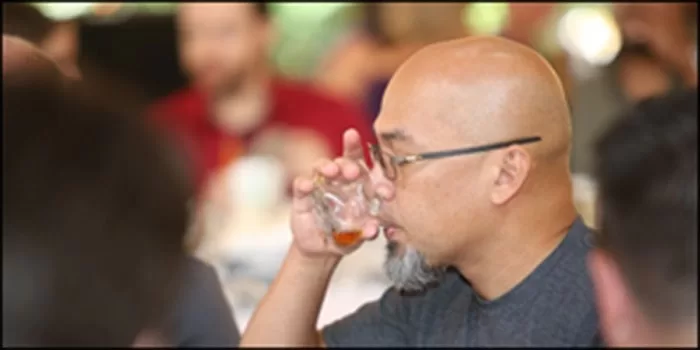
## Observations: Irritating Ethanol is the Enemy of Sensory
- Ethanol is a medical anesthetic, irritating the trigeminal nerve endings and massively impeding sense of smell from first sniff. However, that doesn’t stop drinkers, they adapt quickly.
- The sharp, pungent ethanol stimulus diverts focus away from aroma detection.
- Ethanol is the most volatile compound in any spirit, (whiskey, rum, tequila, vodka, gin, cognac, and all), evaporates first, travels quickest, and in tulip glasses, crowds out less prevalent aromas on its way to the nose to irritate the trigeminal nerve endings.
- Subsequent sniffs increase irritation, and the lingering first sniffs of defining aromas disappear. Without conscious pain or warning, the consumer has no clue that *ethanol up the nose* destroys aroma detection and identification. In a nutshell, that is why we can’t detect the aromas.
## Observations: Irritating Ethanol is the Enemy of Sensory
- For sure, the consumer is neither stupid nor ignorant. However, our observations reveal they are grossly misinformed since prurient marketing messages reach their emotional needs before scientific fact, and emotional reasons subconsciously direct our actions much more than factual statement. Consumer’s psychology becomes apparent with closer observation.
- We know ethanol is a drug, but discussion of that aspect is socially uncomfortable. We expect and even demand it, and we enjoy the buzz. Consequently, little else ever matters.
- Ethanol’s presence takes priority over the personal quest for seeking character aromas.
- Other than plastic cups with possible off-gassing issues and no headspace to collect aromas, most tastings use tulip glasses and have for decades. Even more common when you had to pay for the tasting experience.
- We never question the tulip glass used by most drinkers and industry educators.
- Very few buy because they like the aromas since, in reality, they could not smell any.
- Decades of tasting with tulip glasses have conditioned the consumer to accept high concentrations of pungent, nose-numbing ethanol. Our observations indicate that many serious tasters dislike tulips.
- Peer pressure plays an important part, in the drinker psychology as many tasters nod in approval at brand ambassadors’ statements.
- Since most drinkers never wish to be perceived as shallow or uninformed, many display a false sense of appreciation while carrying an inner perplexity about the value of the experience.
- Who doesn’t want free samples of ethanol, or that quick buzz.
## How Spirits Industry Observations Set Up the Emotional Sale
- Industry marketers, tasting admins, and brand ambassadors know you can’t really smell character intensity through the ethanol mask; they’ve known it all along. Therefore, they carefully script their presentations, hoping your observations are not that keen.
- Evoking an emotional connection is a key marketing objective to convert sales. As a result, a good background story or attractive brand ambassador cements the deal.
- Tasting hosts attempt to provide as many reasons as possible to convert attendees to loyal buyers.
- Unique bottle shapes, stoppers, label designs, bright colors, and art evoke specific buyer emotions.
- Our observations reveal that bloggers and author/critics all help steer drinkers to purchase their personal favorites, using emotional phrasing, and many are paid to write glowing reviews.
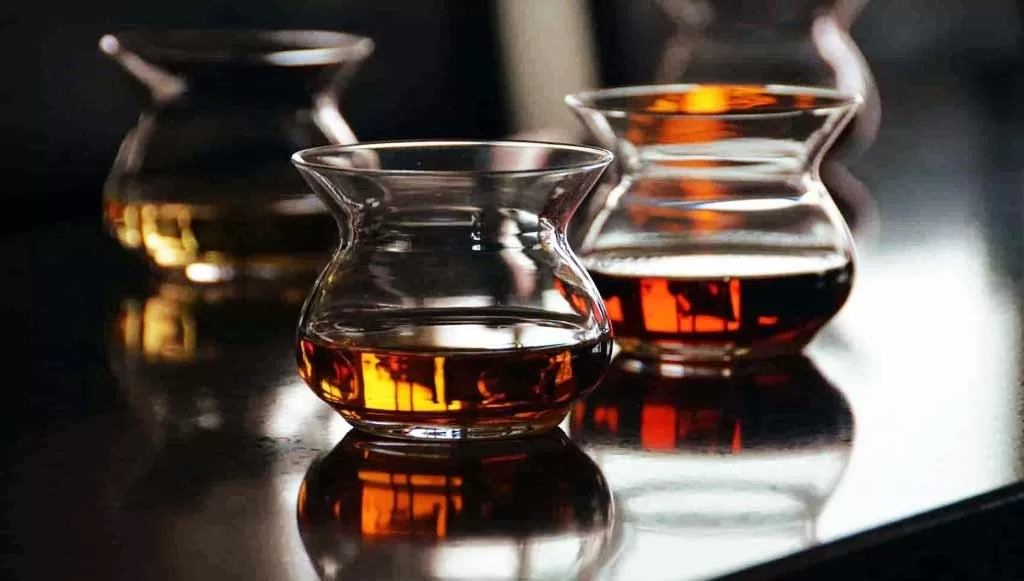
## Industry Marketing is in Control, not Likely to Give it Up
Corporate and distributor designed spirits tastings are all about controlling sales conversions. Psychology is the “secret weapon” of the marketing department, never publicly discussed. “Swept under the rug,” are true, personal purchasing motivations, in favor of the marketing engine room, and controlled by the tasting administrator, where incisive and effective marketing is carefully designed and implemented to push product over personal sensory appeal.
The engine room shelf of tools includes a compelling story, subliminal suggestions, and many others. The consumer buys if the engine room tools are convincing enough to push personal preferences aside to buy history, celebrities, colorful labels, unique bottles. Observation includes examining the product and packaging to improve awareness of the play on personal psychology.
## We Love Ethanol and Its a Problem
Spirits will always have ethanol; *it’s why we drink*. However, the face of the spirits tasting is whatever the industry wants it to be, as they continue to support numbing the consumers’ senses and manipulation. If the consumer is silent, then the administrator will leave it there. Silence is golden for the taster, but does not result in a sale. Ethanol “haze” is the gift of the ambassador, who hopes some remnant of the experience will later result in a sale. [Science journal paper](https://www.mdpi.com/2306-5710/10/4/116 "Science journal paper") explains what ethanol does to our olfactory.
## Summary
The tulip is worthless as a functional diagnostic glass, and it is the enemy of our personal sensory faculties. Sadly, drinkers who prefer the iconic, traditional tulip-shaped, nose-bomb glass generally use it because everyone else does, or because he/she is compelled to honor centuries old tradition. As in politics, the uneducated are resistant to change and comfortable as sheep is a norm.
Ethanol is a double-edged sword. We love it, but if we can keep it away from our noses, we can make more satisfying and intelligent decisions about what we want to keep in the cabinet. The reward is an improved tasting experience. Finally, any wide-mouth glass is a boon to the olfactory.
## Conclusion
The consumer can regain the sensory-driven personal choice initiative, but only if he/she wants it. If you are a serious spirits drinker, then the solution truly begins by acting on your personal sensory preferences and your personal psychology. Our observations reveal that personal preference most often gets side-lined in favor of well-constructed marketing.
Glass choice is key to traveling the enlightened path to a more rewarding flavor and tasting experience. Tulips concentrate ethanol, plastic throw-away cups have no headspace for accurate evaluation. These are the most common vessels at tastings.
Upon personal examination, one may ask: “Who am I?” – a superficial, comfortably numb, eth-head? Or am I serious about appreciating the craftsmanship of distilled spirits? Well trained brand ambassadors have got your number. Heed these tasting observations, take stock of your own psychology, and improve your enjoyment.
**Bio: George F Manska, CR&D, Arsilica, Inc.**
**Qualifications:** Published sensory science researcher, and entrepreneur. BSME, NEAT glass co-inventor
**Mission:** Replace myth and misinformation with scientific truth through consumer education.
**Note: [Enrolled NEATNEWS subscribers](https://theneatglass.com/neat-news/) are entitled to a 10% discount on all purchases and free shipping over $55 for as long as you are enrolled. Coupon code: ILUVNEAT**

The NEAT Glass (CSO) Corporate Strategy Officer, inventor and entrepreneur, (CRD) Chief Research and Development Arsilica, Inc.
[See Full Bio](https://theneatglass.com/author/georgearsilica-com/)
[Facebook](https://www.facebook.com/theneatglass/) [Instagram](https://www.instagram.com/theneatglass/) [TikTok](https://www.tiktok.com/@theneatglass.com) [Pinterest](https://www.pinterest.com/TheNEATglass/) [YouTube](https://www.youtube.com/@TheNEATGlassChannel) [LinkedIn](https://www.linkedin.com/in/theneatglass) [Tumblr](https://www.tumblr.com/the-neat-glass)
**Categories:** The NEAT Newsletter
---
### [The Finer Points of Becoming a Better Spirits Evaluator](https://theneatglass.com/better-spirits-evaluator-perception/)
**Published:** January 2, 2026
**Author:** The NEAT Glass
**Content:**
## The Finer Points on Becoming a Better Spirits Evaluator
Daily, we see, smell, taste, and feel everything we come into contact with. Moreover, our sensory systems remain the only contact with the world outside. Therefore, our sensory abilities and perception become extremely important to us, yet we take them for granted. Becoming a better spirits evaluator involves consideration of a few finer points
## Evaluation Report Completeness Creates a Better Spirits Evaluator
Every evaluation should be a complete, descriptive profile which can be used by others as a guideline for purchasing or collecting, or a reference point for comparison. It must be dependable, accurate, and consistently repeatable across evaluators and tasting sessions under defined conditions to validate it as a relevant description. Here are a few things to consider to become a better spirits evaluator.
## **Separate Observations from Emotions** to Become a Better Spirits Evaluator
Sensory evaluation is quite a bit more complicated than the brand tasting at the liquor store. Opinions freely given at random group tastings are often emotional impressions and therefore are not part of a usable, communicable description. Bob thinks this whiskey is too harsh and it tastes “mean.” Jill loves the soothing caramel taste that she describes as “inner warmth and sublime.” These are emotional opinions, not truth in evaluation. One may purchase, the other may not. In all probability, both will solidify their personal opinions based on emotional perceptions, not attributes or true flaws.
In spirits evaluation, we seldom recognize the sensory connection to our emotions. Few ever discuss how important the connection is, yet we experience it every time we taste and smell. Emotional and hedonistic responses are valid. However, they should be recorded separately from descriptive observations because they are personal and less transferable between evaluators. One of most important finer points: Competent evaluators must learn to separate their emotions from the analysis of flavors and quality. Particularly in spirits, most drinkers have a misconception of how much of the spirit is actually a flavor.
## **Apply a Sensory Weighting Model**
There may be other models; however, consider our applied sensory model as explained in *Distilled Spirits Sensory Science***: Flavor = 90% smell + 5% taste + 5% mouthfeel.** It’s not exact, and can’t be applied to all spirits, particularly those with added flavorings or syrups. An evaluator should note the order of magnitude of the olfactory contribution. A spirits evaluator should see this model equation as a generalized perspective for weighting sensory flavor components on unflavored spirits. This weighting changes for neutral or intentionally flavored spirits such as vodka, high-proof neutral spirit, and aquavit.
## Understand the Magnitude and Balance of Spirits Components
In this table, we note that 99.5 % or more is water and ethanol. In the case of our sense of smell, air and water (humidity) are with us from day one, so our sensory system, for the most part, considers them as background. Therefore, our brains do not register a notable taste or smell. On the other hand, we smell ethanol (not a background aroma) and congeners (the tastes and smells of the alcoholic beverage).
Although congeners may constitute less than 0.5% of many straight spirits, their low odor thresholds contribute much of the character we identify as whiskey, rum, brandy, or another spirit. We tend to think that congener concentrations are much larger.
The fact that we consider small amounts of character in our spirits to be more plentiful than they actually are is a tribute to the effectiveness of our senses and the ability of our brains to discount background sensory “noise.”
## **What is the Composition of the Congener Portion of the Spirit?**
Note that quantity alone does not determine sensory importance. An aroma compound contributes when its concentration approaches or exceeds its odor threshold. Odor-activity value compares a compound’s concentration with that threshold, helping explain why a trace compound can strongly influence a spirit’s aroma.
Congener perception depends on concentration relative to odor threshold. We know how different rum can taste from a whiskey. Our sensory library has associated their “category” names with our sensations of taste or smell. The similarities of different types of spirits are surprising. Different spirit categories contain many of the same broad chemical families, but differences in individual compounds, concentrations, and interactions produce the distinct character we identify as rum, whiskey, brandy, or another spirit.
## Chemical Names are Important to a Spirits Evaluator to Connect Aromas Sources
The different chemical concentrations do not make sense until we associate which chemical group names go with their smell and taste descriptors. To understand the beauty of these finer points, we can consult the olfactory/taste definitions of each compound as they appear in spirits. Here are a few of the most prominent smells of compounds found in spirits. Adjust your perception to detect and identify.
The different chemical concentrations do not make sense until we associate which chemical group names go with their smell and taste descriptors. To understand the beauty of this, we can consult the olfactory/taste definitions of each compound as they appear in spirits. Here are a few of the most prominent smells of compounds found in spirits.
**Terpenes/Lactones:** nutty, maple, caramel, balsamic, pine, floral, coconut, peach, fruity, woody, spicy.
**Sulfur Compounds:** rotten eggs, skunk, cooked cabbage, onion, garlic, burnt rubber, putrid.
**Phenols:** smoky, medicine, tar, barnyard, clove, spicy, woody, vanilla.
**Acids:** Sourness, texture, pungency, tartness, vinegar, cheesy, waxy, green apple, goat-like, soapy, fatty, grassy.
**Aldehydes:** green apple, burnt fat, sweet nuts, grassy, almond, cherry, baked sugar, caramel, vanilla, anise, lemon, warm spice, cinnamon, floral, citrus, orange, cooked potato, malty.
**Higher Alcohols:** banana, fusel.
**Esters:** solventy, fruity, nail polish, pineapple, apple, pear, banana, candy, floral, honey, coconut, cinnamon, jasmine, sweet, balsamic, raspberry, strawberry.
## **Control Ethanol Before It Controls Evaluation**
In their 2024 peer-reviewed study, Wang and Cadwallader found that ethanol vapor raised the odor-detection thresholds of every odorant tested, and suppression increases as ethanol concentration rise. Alcohols, esters, hydrocarbons, and phenols were among the more strongly affected groups. Their results support reducing ethanol vapor reaching the nose through appropriately shaped glassware.
## Spirits Evaluator says “Two Sniffs and it’s Gone, Right?”
Straight spirits are bottled at approximately 40% ABV or higher. Because ethanol is vastly more abundant than individual congeners and readily enters the headspace, it can dominate the vapor reaching the nose. A professional spirits evaluator is aware of the effect of ethanol on perception. Just because you don’t smell it after a couple of whiffs does not mean it is not there, affecting evaluation. It quickly becomes a background odor but still affects the trigeminal nerve endings.
## Glassware Knowledge is Important to Becoming a Better Spirits Evaluator
When evaluating a spirit in a tulip glass, you must recognize that its narrow rim concentrates ethanol-rich vapor at the nose. Ethanol’s pungency activates the trigeminal system, while its pharmacodynamic effect raises the detection thresholds of character odorants. Together, these effects allow ethanol to dominate the initial impression, obstruct accurate aroma identification, and hinder perception. [More about the glass.](https://www.mdpi.com/2306-5710/4/4/93 "More about the glass.")
## **Use Common Sensory Language**
A good spirits evaluator needs a shared, standardized vocabulary for aroma, taste, mouthfeel, and finish. Without agreed descriptors, terms such as *smooth*, *rich*, *balanced*, and *complex* remain personal impressions that others cannot reliably interpret. A common lexicon enables evaluators to identify sensory attributes precisely, communicate observations consistently, and separate what they perceive from what they personally prefer. The finer points of evaluation include meaningful vocabulary.
Quality also requires explicit, category-appropriate standards rather than personal preference alone. Evaluators should judge a spirit against defined criteria—including balance, intensity, integration, identifiable defects, and fitness for its intended style—while recognizing that standardized language does not make human perception identical. It provides a common framework that makes evaluations teachable, repeatable, comparable, and open to verification.
## **Build Your Sensory Library** to Become a Better Spirits Evaluator
Examining the descriptors within the chemical compound categories closely, one might become suspicious that several different chemical groups can have similar smells. This occurs because the descriptor is not a one-to-one chemical label. A single compound can evoke several descriptors. Several compounds may evoke the same descriptor, and mixtures of compounds can produce qualities that are not obvious from their individual components.
It can be daunting to one who wants simple one-word definitions. Understanding the complexity of translating good descriptors to aromas and flavors is key to becoming a proficient evaluator of spirits. For this reason, it is necessary to establish a lexicon consisting of a descriptive vocabulary for spirits.
One does not necessarily need to know chemical group names; however, they help when relating the production processes of fermentation, distillation, and maturation to flavor. Chemists name the compounds; evaluators must connect those names with sensory experience and perception. The evaluator who wants to understand aroma sources must also understand the transition from chemical compound names to their specific aromas.
However, the first and most important step to becoming a better spirits evaluator is to build a deep impression in the sensory-aroma library using universal, common terminology for character descriptors. That is a subject for another day.
## Summary:
The complexity of sensory evaluation goes much deeper than we can define in a short article. This framework gives aspiring evaluators four practical disciplines: separate preference from description, weigh olfaction appropriately, control ethanol exposure to improve perception, and build a standardized sensory vocabulary. Through training and adopting a global descriptive language, we communicate more clearly when describing the flavors of spirits. Hopefully, these finer points are enough to begin your journey to becoming a better spirits evaluator.
- Our senses still detect small concentrations of aromas, and much of our flavor judgment depends on smell.
- Most people with normal olfactory function can develop a better sense of aroma identification through practice and adopting a methodical approach to tasting and evaluating spirits. Building solid universal descriptors into your memory of aromas is key to improving perception.
- Ethanol can be the enemy of accurate evaluation. Use a diagnostic vessel that diffuses ethanol odor away from the nose. No ethanol-concentrating tulips.
The objective is to rise above the common conversational evaluations of spirits and sharpen your senses to become a better evaluator, purchaser, collector, and appreciator of spirits. Keep evaluations in perspective. Vocal or written, a good evaluator uses a universal vocabulary and accurate descriptors.
Tradition is not proof of diagnostic fitness. When measured against glassware designed to reduce ethanol at the nose, the tulip’s concentrating behavior works against aroma identification. Evaluators should question any vessel that concentrates the compound shown to suppress the aromas they are attempting to judge. Standardize your chosen glassware.
In this corner, we will continue to add increasing value and more finer points to your tasting experience. *Distilled Spirits Sensory Science*, available at IngramSpark and Amazon, provides a complete course in understanding spirits.
**Bio: George F Manska, CR&D, Arsilica, Inc.**
**Qualifications:** Published sensory science researcher, and entrepreneur. BSME, NEAT glass co-inventor, and author of *Distilled Spirits Sensory Science*
**Mission:** Replace myth and misinformation with scientific truth through consumer education.
**Note: [Enrolled NEATNEWS subscribers](https://theneatglass.com/neat-news/)** are entitled to a 10% discount on all purchases and free shipping over $55 for as long as you are enrolled. **Coupon code: ILUVNEAT**
PDF
Print
Share
[Email](#)

The NEAT Glass (CSO) Corporate Strategy Officer, inventor and entrepreneur, (CRD) Chief Research and Development Arsilica, Inc.
[See Full Bio](https://theneatglass.com/author/georgearsilica-com/)
[Facebook](https://www.facebook.com/theneatglass/) [Instagram](https://www.instagram.com/theneatglass/) [TikTok](https://www.tiktok.com/@theneatglass.com) [Pinterest](https://www.pinterest.com/TheNEATglass/) [YouTube](https://www.youtube.com/@TheNEATGlassChannel) [LinkedIn](https://www.linkedin.com/in/theneatglass) [Tumblr](https://www.tumblr.com/the-neat-glass)
**Categories:** The NEAT Newsletter
---
### [NEAT Science: Your Nose Knows Better than You Do](https://theneatglass.com/neat-science-your-nose-knows-better-than-you-do/)
**Published:** November 17, 2025
**Author:** The NEAT Glass
**Content:**
## **How America Learned to Love Ethanol Burn and Why Science Says It’s Time to Reconsider**
In NEAT science—sensory science—the nose serves as one of the body’s strongest warning systems against poisons and irritants. Your nose detects what your glass delivers, but ethanol irritates the nasal passages and masks subtle aromas, making them difficult to recognize. For decades, repetition rather than evidence conditioned American drinkers to interpret ethanol’s nasal burn as a sign of quality in whiskey, bourbon, rum, and tequila. Chemistry, sensory science, and controlled experiments did not create this belief. Tradition shaped it, the language of strength and authenticity reinforced it, and one largely unquestioned piece of hardware—the tulip-style glass—cemented it.
## **Tradition is Mistaken for Truth** and Science
When a convenient explanation appears early in a field, it often becomes permanent by default. History offers countless parallels—Aristotle’s Earth-centered universe, centuries of medical bloodletting, and other confident errors that persisted simply because no one doubted them. Einstein put it plainly: once a concept proves useful, “we forget its earthly origins.” Confucius echoed the caution millennia earlier: real knowledge requires recognizing the limits of what we think we know.
The same dynamic shaped the spirits world. Before modern sensory science could analyze aroma delivery, researchers did not scientifically validate the reasons vessel shapes gained acceptance. Once popular, they solidified into doctrine: narrow is better, concentration is desirable, intensity must equal quality. Few paused to ask whether the tools were fit for purpose.
## **How Glassware Distorted Expectations**, Inventing its Own Science
The tulip and Glencairn-style glasses became the unquestioned standard in the United States. They were adopted under the assumption—phrased with authority but unsupported by physics—that “concentrating” aromas heightens perceptual accuracy. In high-ethanol beverages, the opposite is true.
Ethanol evaporates readily and stimulates the trigeminal nerve. Narrow chimneys trap and accelerate ethanol vapor, directing concentrated pungency up the nose’s centerline and overwhelming human olfaction. Tulip glasses intensify nasal heat and anesthetic effects, shift detection thresholds, and impair the nose’s ability to distinguish nuanced congeners such as esters, phenols, aldehydes, terpenes, and oak-derived compounds. More [glassware science](https://www.mdpi.com/2306-5710/4/4/93).
But the tulip shaped the entire drinking culture and turned this distortion into the expected experience. Drinkers blamed the spirit rather than the vessel for the burn. Distillers and reviewers praised “heat,” “bite,” and “kick,” treating excess ethanol volatility as evidence of quality. They judged whiskey without aggressive ethanol as weak or simplistic—even when its calmer profile revealed greater compositional balance. Simply put, glass shape can concentrate ethanol. Tulips funnel ethanol into the nose.
\#image\_title
Over time, the public learned not only to expect the burn but to *crave* it. The sharpness felt like proof of authenticity. The sting became the confirmation ritual. This became a circular logic: the glass made the ethanol overwhelming, the drinker interpreted the overwhelm as a mark of seriousness, and the market reinforced the preference.
## **Science Arrives Late**
Modern sensory science eventually caught up to the reality distillers had long experienced anecdotally: the glass is not neutral. It is a variable that shapes the data before the evaluator even begins. Vessel geometry governs vapor stratification, ethanol dispersion, and the order in which molecules reach the olfactory epithelium. A small design change can either reveal complexity or destroy it.
In other fields such as wine and perfume, this truth was recognized earlier. In spirits, high ethanol levels delayed the scientific scrutiny. The industry relied on tradition, authority, and heritage instead of empirical testing. By the time researchers began systematically examining vapor behavior, the tulip had already become institutionalized—used in competitions, tastings, bars, and homes, with almost no experimentation into alternatives.
## **A Missed Century of Experimentation**
Had science intervened earlier, the assumption that narrow rims enhance spirits would never have survived controlled testing. Simple vapor-dispersion measurements demonstrate that narrow chimneys increase ethanol concentration at the nose, suppress heavier aromatic compounds, and mislead the drinker about true character. Consumers spent generations forming opinions about distilleries, categories, and brands based on incomplete sensory information. The tragedy of an accepted error is not the original mistake; it is the generations who build upon it without knowing the foundation was flawed.
## **Re-Examining Glassware as a Sensory Tool** to Avoid Ethanol Concentration
The discussion of glassware is not a matter of marketing preference or aesthetic style. It is a question of sensory integrity. A tasting glass should be treated as an *instrument*: it either helps reveal the spirit’s data or it distorts it. A poor aroma detection instrument will concentrate ethanol.

We introduced the NEAT glass in 2011 as the first vessel engineered from the ground up using ethanol physics, human olfactory physiology, and measured vapor behavior. We did not design NEAT to create a brand identity. NEAT is designed it to correct a sensory bottleneck: ethanol’s dominance at the rim. The glass directs lighter ethanol outward while keeping heavier aromatic compounds nearer the center, revealing aroma families that traditional tulip glasses obscure. [How NEAT works](https://theneatglass.com/how-it-works/).
The principle, however, extends beyond any single design. Any vessel that reduces ethanol concentration, lowers vapor velocity, broadens the headspace, and permits natural diffusion can improve sensory accuracy. Physics, not brand allegiance, should determine glass shape.
As scientific laboratories, distillers, and research groups contribute more data, designers may develop solutions that surpass today’s designs. Progress requires us to embrace evidence and challenge inherited assumptions.
## **Reclaiming True Quality** is about Using Science to Dispel Traditional Myth
Considering all the above, whatever glass you choose, remember: Ethanol pungency does not define quality and gets in the way of genuine appreciation
Tradition has conditioned the public to equate ethanol burn with quality, but ethanol intensity distracts the senses rather than measures craftsmanship. Coherence, balance, congener integration, and a spirit’s ability to express its identity—through grain, fermentation, distillation, maturation, and age—provide the true markers of quality. High ethanol concentrations at the rim conceal these signals and elevate force over fidelity.
## **Summary: Science Finally Steps Into the Room**
Science arrived late to spirits evaluation, allowing tradition to fill the void for decades. Dominant glassware made ethanol burn unavoidable and conditioned drinkers to interpret it as quality. Sensory science now shows how glass geometry controls vapor behavior and challenges us to reconsider the vessel. The glass does more than hold the spirit—it serves as the first tool of perception. Correct the tool, and the spirit finally speaks for itself. More in the [MDPI Beverages Journal Paper.](https://www.mdpi.com/2306-5710/4/4/93)
**Bio: George F Manska, CR&D, Arsilica, Inc.**
**Qualifications:** Published sensory science researcher, and entrepreneur. BSME, NEAT glass co-inventor, and author of *Distilled Spirits Sensory Science*
**Mission:** Replace myth and misinformation with scientific truth through consumer education.
**Note: [Enrolled NEATNEWS subscribers](https://theneatglass.com/neat-news/)** are entitled to a 10% discount on all purchases and free shipping over $55 for as long as you are enrolled. **Coupon code: ILUVNEAT**
PDF
Print
Share
[Email](#)

The NEAT Glass (CSO) Corporate Strategy Officer, inventor and entrepreneur, (CRD) Chief Research and Development Arsilica, Inc.
[See Full Bio](https://theneatglass.com/author/georgearsilica-com/)
[Facebook](https://www.facebook.com/theneatglass/) [Instagram](https://www.instagram.com/theneatglass/) [TikTok](https://www.tiktok.com/@theneatglass.com) [Pinterest](https://www.pinterest.com/TheNEATglass/) [YouTube](https://www.youtube.com/@TheNEATGlassChannel) [LinkedIn](https://www.linkedin.com/in/theneatglass) [Tumblr](https://www.tumblr.com/the-neat-glass)
**Categories:** The NEAT Newsletter
---
### [The Love of Ethanol Drives Sales of Cask-strength Spirits](https://theneatglass.com/why-cask-strength-whiskeys/)
**Published:** September 10, 2024
**Author:** The NEAT Glass
**Content:**
### **Why Cask-Strengths and Over-proofs?**
All for the love of ethanol? Over the last decade, new releases and enthusiastic interest have driven growth. This has led to a strong rise in cask-strength whiskey sales. Distillers bottle cask-strength spirits straight from the barrel without diluting them to the 40% ABV (alcohol by volume) standard. They offer more robust flavors compared to standard expressions, as well as ethanol levels of 50%-70% ABV or even higher.
Enthusiasts seek the undiluted experience of cask strengths, which showcase the full spectrum of flavors developed during aging. Additionally, whiskey tourism and a proliferation of whiskey clubs and societies have boosted cask strength popularity. [Science journal paper](https://www.mdpi.com/2306-5710/10/4/116 "Science journal paper") on Ethanol vs Odorant Detection.
Braeburn’s BC20 Whiskey Cask Index reported growth of 14.95% in 2022. The premium global whiskey market segment includes cask-strength products. Braeburn’s BC20 Whiskey Cask Index estimated the market to surpass $67.6 billion in 2023. Global Market Insights, Inc. projects an annual growth rate above 6.8% from 2024 to 2032. Who wins in this quickly evolving marketplace?
## Distiller Wins with Cask-Strength Spirits
1. Higher Profit Margins: Producers price cask strength whiskeys at a premium because of their higher proof and perceived value. Premium pricing and lower dilution costs generate higher profit margins than those earned on standard 40% ABV whiskeys.
2. Market Differentiation: Cask strengths can set a brand apart in an overcrowded market, building a niche market segment attractive to connoisseurs and collectors. Offerings enhance brand image, elevate brand perception and improve sales.
3. Customer Engagement: Distillers create limited edition cask strength releases to drive interest, brand loyalty, purchasing urgency, and strengthen customer engagements. Barrel programs for bars, restaurants, and private collectors allow distillers to build deep relationships with key customers and influencers and broaden market presence.
4. Inventory management: Barreled whiskeys deemed acceptable for drinking are sold as cask-strength. These whiskeys lie outside the taste profile for internal blending. This practice improves inventory management efficiency.
## Presumed Customer Wins with Cask-strength spirits
1. **Enhanced Flavor Experience**: More intense and complex flavor profiles compared to their diluted counterparts. Consumers experience the whiskey in its purest form with a full spectrum of aromas and flavors. Some claim cask strength allows them to customize their dilution level, yet adding water defeats the flavor benefit of cask strength.
2. **Value for Money**: Some say that although cask strength whiskeys are more expensive upfront, their higher alcohol content means that a single bottle can yield more servings once diluted to regular drinking strength. However, increased demand for cask strength has increased price points, and there’s actually little to no economic advantage. Again, why pay for cask strength and dilute it?
3. **Collectability and Investment**: Many cask strength releases are limited editions, making them collectible items. As these bottles can appreciate in value over time, they also serve as investments. Bottles from a specific cask or batch may provide a sense of exclusivity and connection to the distillery, for some whiskey aficionados.
4. **Giving Back**: Purchasing cask strengths supports many artisan distillers and their dedication to craftsmanship.

## The Glitch
As sensory science researchers, we know that less water means more flavors/aromas; many research papers validate this point. In a crude, generalized explanation, hydrogen bonding of water molecules hinders flavor release, and cask strength whiskeys have more intense flavors and aromas solely due to the reduced water content. However, many do not understand the aroma benefits of cask strength and purchase them for different reasons. Some dilute with water as previously noted; some are impressed by top-shelf-name-brand special editions, and many treasure ownership of scarce, limited quantities.
**The search for ethanol:** Tulip glass headspace contains 65-80% ethanol, 10-20% air and water, and less than 0.5% character aromas from a 40% ABV whiskey, and the higher end of the ethanol range applies to cask strengths. In addition, drinking from tiny rim tulip glasses for decades has preconditioned drinkers’ ethanol expectations, misdirecting them to a primary, perhaps subconscious search for ethanol presence, usually justified by the detected degree of pungency. Consumers confirm this mass ethanol pursuit in other ways by seeking the ABV statement when shopping.
Sadly, after a minute or two of tasting, most drinkers lose the ability to recall specific aromas because ethanol acts as an anesthetic that suppresses aroma detection with every sniff. Repeated ortho-nasal exposure to ethanol numbs the olfactory system and dramatically reduces the aroma component of flavor, leaving only a fleeting memory of the first few aromas perceived. Serious whiskey drinkers prioritize aroma and character over ethanol strength. Remember: aroma accounts for 90% of flavor, while mouthfeel and taste each contribute just 5%.
## In Summary
**What’s the best way to appreciate cask strengths?** A simple diagnostic glass rewards the serious cask-strength whiskey drinker. Dump those nose-numbing ethanol-concentrator tulips for a tumbler or the best, a NEAT glass.[ NEAT works well when drinking 40% ABV whiskey and performs wonders with cask strengths.](https://theneatglass.com/sensory-evaluation-laboratory-specs/ " NEAT works well when drinking 40% ABV whiskey and performs wonders with cask strengths.") Ethanol concentration in the center of the rim plane is 0%, and at the rim is only 11%, and there’s room for your nose in the glass. We love ethanol, but it’s no excuse to numb the nose, overriding and obliterating the enhanced flavors and aromatic benefits of cask strengths. Ethanol pungency is an irritant and is not to be confused with flavor. Most whiskey drinkers confuse pungency with character aroma.
Change your glass to elevate your sensory experience level to enjoy the *real* customer win from cask strengths; intense flavor, aromas and unique character. Science eventually renders non-functional tradition obsolete, revenues from NEAT sales fund further research.
\*Cask and barrel are used interchangeably for simplification. Technically, all barrels are casks, but not all casks are barrels. A barrel specifically refers to a cask size of 50-53 gallons
PDF
Print
Share
[Email](#)
**Bio: George F Manska, CR&D, Arsilica, Inc.**
**Qualifications:** Published sensory science researcher, and entrepreneur. BSME, NEAT glass co-inventor
**Mission:** Replace myth and misinformation with scientific truth through consumer education.
**Note: [Enrolled NEATNEWS subscribers](https://theneatglass.com/neat-news/) are entitled to 10% discount on all purchases and free shipping over $55 for as long as you are enrolled. Coupon code: ILUVNEAT**

The NEAT Glass (CSO) Corporate Strategy Officer, inventor and entrepreneur, (CRD) Chief Research and Development Arsilica, Inc.
[See Full Bio](https://theneatglass.com/author/georgearsilica-com/)
[Facebook](https://www.facebook.com/theneatglass/) [Instagram](https://www.instagram.com/theneatglass/) [TikTok](https://www.tiktok.com/@theneatglass.com) [Pinterest](https://www.pinterest.com/TheNEATglass/) [YouTube](https://www.youtube.com/@TheNEATGlassChannel) [LinkedIn](https://www.linkedin.com/in/theneatglass) [Tumblr](https://www.tumblr.com/the-neat-glass)
**Categories:** The NEAT Newsletter
---
### [Bias Works to Corrupt Results and Destroy Quality Assessment](https://theneatglass.com/bias-works-to-corrupt-results-and-destroy-quality-assessment/)
**Published:** December 14, 2024
**Author:** The NEAT Glass
**Content:**
## Bias Works to Corrupt Results and Destroy Quality Assessment
Bias works to corrupt evaluation results, and worse, they destroy valuable spirits quality assessments. Psychology endeavors to provide explanations for human thoughts, actions, and beliefs and biases. Carefully screening evaluators uncovers bias. Strong beliefs and biases create barriers to acceptance of functional science, particularly relating to subjects considered artistic or creative.
Wine and spirits tasting, evaluation, ratings, and quality assessments have long existed. But, until recently, evaluations were largely devoid of practical sensory and physical science methodology.
## It’s Not that Simple
After all, what is there to understand? Pour the beverage into the glass, look at it, smell it, taste it, and decide whether you like it or not. Few ever question the procedures and apparatus used, and most believe that if many experts follow a set process, then it must be correct. Understanding yourself makes sure you are qualified to make accurate assessments and purchasing decisions. [More on ethanol issues](https://www.mdpi.com/2306-5710/10/4/116 "More on ethanol issues").
## Psychological Attitudes; the Quest for Best, where Biases Lurk
Beliefs, feelings, and behavioral tendencies shape psychological attitudes. A multitude of choices confronts consumers, so they rely on “best” claims to guide their buying decisions. They demand concise, prioritized lists while subscribing to impatient, psychological attitudes, “Just tell me which ones are best, don’t clutter my mind with details, Gimme the best and I want it now.” It is truly a sign of the times.
These attitudes strongly influence consumer behavior. Each year, the Wine Spectator list of the 100 “Best” Wines of 202X inspires thousands of wine lovers to tear out the summary page and rush to secure a few of the highest-ranked bottles. Distributors allocate scarce, sought-after brands to stores with the highest sales volumes, while surging demand drives prices upward. Long lines, limited availability, and prices beyond many consumers’ means leave frustrated buyers competing for access. The marketplace turns hostile.
## Bias can be Worked into the Story or Twist the Vocabulary by Marketing
**Storytelling:** • Compelling narratives of history, heritage, and craftsmanship, creating an emotional connection with consumers, suggesting a rich and authentic backstory. Bias can come in your attitude toward the story.
**Twisted Marketing Science/Pseudo-Scientific Language**: Many brands use complex-sounding scientific terminology to describe manufacturing processes suggests a higher level of sophistication or intellect unsupported by science (e.g., “proprietary molecular aging,” “scientifically crafted.”). Bias can come from your opinion of the language used.
## Other Attitudes Work in Concert with Biases to Corrupt Quality Assessment
Brands that make the “best” lists are usually (1) scarce and pricey, (2) received good reviews from popular reviewers, or (3) won medals at prestigious competitions. As consumers turn to these prioritized lists to make buying decisions, they surreptitiously avoid personal accumulation of “unnecessary” baggage-knowledge-details. As a rule, impatience automatically dismisses any inkling of the concept of making meaningful personal choices and will corrupt quality assessment.
Choosing to bypass the learning curve to proficient evaluation, consumers turn to exposure experiences for social media posts that prove their self-involvement; like taking selfies of drinking Petrus (any vintage) and toasting in the presence of a Pappy van Winkle bottle. This widespread practice has become shameless and necessary to validate oneself as a “knowledgeable” participant.
Those treasured “sharing-the-spotlight” moments are all about a personal, prestigious “I belong” association with tradition, rare labels and vintages, or age statements, and not about the internal search for personal satisfaction and value.
Consumers voluntarily exchange their personal development for external experiences that portray them as “in-the-know” and “active participants.” It simply requires too much time and effort, and self-validation is too important to play this game differently. As a result, these attitudes become a barrier to discovering your personal biases
## Well-worn Practices Create Bias, and Science Creates Upheaval
Science is usually late to influence artful and skillful topics, but it has now arrived, and suddenly everyone is confused by new, “unbelievable,” and unacceptable ideas. For example, wine attributes traditionally described as “terroir” no longer fit that convenient catchall explanation. Also, glass shapes used for centuries now mask aromas with concentrated, anesthetic ethanol. Additionally, water does not “open up” whiskey. We now know beers should be swirled.
Personal taste may be more important than labels and vintage. New scientific rationale threatens old memes, and resistance to change is nearly insurmountable as the consumer has become comfortably numb on his path to gathering external participation experiences and notoriety over an internal quest for discovering the sublime.
## Evaluators Biases Corrupt Results, Destroy Quality Assessments
If organizers allow competition judges to participate without screening, they may produce disastrous results. As you read the biases below ask yourself whether you judge impartially, even for your own purchases. This exercise can teach you a great deal if you are willing to acknowledge that your own faults may affect fairness and accuracy. Corrupt data is useless to everyone.
## Bias List (Partial)
**Confirmation Bias:** Occurs when one seeks out, interprets, and chooses to remember only information confirming preexisting beliefs. People turn myth into accepted fact when they embrace information that supports their existing views and ignore or dismiss contradictory evidence. Experts often reinforce these beliefs when they view scientific explanations as threats to the opinions they previously defended. In addition, confirmation bias sustains myths and deeply rooted false beliefs throughout religion, politics, and social media, and it may represent one of today’s greatest barriers to the acceptance of science.
**Availability Heuristic Bias:** The tendency to overestimate the importance of readily available information. Recent news of a rare event leads one to believe it is a common occurrence.
**Anchoring and Adjustment Bias:** Relying too heavily on the first piece of information read because it confirms pre-existing beliefs.
**Hindsight Bias:** An event was predictable or expected, simply because it has already occurred.
**Overconfidence Bias:** Overestimation of knowledge, capabilities, and confirmation of the accuracy of beliefs and predictions.
**Self-Serving Bias:** Successes are the result of personal efforts and talent; failures are someone or something else’s fault. This can be an easily recognized bias, and it will corrupt quality data.
**Dunning-Kreuger Effect:** Individuals with low ability or knowledge tend to overestimate their ability/knowledge. Conversely, those with a high degree of ability/knowledge tend to underestimate themselves. Ultimately, Dunning-Kreuger is about individual self-assessment of expertise and competence.
**Groupthink Bias:** The group values consensus and cohesion over critical thinking.
**Status Quo Bias:** Preference to stay the same, even if change is beneficial (avoid unknown consequence or loss).
**Loss Aversion:** Prefer avoiding a loss over acquiring gains (risk aversion)
**Negativity Bias:** Giving more weight and importance to negative information than to positive information or experiences.
**Recency Bias:** Placing more importance on recent information than older ones when making judgments.
**Cultural Bias:** Interpretation of issues as compared to the correctness of one’s own culture (ethnocentrism).
Did you recognize any of these? There are many more, this is just a start.
## Summary
Bias is least understood and seldom recognized but plays a big role to producing corrupt data and quality assessment. The true unbiased judge is open-minded and strives to understand things scientifically, with the ultimate goal of improving judgment, buying decisions, and ultimately, personal satisfaction. Ultimately, that true judge and evaluator is you, because you are the only one who knows what *you* like or dislike. Not to mention that knowing yourself is the only way to be fair with others while properly assessing quality.
If you rely on others’ opinions, ask yourself “Is the critique fair and unbiased?” Question the information: Is it rational, does it correlate with other sources, are they (or am I) practicing a bias?
Reading and listening are indispensable tools, but developing a sharp sense of recognizing and retaining accurate information is key to enhancing enjoyment and has other far-reaching benefits – if you let it. Recognizing and controlling personal biases is the first step. It will help you to avoid corrupt, non-repeatable findings, and improve your evaluation of quality characteristics. Discover how one [independent research study](https://sensationresearch.com/wp-content/uploads/2020/01/Glass-Vessel-Aroma-DA-Study-Sept-2019.pdf "independent research study") is a good example of eliminating biases. [Journal paper](https://www.mdpi.com/2306-5710/10/4/116 "Journal paper") on ethanol and spirits evaluations
**Bio: George F Manska, CR&D, Arsilica, Inc.**
**Qualifications:** Published sensory science researcher, and entrepreneur. BSME, NEAT glass co-inventor
**Mission:** Replace myth and misinformation with scientific truth through consumer education.
**Note: [Enrolled NEATNEWS subscribers](https://theneatglass.com/neat-news/) are entitled to 10% discount on all purchases and free shipping over $55 for as long as you are enrolled. Coupon code: ILUVNEAT**
#### About The Author
[The NEAT Glass](https://theneatglass.com/author/georgearsilica-com/)
Discovered and developed Naturally Engineered Aroma Technology (NEAT) to enhance the presentation and perception of spirits by separating the disagreeable, numbing aromas of ethanol alcohol from characteristic spirit essences. NEAT connects human physiology, chemistry, and basic physics to improve glassware design to appeal to the flavor senses of smell and taste. Glassware today is designed in the styling studio, and marketing is added later to sell the design and insinuate function.
Our mission is to educate the public and industry professional to improve knowledge on nosing and tasting spirits. Scientifically designed glassware exposes all traits of a spirit, good and bad, and raises the bar of excellence by exposing the true quality previously hidden by nose numbing ethanol. We are: Changing the Way the World Drinks. NEAT is the Shape of Flavor, and Form Follows Function.
PDF
Print
Share
[Email](#)

The NEAT Glass (CSO) Corporate Strategy Officer, inventor and entrepreneur, (CRD) Chief Research and Development Arsilica, Inc.
[See Full Bio](https://theneatglass.com/author/georgearsilica-com/)
[Facebook](https://www.facebook.com/theneatglass/) [Instagram](https://www.instagram.com/theneatglass/) [TikTok](https://www.tiktok.com/@theneatglass.com) [Pinterest](https://www.pinterest.com/TheNEATglass/) [YouTube](https://www.youtube.com/@TheNEATGlassChannel) [LinkedIn](https://www.linkedin.com/in/theneatglass) [Tumblr](https://www.tumblr.com/the-neat-glass)
**Categories:** The NEAT Newsletter
---
## Pages
### [The NEAT Glass Delivers Better Flavor and Enjoyment](https://theneatglass.com/)
**Published:** July 17, 2026
**Author:** The NEAT Glass
**Content:**
## NEAT: Discover the Truth in Your Spirit’s Quality and Flavor
Everyone seeks better flavor and more enjoyment from tasting spirits. Sadly, many drinkers believe that tulips concentrate aroma. Fact: 40% ABV spirits in tulips concentrates pungent, ethanol which masks character-defining flavor and truth in your spirits quality, whereas, **NEAT** reduces ethanol, unmasks aromas, delivers trustworthy evaluations. **NEAT** is the ***Ultimate, Universal Spirits Glass***, and the new scientific, intelligent path to maximizing enjoyment and discovering the truth in all your spirits.
If you believe strong ethanol indicates high quality, then it’s time to rethink your glass choice. Tulips are designed for low‑ABV sherry. As a result, tasting spirits in tulips creates an *ethanol nose-bomb*. Pungent, ethanol destroys your ability to detect, identify, and evaluate flavor and quality. Discover subtle nuances, detect hidden flaws. Above all, your spirits purchasing confidence improves because you can learn and know more about what you like and buy**.** [More science.](https://www.mdpi.com/2306-5710/4/4/93) [**Subscribe to our NEWSLETTER**](https://theneatglass.com/neat-news/)*.*
## [The NEAT Glass Delivers Better Flavor and Enjoyment](https://theneatglass.com/)
## Free Shipping on NEAT orders over $50
## Flavor is Why We Drink
Tasting spirits was never about snorting concentrated ethanol. However, for 200 years, spirits drinkers have put up with tulips because no one discovered how to dissipate ethanol pungency. In the first place, tulips are designed for tasting 22% ABV (alcohol by volume) sherry. Therefore, tasting 40%+ ABV spirits in a tulip creates an *ethanol nose bomb*, and destroys flavor in favor of ethanol’s sharp pungency, missing the entire, broad spectrum of flavor. In fact, that’s not enjoyment, and ethanol is not a flavor.
## The Tasting Experiences
You pay much more for your spirits than for the glass, yet the glass is the only tasting tool that can improve flavor and spirits enjoyment after the spirit is bottled. The pricier the spirit, the higher your expectations of quality and enjoyment. **NEAT** is the only functional spirits glass ever designed to release flavor, improve enjoyment, and deliver exactly what you pay for and expect. ***Finally, You Should Decide:*** Honor the long-standing tradition of non-functional-ethanol-nose-bomb-tulips? *or*, discover flavors hiding in my glass by switching to **NEAT**?

## Science Eventually Replaces Tradition and Enhances Flavor
Since the beginning of time, science has been the innovative factor in replacing tradition with function. Wheels replaced skids, cars replaced horses, microwave ovens replaced stoves, and the **NEAT** glass is replacing tulips. Why? It’s simple: Science improves our lives, saves time, dispels myth, and gets closer the universal laws of nature.
We would consider it laughable to claim that **NEAT** sits at the top of the ladder of spirits sensory science. However, we are a lot closer to better sensory evaluation, tasting, better flavor, appreciation, and enjoyment of spirits than traditional tulip glasses. As you explore our website, take note of the many references to the science of spirits evaluation and diagnostics. We are all about science, because it operates for the common good. It certainly is not some quick, gimmicky, money-making scheme.
Our scientific motivation drives ongoing sensory research to identify improved methods for evaluating and appreciating man-made spirits. Altruistic? You are darn right it is. Somebody has to be, and we have consciously chosen that role. Unashamedly, tasting, flavor, and enjoyment link us humans to the scientifically designed products which we need to enhance our hedonistic existence.
---
### [Strong Sensory Design Enhances the Validity of Test Results](https://theneatglass.com/sensory-evaluation-laboratory-specs/)
**Published:** July 11, 2026
**Author:** The NEAT Glass
**Content:**
## **Product Specifications for Sensory Evaluation & Laboratory** Use
Sensory laboratory specifications and strong sensory design are essential to enhance testing, evaluation and maintain repeatable, accurate, and dependable results. For this reason, these specifications are provided for the professional sensory researcher, scientist, and evaluator. These specifications define conformity to standard laboratory procedures and methods.
Document Number: NEAT-MTS-001, Rev. A, June 2026: Material, Thermal Tolerance, Sanitization, and Sterilization Datasheet, Compliance Reference Specification: Prepared for: food, beverage, analysis, distilled spirits, food and beverage flavor & fragrance, perfume fragrances, olive/saffron/cooking oils, food and beverage infusions, and additives laboratories.
**Intended Use:** Aroma and flavor evaluation, sensory analysis, distilled spirits assessment, beverage quality control, laboratory tasting panels, and food-grade analytical applications.
Arsilica, Inc. owns all photographs and holds trademarks for NEAT, Ultimate Spirits Glass, Taste the Truth, and Universal Spirits Glass. Accordingly, their usage requires express permission from Arsilica.com.
**Not Intended for:** **NEAT™** is not a substitute for borosilicate laboratory apparatus. **NEAT™** cannot be substituted for volumetric analytical glassware**,** reaction vessels**,** or high-temperature lab processing equipment.
## Material Specification
Lead-free European Crystalline Glass manufactured to applicable European crystalline glass standards. Notably, contains no added lead oxide (PbO), and is formulated using crystalline glass constituents designed to provide high optical clarity**,** enhanced brilliance**,** food-contact suitability, and resistance to normal laboratory and beverage-service conditions. Perfect for sensory evaluation.
## Food Contact Compliance
Intended for direct contact with:
✅ Distilled Spirits
✅ Wine, beer, alcohol beverages
✅ Non-alcoholic beverages
✅ Food-grade flavor solutions
✅ Food/beverage sensory evaluation
## Laboratory Usage
✅ Beverage QC laboratories
✅ Distilled spirits laboratories
✅ Food science laboratories
✅ Sensory evaluation laboratories
✅ Flavor development laboratories
✅ Sensory evaluation facilities
✅ Flavor development laboratories
✅ Consumer product testing programs
✅ Winery/brewery analytical depts.
## **Operating Temperature**
**Note:** Rapid transitions between hot and cold conditions should be avoided.
| **Parameter | **Temperature |
|---|---|
| Recommended service temperature | 0°C to 80°C (32°F to 176°F) |
| Maximum intermittent exposure | 121°C (250°F) |
| Controlled dry heat exposure | 150°C (302°F) |
| Minimum recommended temperature | 0°C (32°F) |
## **Steam Sterilization**
**Autoclave Compatibility** – Suitable for standard laboratory steam sterilization cycles. Compatible with standard steam sterilization cycles at 121°C (250°F) when subjected to controlled heating and cooling procedures. Cool prior to sensory use.
| **Parameter | **Rating |
|---|---|
| Temperature | 121°C (250°F) |
| Pressure | 15 psi nominal |
| Exposure Duration | Up to 30 minutes |
| Cooling Method | Controlled cooling recommended |
## **Dry Heat Sanitization**
Recommended Dry Heat Exposure. May be subjected to controlled dry heat sanitization up to 150°C (302°F). Sudden temperature changes should be avoided.
| **Parameter | **Rating |
|---|---|
| Maximum temperature | 150°C (302°F) |
| Exposure duration | Up to 60 minutes |
| Heating rate | Controlled |
| Cooling rate | Controlled |
## Acceptable **Sanitization** Methods (Always Use)
The following are acceptable methods:
✅ Hot water wash and commercial dishwasher cycles.
✅ Use compartmented racks avoid high-pressure spray.
✅ Steam sterilization at 121°C (250°F)
✅ Chemical sanitization okay for food contact surfaces
✅ Ethanol and/or isopropyl alcohol sanitization
✅ Peracetic acid systems
✅ Quaternary ammonium sanitizers
## **Not Recommended** Sanitation (Do Not Use)
❌ Open-flame sterilization
❌ Direct burner heating
❌ Dry heat sterilization above 150°C (302°F)
❌ Thermal shock processing
❌ Rapid ice-water cooling following heating
❌ Super-heated liquids shock
## ****Thermal Shock Limitation**** (Do Not Use)
Lead-free crystalline glasses generally exhibit lower thermal shock resistance than laboratory borosilicate
❌ Do not expose to direct flame
❌ Do not use on stovetop or laboratory
❌ Do not use on lab burner
❌ Do not heat in microwave
❌ Do not transferred directly: freezer to boiling liquid
❌ Do not water quench after heat exposure
❌ Hot liquids can cause breakage
## ******Storage and Handling******
Store under normal indoor conditions: Flared rims are smaller than max bowl diameters, will not touch when glasses placed together on flat surface. Do not pickup multiple glasses in one hand, rims may break upon collision with other rims. Moreover, sensory glassware should be examined for rim chips prior to tasting.
| **Parameter | **Value |
|---|---|
| Temperature | 5°C to 40°C (41°F to 104°F) |
| Relative Humidity | Non-condensing |
| UV Exposure | Avoid prolonged exposure |
## ******Compliance Specification Statement******
For POs, specifications, tenders, and compliance documentation: **NEAT™** the sensory evaluation glass is manufactured from lead-free European crystalline glass by Rona a.g., Republic of Slovakia. Moreover, they are suitable for direct food and beverage contact, compatible with standard steam sterilization cycles up to 121°C (250°F), and suitable for controlled dry heat sanitization up to 150°C (302°F). All **NEAT™** products are for sensory evaluation, beverage analysis, and laboratory applications. **NEAT™** is not borosilicate laboratory glassware. Nor intended for high-temperature laboratory sterilization processes above specified limits.
## Evaluation ******Sample Coverings******
For lab or comparison evaluation, sensory samples should be covered with lids to allow headspace equilibrium to occur prior to olfactory sampling. **DO NOT USE soda lime glass lids/dishes, as they are prone to breakage. Acceptable lid options are:**
| **Lid Material** | **Recommendation** |
|---|---|
| Paper or plastic | Hotel-style sanitary glass caps, food beverage caps |
| Borosilicate glass | Sanitized, borosilicate reduces chances of shards |
**Naturally Engineered Aroma Technology (NEAT)** is the foundation for the best spirits sensory glass available. Flavor is 90% aroma, and every spirits glass should display all aromas and enhance flavor.
The NEAT spirits glass was tested against tulip whiskey glasses, Glencairn, and other spirits glasses under controlled, uniform conditions by the **University of Nevada at Las Vegas (UNLV) Chemistry Department** to verify empirical panel tasting results. Specifically, GCMS testing was performed. Independent sensory studies verified our years of research. As a result, other whiskey nosing glasses and spirits glasses can’t compare to NEAT aromas and flavor. Finally, science built a better glass.
Same Scientific Bowl Design, 3 Versions. Elegance, Elite, Artisan
[Scientific Design Study](https://www.mdpi.com/2306-5710/4/4/93)
---
### [Want to Become a NEAT Glass Reseller? Sign up Now.](https://theneatglass.com/reseller-neat-glass-reseller/)
**Published:** July 29, 2021
**Author:** The NEAT Glass
**Content:**

**NEAT Glass Retail Reseller POP Display Case.** Small footprint for next to register placement. As a result, the reseller gains an advantage: unexpected revenue generated from additional sales at point of purchase. All our products fit nicely into this display, including Artisan, Elite, and the beautifully stemmed Elegance. They are free with a one case minimum order of each product, and ship with your order. Fold and lock tabs and you are ready to stock.
## **Become a NEAT Glass Reseller**
###### Want to become a NEAT glass reseller? Sign up now. Bulk NEAT glasses work best for bars, restaurants, hotels, and events. Our retail-ready products generate steady renewable revenue in liquor stores, distilleries, gift shops, and department stores.
**Additionally, our products have generous profit margins.** Because of NEAT’s unique design, register impulse sales are high. Submit form for a quote, email george@arsilica.com, or call [1 (702) 332-7305](tel:17023327305). Because good business includes protecting our resellers, Arsilica, Inc. enforces a strict MAP policy, and MSRP. Therefore, prices displayed on this website are also MAP. Please also include your reseller license number from your county or city.
***We are seeking distributors in foreign countries. Our products are made in Slovakia. European territories are available, as well as Australia, New Zealand, Africa, Some Asia, South America, Canada and Mexico.***
Still not convinced? See this **[Independent Research Study](https://sensationresearch.com/wp-content/uploads/2020/01/Glass-Vessel-Aroma-DA-Study-Sept-2019.pdf "Independent Research Study")** comparing tasting attributes of other popular glasses to NEAT using different spirits.
## Reseller Form
## Minimum Advertised Price (MAP/MSRP) Policy
**Purpose**: Protect product image, maintain fair competition among resellers, and ensure product value.
**Policy**: The attached schedule lists pricing. NEAT glass resellers are required to advertise and sell our NEAT products at or above these minimum advertised prices. See our [Terms of Service](https://theneatglass.com/customers-most-important-priority/ "Terms of Service").
## **MAP/MSRP Price List**
In brief, we reserve the right to adjust MAP prices at our discretion. Also, appropriate notice will be provided to all resellers. This policy applies to all forms of advertising, including but not limited to online platforms (e.g. websites, social media, email marketing), print ads (e.g., newspapers, magazines), broadcast media (e.g., television, radio).
## NEAT Glass Resellers: Protecting the Integrity of Our Product
**– First Offense:** Written warning and request to correct the advertised price.
**– Second Offense:** Temporary suspension of orders for 3 months.
**– Third Offense:** Termination of the reseller agreement
**Exception Dates**
Ultimately, we recognize that certain promotional periods may require exceptions to the MAP policy. The following special days are approved exceptions where NEAT glass resellers may advertise below the MAP up to 25% off without penalty. Note: Any discounts or promotions that result in advertised prices below the MAP during these exception periods are solely at the retailer’s discretion. Moreover, Arsilica, Inc. does not provide any funding or financial support for such discounts.
As a result, the following periods may be discounted:
Valentine’s Day, Father’s Day, Black Friday / Cyber Monday, Christmas
**NEAT Glass Reseller Contact Information**
Arsilica, Inc.
452 Silverado Ranch Blvd.
Suite #222
702-332-7305
[Science Journal](https://www.mdpi.com/2306-5710/4/4/93)[Our Partners](https://theneatglass.com/fantastic-partners-valuable-resources/)
---
### [Spirits Academy: Smart Spirits Drinkers Love Science, Truth](https://theneatglass.com/spirits-academy-smarter-drinkers/)
**Published:** August 31, 2020
**Author:** The NEAT Glass
**Content:**

## Spirits Academy: Smart Spirits Drinkers Love Science, Truth
Spirits Academy is presented to give the spirits drinkers a deeper understanding of the basic science of evaluating spirits. Even more, we rely on natural science to support every aspect of the spirits craft. Ultimately, fermentation, distillation, and maturation are the basic sciences that create spirits. Glass geometry, biophysics, and gaseous diffusion are the sciences that govern perception.
## Science: Directly Connected to Enjoyable Experiences
We humans attempt to discover just how well spirits can please us. As a matter of fact, evaluation is the search for the wonderful, hedonistic enjoyment experience. There are many ways to enjoy and evaluate spirits, some better than others. Our Spirits Academy Mission is to show you how evaluation methods work, how your body senses and deciphers the flavors and aromas, and how you can improve your understanding of the creation process and what it finally delivers to you.
## Education: Knowledge is a Powerful Tool
You can’t participate well in any activity in life unless you are willing to learn more about it. We shake our heads when we see social media responses like DNRTL (Did not read, too long). Invariably, those are the same people who will trip over a dollar to pick up a dime or ignore long term consequences for immediate or imagined benefit. They nearly always discount scientific fact. Education is a powerful tool. Therefore, it is necessary to read, learn, and use it. My dad used to say, “Use your head for something besides a hat rack.” As spirits drinkers, you should know that each sip has the power to teach something new. Therefore, Spirits Academy is here for you.
As we see the need to provide more insight, we will add to Spirits Academy and NEAT Newsletter. In the meantime, we wish all of you who have a higher interest in spirits a most enjoyable and rewarding experience. One should always remember that the joy is in the hunt. By definition, the hunt is eternal. Slainte, Slainte mhath, Kanpai, Prost, Sante, Salud, Chon kaew, Gahn-bei, Za zadorovye, Aapki sehat ke naam. Cheers, and enjoy the Spirits Academy. Check back for new entries.
## We Value Your Input to Spirits Academy
Please do not hesitate to question our material or request any additions to our curriculum. We are all about the spirits drinkers. Visit the [contact us](https://theneatglass.com/important-constructive-comments-welcome/ "contact us") page to submit comments. All constructive criticism is accepted and deeply appreciated. More information on the [NEAT Newsletter](https://theneatglass.com/neat-newsletter-mastering-sensory-skills/ "NEAT Newsletter") page. Also, see [glassware comparison](https://sensationresearch.com/wp-content/uploads/2020/01/Glass-Vessel-Aroma-DA-Study-Sept-2019.pdf "glassware comparison") by independent research.
## Spirits Academy: Evaluation Technique and Science
- [Practical Science Education to Inform the Spirit Lover](https://theneatglass.com/practical-science-education-spirit-lover/)
- [Sense of Smell – Discovering the Best Spirits Evaluation Perspective](https://theneatglass.com/sense-of-smell-evaluation/)
- [Developing Powerful Techniques for Best Spirit Evaluation](https://theneatglass.com/powerful-techniques-best-evaluation/)
- [Popular Olfactory Theory and its Relationship to Accurate Test Results](https://theneatglass.com/popular-olfactory-theory-test-results/)
- [Swirling Your Spirit Exposes its Quality](https://theneatglass.com/swirling-myths/)
- [Choosing the Best Glass – History & Myths of Popular Glassware](https://theneatglass.com/choosing-best-glass/)
- [New Concept: Diffusing Ethanol to Improve Test Results](https://theneatglass.com/new-concept-diffusing-ethanol-improve-test-results/)
- [New Sensory Glass Results in a Better Spirit Test Outcome](https://theneatglass.com/sensory-glass-test-outcome/)
- [Descriptive Vocabulary is the Hallmark of Better Evaluation](https://theneatglass.com/descriptive-vocabulary-hallmark-evaluation/)
- [Truth May Actually be Myth and Misinformation](https://theneatglass.com/truth-myth-misinformation-spirits-evaluation/)
- [When You Add Water to Spirits (Almost Never)](https://theneatglass.com/adding-water-to-spirits/)
- [Gender Equity is Important to Accurate Spirit Evaluation](https://theneatglass.com/gender-equity-in-evaluation/)
- [A Practical Evaluation Method for Every Spirit Lover](https://theneatglass.com/aroma-academy-evaluation-method/)
- [Which Spirits Evaluation and Rating System is Better?](https://theneatglass.com/spirits-scoring-and-rating-system/)
- [Sources of Poor Quality are More Important than the Flaws](https://theneatglass.com/sources-of-poor-quality-flaws/)
- [Truth, Science: The Path to Better Understanding](https://theneatglass.com/truth-understanding-science-best/)
- [New Concept: Diffusing Ethanol to Improve Test Results](https://theneatglass.com/new-concept-diffusing-ethanol-to-improve-test-results/)

---
### [NEAT is the Ultimate Scientific Spirits Glass Design](https://theneatglass.com/ultimate-scientific-spirits-glass-design/)
**Published:** August 30, 2026
**Author:** The NEAT Glass
**Content:**
This is a summary of scientific spirits glass design, including most of those glasses whose manufacturers outright claim to have a scientific design. In the first place, there are many reasons why customers use certain glasses to taste their spirits. Secondly, this summary discusses only one of those reasons: Scientific consideration in design and development. Third, many manufacturers knowingly make false claims about the applied science of their spirits glasses. *Believable is not scientific.*
This article is not a condemnation of any spirits glass; however, it is an assault on the twisted marketing employed to sell a spirits glass design as a “scientific,” when in fact they cannot produce one shred of evidence other than a panel of their own biased judges.
## ****Marketers Will Market: Is it Science or Lie-nce?****
### The First Camp: Casual Drinkers
The spirits drinking world is divided into two basic camps. The largest, by far, is the camp which loves their spirits (rum, scotch whisky, bourbon, tequila, whiskey), loves the sniff of pungent ethanol, and drinks for social interaction, yet only lightly touching the much deeper subject of distilled spirits. They don’t want to know much about the spirit, and generally buy based on label, shelf/bottle appearance, a good back-story, or celebrity endorsement. Their decisions are no deeper than “like” or “don’t like.”
If you are in this camp, this article is definitely not for you. You will buy and use the cutest glass, the gimmick that sets you apart from the crowd: The glass design you like best for style and shape, and you will believe whatever the manufacturer says about the science because it supports your purchasing motive. You are image-driven, and you will always be convinced that your spirit tastes better in your chosen glass only because you feel better using it.
### The Second Camp: Genuine Interest in Spirits
Nevertheless, the second camp, numbering far fewer, is genuinely interested in the spirit and the flavor profile it offers. They seek a satisfying spirit they would repurchase. To accomplish that ends, they seek a glass which delivers a true aroma profile. The best glass design exposes all the nuances, attributes and flaws of each spirit while you search and seek your favorites.
If you are in this camp, this article is for you. Science provides the difference between sensory satisfaction and a buzz-on-demand-quick-shot of ethanol up the nose or homage to a cute marketing presentation. It is proven fact that ethanol is a pungent nerve irritant and grossly interferes with aroma detection. The higher the ethanol the less aroma detectability.
### **Scientific Glass Design is Often Misused as a Marketing Tool**
Regardless of which camp you are in, the glass marketers are having a field day with your mind when it comes to scientific application. If you don’t know science, you are fair game for the marketing wizards, who, by the way, don’t know science either. As a result, we asked ChatGPT, using highly disciplined prompts created to filter out opinion, to find spirits glassware scientific claims and analyze them for accuracy. However, we discovered that many “science” statements are hilariously laughable and are clearly twisted to what they want you to believe, hoping you will never question it. You are the judge.
## **Chronology and Scientific Appraisal of Spirits Glass Design (ChatGTP)**
**Purpose.** Distinguish documented scientific support from plausible geometry, undisclosed testing, decorative design, and unsupported marketing. “Debunk” here means audit the evidence; it does not mean presume every claim false.
**Scope and caveats.** The controlling list counts purpose-designed spirits-glass market entries with a verified first-entry year. It excludes wooden vessels; generic tumblers;
**Evidence rule.** In essence, the manufacturer wording is taken from first-party material where available; secondary descriptions are identified. Additionally, “No public validation located” means no accessible method/data/report was found in the reviewed material, not proof that private testing never occurred. Patents establish intellectual-property rights, not sensory efficacy. *Note these chart color codes in audit section:*
**Science Audit Spirits Glassware Key**
## ChatGTP Audit of Spirits Glass Design for Scientific Verification
### The “Old Guard” of Spirits Glassware – No Science Considered
### “Old Guard” to NEAT Period – Also No Science
### NEAT and Beyond – First Evidence of Science
Date qualifiers: † secondary historical account; no primary first-use record or exact distilled-spirits adoption date located. ‡ earliest whiskey-specific museum object located, not a claim of first-ever use. \* company-reported founding/entry year; ? probable year, exact commercial introduction not independently verified. Rows sharing a year are not asserted to be in month-by-month order unless a month is shown. The supplied chronology notes one current NEAT page using 2011, while its detailed history and contemporaneous records support February 2012; this chart follows the better-supported 2012 date.
**Overall evidence finding:** Within the reviewed material, **NEATTM** has the strongest accessible scientific record: a stated physical mechanism, mathematical treatment, a peer-reviewed technical report, and a third-party descriptive-analysis comparison.
SAVU reports scientific/university development, but an accessible validation report was not located. Most other sensory claims are plausible geometric *hypotheses or marketing statements without disclosed controlled validation*.
## **Why Your Chosen Spirits Glass Design may not** be Scientific
### Geometry Specific
- Is the rim smaller diameter than the bowl? If it is you are concentrating ethanol and the flavor aromas. There is much more pungent, distracting, nose-numbing ethanol in the spirit than there are flavor aromas. Air and water are “background” aromas, which we do not smell, because they are there every day, 24/7. That means the only things we smell are ethanol and congeners. In liquid form, congeners are less than 0.5% of the spirit (slightly higher in flavored liqueurs, amari). In the evaporated form(which is what you smell), that means you are smelling 98.5% ethanol, and less than 1.5% congeners (flavor molecules). The next time anyone tells you that they use tulips because they concentrate the aromas, remind them that they also concentrate ethanol, which is much worse and much more abundant.
- Is the glass tall? Less aromas reach the rim for detection in taller glasses. Remember ethanol is light, aromas are heavier. Tall glasses have much more ethanol at the rim plane, much less congeners. *Short beats tall if you are looking for aroma, aroma is the largest contribution to flavor.*
- Is the glass wide at the bowl? Wide bowls swirl better. Swirling is the engine that releases aromas for the nose to detect. Fat beats skinny for swirling.
- Is the glass rim tiny? It concentrates ethanol, and your nose also bumps the rim. A good tasting glass lets your nose in to smell the aromas close to the liquid level while sipping.
### Physical Science Specific
- Are there ridges or bumps in the glass? Those “bumps” have been added to improve swirling aeration. The problem is most of them do not work. For the most part, the bumps, “mountains,” and ridges are below the liquid level, and have little effect on aeration. Many have obstructions in the glass bowl to improve aeration. Don’t waste your money. A good swirl in a round inner bowl is sufficient to create enough liquid shear to release more aromas. Marketers overemphasize swirling aeration with false claims.
- Some glasses claim to “hold down the ethanol.” That is a physical impossibility in an open top glass. Moreover, ethanol is by far the most abundant and volatile substance in all of spiritdom. It moves upward in the glass through its normal vapor pressure, until it reaches the rim and it then falls to the ground because it is heavier than air. So why can a 6-foot-tall guy smell ethanol in the tasting room? Air currents. Even light currents are powerful enough to distribute the ethanol at 6 foot levels or higher. In a closed, no-air-current room ethanol falls to the floor. If the manufacturer says his glass holds down the ethanol, turn and run, don’t look back.
## **Most Purported Whiskey Glass Design Science is a Joke.**
Casual buyers purchase most spirits glasses to show membership in the fraternity of spirits drinkers, or as a feel-good gimmick. Choices are mind-boggling. As of August 2026, a search of Amazon alone reveals over 3,000 whiskey and rocks glass results. Using aroma delivery science to choose makes sense and reduces this number to a very few. There are only two exceptions to that rule. The first one is obvious.
Your great grandad’s tumbler has proven to be the tried-and-true choice in glass design. Short and fat beats tall and skinny. You can get your nose in the glass close to the heavier aromas lurking just above the surface of the liquid. The bowl is big enough to swirl well.
## The AI Verdict
**NEATTM** is the only glass ChatGTP analyzed which has a provable, published scientific design. It has all the benefits of the tumbler, plus two more. **NEATTM** has a “neck” and a controlled flare to disperse ethanol away from the nose. The neck restriction enhances aroma access more than the tumbler by increasing molecular collisions. See an actual glassware [comparison](https://sensationresearch.com/wp-content/uploads/2020/01/Glass-Vessel-Aroma-DA-Study-Sept-2019.pdf) by independent sensory research.
That means that the heavy molecules are throwing their weight around in the neck and the lighter ethanol molecules run fast to the flared rim, where they creep over the edge in a controlled disappearance, leaving the nose free to pick up all the subtle nuances of flavor in the spirit without ethanol interference. It’s easier to detect the flaws in a poorly made spirit. It’s science. Real science. Move the ethanol out of the way to savor the flavor. Here is the kicker: Stick your nose below the neck of the **NEATTM** glass and it smells exactly the same as any tulip glass, the “huffer’s paradise.” Versatility.
## Summary
Some say **NEATTM** looks weird, we say *form follows function*. Some say it’s hard to drink from, we say sip, don’t gulp, *the rim is no different than a cocktail or martini glass* *rim*. Our mission is to place the purchasing decision back into the hands of the drinker based on his personal likes and dislikes, and out of the hands of deceptive marketing. It’s much more about applied science than selling membership paraphernalia and trinkets. *Using fake science to sell a spirits glass is like putting a lab coat on a salesman and calling his spiel scientific research*. Notice how many glasses with scientific claims do not publish their research; it’s because there isn’t any. Simple physics is not a well-guarded secret. Company tasting panels are biased. Marketers will market: Lie-nce is not science. Which camp are you in?
### If you have to lie about science, what else do you lie about?

The **NEATTM** Spirits glass surpasses the tulip glass functionally, so you taste the truth and positively determine spirit quality. Science designed **NEATTM** for the discerning professional, collector, or aficionado, and it enhances enjoyment for the average drinker. Learn more about **NEATTM**, the [Ultimate Spirits Glass](https://theneatglass.com/the-best-spirits-glass/)
---
### [Our Fantastic Partnerships are Your Valuable Resource](https://theneatglass.com/fantastic-partnerships-valuable-resources/)
**Published:** September 3, 2024
**Author:** The NEAT Glass
**Content:**
## Our Partners are Your Valuable Resource
Additionally, our partnerships are the specialists who believe sensory science helps us understand spirits better. As a result, they employ proven science to dispel long-standing myths, debunk false advertising, and clarify the unexplained. Moreover, they share our goals, making them valuable resources. They base their knowledge on truth, dependable as a valuable resource to serve your needs.
With this in mind, attend their functions buy their products. You can’t go wrong following their path. As a result, together we can build a community that overcomes twisted marketing by exposure to the facts. **[Back to SHOP](https://theneatglass.com/ "Back to SHOP")**.
## Consider Joining Our Group: Become a Valuable Resource
If you would like to be one of our elite group of customer conscious partnerships and become a valuable resource to our readers, send us a note. Specifically, click [CONTACT US](https://theneatglass.com/important-constructive-comments-welcome/), provide your reasons, and tell us about you. Then, we will consider adding you to our prestigious list.
## Here are Our Partnerships
[](https://7thskyventures.com/the-neat-glass)
**[7th Sky Ventures](https://7thskyventures.com/the-neat-glass)** is the trade side of our family of projects. A boutique licensed importer and exporter for beer, wine and spirits. 7th Sky is also a registered vendor with the liquor board of Ontario in Canada and a distributor partnership with NEAT for Florida and the Caribbean.
[](https://specsonline.com/)
**[Spec’s is Texas’ largest liquor store](https://specsonline.com/search-results/?page=1&orderBy=relevancy&q=the+NEAT+glass)** and alcohol delivery service, offering a wide range of wine, spirits, beer, seltzers, food, and more. For over 60 years, Spec’s has been your Texas go-to for good times and gourmet foods. Now, with over 180 locations and more on the way, we’re bringing savings and selection to every corner of the Lone Star State and others.
[](https://issuu.com/proofthemagazine/docs/pr_f_the_magazine_-_june_2026/23)
**[The PR%F Awards](https://issuu.com/proofthemagazine/docs/pr_f_the_magazine_-_june_2026/23)** Double-Blind Tasting Competition and The Total Package Competition are powered by Food and Beverage Magazine (14 million+ readers monthly, credited by Alexa Rating System), Delta Sky Club®, and The NEAT Glass. Our competition is unique in that every single judge is a buyer. Period. NEAT published articles are a valuable resource to our partnerships.
[](https://chilledmagazine.com/inside-manskas-mind-exposing-the-traditional-tulip/)
**[Welcome to Chilled Magazine](https://chilledmagazine.com/inside-manskas-mind-exposing-the-traditional-tulip/)**, your premier source for the latest insights, trends, and stories within the dynamic world of the Beer, Wine, and Spirits industry. With a primary focus on bartenders and mixologists, we are dedicated to providing a wealth of knowledge and inspiration to those passionate about crafting exceptional libations. Published NEAT articles are a valuable resource.
[](https://thedailypour.com/rum/5-vasos-recomendados-para-catar-ron/)
**[The Rum Lab](https://thedailypour.com/rum/5-vasos-recomendados-para-catar-ron/)** (aka TheRumLab.Com): The Rum Lab is an educational platform focusing on the rum, rhum & ron industry. Moreover, our Industry Newsletter is shared with thousands in the spirits industry. Additionally, we host a series of educational Interviews, infographics, Livestreams, and Videos that support and promote the Rum Industry. NEAT is just one of our many partnerships.
[](https://www.sandiegospiritsfestival.com/2026-international-spirits)
[San Diego Spirits Festival](https://www.sandiegospiritsfestival.com/2026-international-spirits) TOP 5 Cocktail Festivals in America! for Lovers of Cocktails, Culinary & Culture. The goal of the San Diego Spirits Festival is to advance the industry and all that it encompasses via market launches, industry advancement and exposure, product innovation, education, and directly engaging with your target audience and of course, a good time filled with entertainment camaraderie and just good fun.
[](https://www.swisscubancigars.com/)
Welcome to the world of [SwissCubanCigars.com](https://www.swisscubancigars.com/). Here you will find the widest selection of high-grade Cuban cigars through the Internet. As a matter of fact, we are the largest online shop that sells the finest Cuban cigars on the web.
[](https://beaumontpps.com/gallery-preview/)
[We love everything about it;](https://beaumontpps.com/gallery-preview/) the way it completely changes your drinking experience, the Instagrammable aesthetic look, as well as its compelling backstory. Finally, it’s time for the science to appear on the scene. Our partnerships include NEAT USA. We sell NEAT glasses in UK.
[](https://theneatglass.uk/)
**[The NEAT Glass U.K.](https://theneatglass.uk/)**
Naturally Engineered Aroma Technology. Likewise, the foundation for the best spirits glass available. In fact, flavour is 90% aroma, and every spirits glass should display all aromas and enhance flavour. Additionally, distributor partnerships include NEAT glass.
[](https://sipawards.com/event-gallery/)
**[SIP Awards](https://sipawards.com/event-gallery/)**
This event is the only internationally recognized consumer-judged spirits competition. Accordingly, we provide a distinctive and unique platform. Unlike others, industry brands are evaluated by a panel of unbiased consumers, to ensure results that truly reflect public preference. Our partnerships include use of NEAT glasses for tastings
[](https://bartendermagazine.wordpress.com/2012/02/20/this-new-whiskey-glass-is-truly-neat/)
**[New Whiskey Glass a Combination of Aesthetics and Science](https://bartendermagazine.wordpress.com/2012/02/20/this-new-whiskey-glass-is-truly-neat/)**.
Whiskey drinkers, rejoice! Forget traditional shapes of glasses that direct *all* the whiskey’s aromas to the nose; here’s a scientifically-designed glass that lets “the alcohol smell” escape, and emphasizes only the pleasant aromas.
[](https://californiarumfest.com/the-neat-glass-is-the-official-glass-of-the-2020-miami-rum-congress/)
**[The NEAT glass is the Official Glass of the 2020 Miami Rum Congress](https://californiarumfest.com/the-neat-glass-is-the-official-glass-of-the-2020-miami-rum-congress/).**
The NEAT glass was chosen as the official glass for its exceptional delivery of aromas and enhanced flavor. Moreover, taste and aroma are the truest measure of a spirit’s quality. Alcohol burn overwhelms the truth and numbs the nose, spoiling the experience.
[](https://violentfermentation.blogspot.com/2020/09/through-glass-brightly-tasting-with.html)
[With my insistence on “Taste & Compare”](https://violentfermentation.blogspot.com/2020/09/through-glass-brightly-tasting-with.html) I often look for reasons to do just that. So I conducted my own semi-scientific controlled spirit tasting comparing the NEAT and Glencairn-design glasses. Reviewer partnerships are a key to success.
[](https://spiritsreview.com/reviews/the-neat-glass/)
**[The NEAT glass](https://spiritsreview.com/reviews/the-neat-glass/)** Really does remove the alcohol vapors quite a bit when nosing and tasting, allowing you to concentrate on all the other aspects of a particular spirit and lets you enjoy and or evaluate all the other facets without the alcohol overlaying or interfering with your nosing – quite remarkable!
---
### [Success is the Reward for our Expert Team](https://theneatglass.com/about-neat-glass-team/)
**Published:** January 17, 2021
**Author:** The NEAT Glass
**Content:**
## Introducing the Innovative Experts of the NEAT Glass Team
The **NEAT** Glass team is dedicated to designing, developing and producing the NEAT spirits glass to become the spirits nosing and tasting glass of choice, engineered with true sensory science. Our success is yours, as we strive to make you a better, personally empowered spirits evaluator.

**George Manska**

**Lynda Schultz**

**Christine Crnek**

**Jim Manska**
## The Roles of our NEAT Glass Team Members
**George** is the research scientist on the **NEAT** glass team, Chief of Research and Development (CR&D), and the author of the advanced college level textbook entitled ***Distilled Spirits Sensory Science***, published in 2026. George is a BSME from NCSU and studied business at Wayne State University. George’s background includes over 40 years of product design, development, and production in automotive engines and computer connectivity devices in addition to his ground-breaking glassware designs. Plus, he holds many patents for sensory glassware, and is well educated in sensory, chemistry, and physical sciences. George is co-inventor of the **NEAT** glass, writes columns for several industry magazines, and has been a consultant to the spirits industry and spirits competitions for over 20 years.
**Lynda** serves as Chief Financial Officer (CFO) on our **NEAT** glass team. She has extensive experience in medical laboratory operations management and more than 20 years of financial planning for high net worth clients as a wealth management advisor. She is a licensed financial advisor. Additionally, Lynda graduated from Ferris State in Michigan. Lynda advises on our financial decisions and legal compliance.
**Christine** is our Chief Executive Officer (CEO) and has many years of experience as operations and logistics management in the fields of shipping, chemical industrial coatings, and personal service retail. In fact, she is co-inventor of the **NEAT** glass. Christine is our organization builder, and also manages our new, and growing sales force, both in the USA and internationally.
**Jim** is our Chief Information Officer (CIO). Jim is responsible for our website, art and design, and computer operations and programming. He studied at Center for Creative Studies in Detroit, and College of Southern Nevada. As a result, he is our operational wizard on the **NEAT** glass team, schooled and well-grounded in both areas.
## Team: Creating Sensory Science Product Design and Customer Satisfaction
Our team of professionals work closely together to deliver sensory science designed products in the alcohol beverage industry. As a result, our products improve the beer, wine, and spirits drinkers’ experiences. Above all, we strive to enhance their ability to rely on their own personal tastes, likes, and dislikes. Conversely, we discourage reliance on spirits marketing which tends to dictate what spirits they should like and buy.
Each member of the **NEAT** glass team is highly proficient, knowledgeable, and experienced in their areas. Therefore, everyone participates in our corporate decisions from product design to customer acceptance. Our unique communication, co-operation, and collusion have created our scientific glass. Our glass surpasses the functionality of all other common glassware. See a comparison of popular spirits glasses by [Independent Researchers](https://sensationresearch.com/wp-content/uploads/2020/01/Glass-Vessel-Aroma-DA-Study-Sept-2019.pdf "Independent Researchers"). **NEAT** is clearly the preferred diagnostic glass.
Our **NEAT** glass team knows there is much more to glassware design than simple, popular style and aesthetics. Unlike other glass manufacturers and distributors, we apply the true physical, chemical, and sensory science to our products. Sure, we love profits, but our primary objective is Changing the Way the World Drinks through applied science. We are appalled by leading companies that will do anything to sell their products. Many twist and rewrite science to serve their prurient interests, misleading the public.
## How Does it Matter?
In the near future, we see the need for product marketing to honor and respect the findings of true science rather than attempting to capitalize on the public’s lack of knowledge. Our team is doing that now. Short of consumer protection legislation on marketing guidelines, we continue to do our part to educate the public. Moreover, with the right diagnostic glass the larger spirit purchase becomes more satisfying. With the right glass, you choose your own level of value, depending less on prurient marketing.
We welcome customer feedback and the possibilities of partnering with other like-minded companies who hold the same respect for scientific product development as we do. Check out our [privacy policy](https://theneatglass.com/privacy-policy/ "privacy policy") here.
---
### [Laser Branding is the Best Choice for Business Growth](https://theneatglass.com/custom-logo-laser-branding-form/)
**Published:** June 18, 2024
**Author:** The NEAT Glass
**Content:**
## Laser Branding is the Best Choice for Business Growth
## How does Laser Branding Help My Business?
Why is laser etch branding the best choice to help grow my business? Laser etching offers one of the lowest-cost, most durable, most effective, and therefore, most valuable forms of advertising. Branding delivers both real and perceived value. We etch NEAT glasses in reverse on the bottom, so the message appears clear, readable, and prominent when viewed through the glass. Each time the customer raises the glass, the logo, brand name, or message comes into view. That is brand reinforcement.
Unlike many other glassware designs, NEAT provides a smooth bottom surface for branding. Comparatively, one should note that logos etched on glassware sides are not visible, as drinkers cover the logo with their hands. Very little brand reinforcement.
Branding glassware indicates to your customer that you have pride in your business, and business is thriving. Branded glasses raise the customer perception of your business, while building esteem and loyalty. We perform all precision etching in-house, eliminating the added shipping costs and potential delays involved in sending glassware to an outside etching company.
## Who Needs Branding?
Great opportunities exist for effective advertising if you are a restaurant, distiller, spirits appreciation group, liquor store, gift shop, corporate business, sports team, sports club, university or college bookstore, food or beverage laboratory, political group. Therefore, if your business needs marketing or advertising value, laser etching supports recognition and growth. Sell your branded glasses in retail boxes near the register. Give as corporate gifts. Great club membership mementos. Business discounts add great profit margins for in-house product resale.
## The Benefit of the Vanishing Glass; Etched Logos Continue to Speak
Even better, your customer may decide to take their branded NEAT glass home. You are building loyalty reinforced at home with every pour and sip. Their friends will see it and ask, “Tell me about this (e.g. restaurant, bar, golf club).” Many business owners consider the missing glass as reinforcement that they made a favorable impression, and repeat business is a greater possibility. Mishandling breaks more glasses than customers take home. A broken glass goes into the trash. However, a “lifted” glass continues to carry your name and serve a marketing purpose. You are the judge: Is it a loss or a gain? Likewise, pennies lost could be dollars gained.
## NEAT Glass Laser Etching and Custom Logo Form
**Please fill out the form to request a quote. The minimum order for a custom logo laser etching is 64 units (2 cases). There is no setup charge if the logo is vector, black and white only, no** gray **or color tones. Simplicity creates the best logo design**

**Our NEAT glass products improve revenue in liquor stores, distilleries, gift shops, and department stores. Especially with custom laser etching. Additionally, our products have generous profit margins. Because NEAT is unique, customer interest is high. Please fill out the form below for a quote, or email george@arsilica.com or call [1 (702) 332-7305](tel:17023327305). By submitting this form, you consent to receive marketing emails from; Arsilica, Inc.** **theneatglass.com. Because you can change your mind, you may revoke consent with the *Unsubscribe® link* at the bottom of every email.** **Please include your current reseller license number from your county or city. Logos are “value-added”, therefore custom NEAT glasses need not follow MSRP or MAP pricing.**
[SHOP for NEAT ](https://www.theneatglass.com/shop)[NEAT SCIENCE](https://www.mdpi.com/2306-5710/4/4/93)
---
### [Your Important, Constructive Comments are Welcome Here](https://theneatglass.com/important-constructive-comments-welcome/)
**Published:** February 10, 2021
**Author:** The NEAT Glass
**Content:**
## We are Always Open to Constructive Comments and Suggestions
Constructive comments rule. Although we strive to provide important, accurate sensory science information to all who love tasting, evaluating, and collecting spirits, we may sometimes get a little too technical. Additionally, we must know your thoughts and ideas regarding your experiences in spirits tasting and evaluation. Especially when it comes to how you use your NEAT glass.
Of course, we are open to constructive comments, criticism, new ideas. Your thoughts on our information is important to our purpose of teaching what spirits sensory science is all about.
We can’t reshape science, it reshapes us. However, our mission is to empower you with making your own decisions about spirits. It is also important to develop your own regimen and vocabulary for determining what best suits your personal needs.
For too long, we have not been able to make constructive purchasing decisions through the ethanol, and we have relied upon the opinions of others, thinking something was wrong with our sniffers. Then comes the marketing departments to turn us away from the spirit and toward an emotional fantasy or reason to entice us to buy. They tell us what they want us to taste. That is an important distinction.
We help you to make important purchasing decision based on your actual, personal likes and dislikes instead of relying on the wiles of emotional marketing and the opinions of those who have no training and only echo their own opinions. An independent study came up with this interesting [paper](https://sensationresearch.com/wp-content/uploads/2020/01/Glass-Vessel-Aroma-DA-Study-Sept-2019.pdf "paper"). It is the basis of the science for our glass, so please read it and submit your important, constructive comments.
Using the best diagnostic glass for tasting and evaluation is important. It’s also a great start to discovering what any spirit has to offer, and what qualities and flaws exist. Without a doubt, you will want to revisit your current favorites if NEAT has not been your “go-to” glass. [How it works](https://theneatglass.com/how-it-works-worlds-best-tasting-glass/). We welcome your important, constructive comments
---
### [Cookie Policy: Your Security and Privacy is First Priority](https://theneatglass.com/cookie-policy/)
**Published:** August 22, 2026
**Author:** The NEAT Glass
**Content:**
## Cookie Policy: Protects Your Browsing Security and Privacy
Cookie policy: This page explains how we use cookies on our website. Cookies improve site performance and personalize your browsing. We store cookies as small text files on your device when you visit our site. We use strictly necessary cookies to run the site. Optional cookies help tailor content and ads with your consent. Browse our spirits glasses with confidence in your own security.
## Why do we Have a Policy?
Cookies help us understand how visitors interact with our site. Our policy lets us offer a smoother and more efficient user experience. We also use cookies to remember your consent choices. Cookies help us tailor experiences across visits while respecting your choices.
For more information on how we handle your personal data, please consult our [Privacy Policy](https://theneatglass.com/privacy-policy/ "Privacy Policy"). In keeping with cookies it explains our data practices, including how we collect, store, and protect information. For example, spirits glasses usage preferences may be processed in line with this cookie policy.
To see our open access beverage journal paper, [click here](https://www.mdpi.com/2306-5710/4/4/93 "click here").

## Essential
Essential cookies enable basic functions and are necessary for the proper function of the website.
| Name | Description | Duration |
|---|---|---|
| dicbo\_id | | |
| wpconsent\_preferences | This cookie is used to store the user's cookie consent preferences. | 30 days |
### Google Tag Manager
Google Tag Manager simplifies the management of marketing tags on your website without code changes.
| Name | Description | Duration |
|---|---|---|
| cookiePreferences | Registers cookie preferences of a user | 2 years |
| td | Registers statistical data on users' behaviour on the website. Used for internal analytics by the website operator. | session |
### Stripe
Stripe is a payment processing platform that enables businesses to accept online payments securely and efficiently.
[Learn more](https://stripe.com/legal/privacy-center)
| Name | Description | Duration |
|---|---|---|
| \_\_stripe\_sid | Fraud prevention and detection | 30 minutes |
| m | Set by payment provider stripe.com to process payments | 10 years |
| \_\_stripe\_mid | Fraud prevention and detection | 1 year |
---
### [How to Master Your Sensory Skills with Essential Science](https://theneatglass.com/neat-newsletter-mastering-sensory-skills/)
**Published:** February 27, 2025
**Author:** The NEAT Glass
**Content:**
# The Neat Newsletter
## Mastering Sensory Skills, Now More Than Ever, Depends on Science
Mastering sensory skills is easier with The NEAT Newsletter. It covers learning the science of spirits as well as evaluation skills. Evaluation is not opinion. Science presents answers, reasons, and cause and effect relationships when well understood. Developing and using a standardized approach ensures accuracy and repeatability, placing all your evaluations on the same baseline of similarity. Mastering sensory skills helps you apply these principles consistently.
The NEAT Newsletter features are designed to familiarize spirits lovers with a scientific approach to evaluating and enjoying spirits. By adopting a repeatable tasting regimen, the drinker and evaluator improve aroma and flavor recognition.
As a result, desirable and least desirable spirit characteristics become more identifiable. Personal quality standards, likes, and dislikes will guide the hunt for the best. Mastering sensory skills requires hard work, repetitive practice, and diligence, including learning the involved science.
- [New Concept: Diffusing Ethanol to Improve Test Results](https://theneatglass.com/new-concept-diffusing-ethanol-to-improve-test-results/)August 19, 2026
- [The Finer Points of Becoming a Better Spirits Evaluator](https://theneatglass.com/better-spirits-evaluator-perception/)January 2, 2026
- [NEAT Science: Your Nose Knows Better than You Do](https://theneatglass.com/neat-science-your-nose-knows-better-than-you-do/)November 17, 2025
- [Tasting Observations are Important to Revealing Hidden Consumer Psychology](https://theneatglass.com/tasting-observations-are-important/)February 26, 2025
- [Bias Works to Corrupt Results and Destroy Quality Assessment](https://theneatglass.com/bias-works-to-corrupt-results-and-destroy-quality-assessment/)December 14, 2024
- [Rating Accuracy is the Most Important Objective](https://theneatglass.com/rating-accuracy-most-important/)October 7, 2024
- [The Love of Ethanol Drives Sales of Cask-strength Spirits](https://theneatglass.com/why-cask-strength-whiskeys/)September 10, 2024
- [Flavor Intensity is the By-product of Great Design](https://theneatglass.com/flavor-intensity-great-design/)July 3, 2024
- [Raise Your Spirits with a Better Glass – NEAT is the Best Spirits Glass](https://theneatglass.com/raise-your-spirits-in-a-better-glass/)May 12, 2024
- [Unexpected New Changes are Welcomed to the Spirits Industry](https://theneatglass.com/unexpected-new-changes-welcomed/)February 16, 2024
- [Your Preferences are More Important than Marketing Claims](https://theneatglass.com/preferences-more-important-than-marketing/)January 26, 2024
- [Barrel Age and ABV Does Not Indicate Better Quality](https://theneatglass.com/barrel-age-and-abv-quality/)January 22, 2024
- [Cynical Tasters Will Never Admit to Poor Sensory Perception](https://theneatglass.com/cynical-tasters-poor-sensory-perception/)November 13, 2023
- [Popular Glassware is the Taster’s Worst Enemy](https://theneatglass.com/popular-glassware-worst-enemy/)August 17, 2023
- [Secrets of the Stem, Silent, Ingenious Glassware Innovator](https://theneatglass.com/stem-glassware-innovator/)July 13, 2023
- [The Amazing, Diverse Personalities of the Spirits Drinker](https://theneatglass.com/amazing-diverse-personalities-whiskey-drinker/)July 7, 2023
- [How to Become a Better, Serious Evaluator](https://theneatglass.com/become-better-serious-evaluator/)May 2, 2023
- [The Truth About Sea Salt Aromas in Whisky](https://theneatglass.com/truth-sea-salt-in-whisky/)April 26, 2023
We publish the NEAT Newsletter to clarify tasting and evaluation issues and dispel myths and false impressions, and aid in mastering sensory skills. As well, we use the NEAT Newsletter to inform you of new science in the spirits industry. Correspondingly, our goal is to empower the drinker, judge, connoisseur, and collector with the ability to make clear cut decisions and step away from reliance on marketing and others’ opinions to make purchasing and evaluation decisions.
In short, mastering sensory skills and learning the related science is important to taking back your decision-making process from emotional marketing and making decisions based on what you like, not the emotional fantasies of “slick” ads. Science [journal](https://www.mdpi.com/2306-5710/10/4/116 "journal") papers also aid in learning and understanding.

SHOP
---
---
### [The Customer is Our First and Most Important Priority](https://theneatglass.com/customers-most-important-priority/)
**Published:** July 21, 2022
**Author:** The NEAT Glass
**Content:**
## Our Priority: Customers and Useful Evaluation Information
We serve our audience and customers in two ways. First, we wish to provide the best information to you about evaluating spirits. We aim to get away from myths, language, and attitudes where spirits drinkers assume a pseudo-knowledge of spirits to cover up their predilection to ethanol. There is great enjoyment in pursuing uniqueness and quality in spirits. In addition, we strive to provide customers with the best and highest priority service when purchasing our products. Your shipping preference is our priority.
## Shipping and Delivery
As our customer, you are our first and most important priority. Accordingly, we process all orders withing 2-3 business days. We fulfill flat-rate and free shipping orders using carriers and methods of our choice. Safe shipping and best price are our priority. Most orders ship same-day, or the following morning for late-afternoon orders. Once a package shows carrier acceptance, the carrier will be responsible for delivery.
## Damaged Merchandise **Replacements & Return Policy**
Damaged merchandise will be replaced with postage paid unless the package indicates carrier damage or abuse. To request a replacement, submit a photo of the delivery package and damaged item(s) within **72 hours of delivery** to <george@arsilica.com>.
- **Packaging:** Returns must include original retail packaging (unless purchased in bulk). Retail packages must be damage-free. There are no restocking fees.
We do not offer returns or refunds on etched or customized glassware. Photo approval is a priority before we etch.
**Handcrafted Glass Anomalies:** NEAT Experience glassware is mouth-blown from lead-free crystal by craft glassblowers and may exhibit minor tool handling marks typical of handcrafted glass. We do not authorize returns for normal hand-crafted, mouth-blown glass anomalies.
**Order Cancellations:** We refund the customer the product price minus the original shipping costs incurred when an order is canceled after shipment.
**NOTE:** USPS, UPS, FedEx, DHL shipping are our priority for customer orders. However, wholesale customers have the option of using our selected LTL carriers for shipping or their own. In general, we do not use priority shipping for returns or replacements.
If you have questions, suggestions, wish to report an issue, would like to discuss an order, or revise shipping priority, please use our [team contact](https://theneatglass.com/important-constructive-comments-welcome/ "team contact") page.
In addition, Distilled Spirits Sensory Science provides more information regarding sensory evaluation. Specifically, this is a college level textbook, available at [Sensorium LLC](http://www.sensoriumllc.com "Sensorium LLC").
---
### [The Ultimate Spirits Glass is for Every Spirit](https://theneatglass.com/the-best-spirits-glass/)
**Published:** July 30, 2021
**Author:** The NEAT Glass
**Content:**
The ultimate spirits glass works for every spirit. Why? It dissipates high concentrations of pungent ethanol, unmasking flavor. Spirits are, by definition 40% or higher alcohol by volume (ABV).
## **Two Centuries of Tulip Glassware Designed for 22% ABV**
Keeping the same design parameters to maintain iconic tradition and/or identity with the scotch whisky industry does not come without consequence. 40% abv spirits have too much alcohol for such a small glass, burning the nose and numbing the sense of smell. Moreover, tulip glasses concentrate alcohol, mask character aromas, and are too tall for the nose to detect complex aromas and quality. They were originally designed for wine. Just another reason why we call NEAT the Ultimate Spirits Glass.
Glass manufacturers mistakenly assume that the spirits industry understands the science of nosing and evaluation. Accordingly, manufacturers keep the same non-functional shapes, which perpetuate high ethanol concentration quickly numbing olfactory senses. Indeed, not daring to be different, the glass industry resigned itself to the mediocrity of chasing style, ignoring science and function. As a result, they overlooked an opportunity to pioneer and innovate in a new, emerging sensory science.
**Tradition Sherry Copita Shaped Most Spirits Glasses**
## Tulip Glass Concentrates, Forces Pungent Ethanol Odor into the Nostrils
What’s so bad about ethanol? Simple. It’s an anesthetic and numbs more human olfactory sensors with every sniff. However, many drinkers mistakenly believe more alcohol is higher quality. In hindsight, could that be why cask-strength spirits are popular?
Tulips create a cloud of nose-numbing ethanol forcing the evaluator to hunt for aromas while sniffing more nose-numbing ethanol, making it impossible to detect all subtle aromas before the nose becomes desensitized with ethanol anesthesia, or olfactory fatigue. It happens with every spirit.
## Best of Both Worlds Does Something Entirely Different, and Better
The divergent glass dissipates aromas, and large convergent glass promotes swirling and evaporation yet concentrates aromas. Specifically, placing the divergent flared rim above the convergent rim creates a “neck” in the design, which is key to separating ethanol from character aromas. (Graham’s Law of Diffusion for the curious).
In the first place, the neck begins the separation process. Then, controlled divergence dissipates volatile alcohol to the outer rim away from the nose. Finally, this enhances the detectability of character aromas. Character aromas tell you what you are drinking: bourbon, scotch whisky, rum, gin, or even vodka, as well as define true spirit quality. This holds true for every spirit. More about the [amazing science](https://theneatglass.com/how-it-works-worlds-best-tasting-glass/ "amazing science") and why we call it the ultimate spirits glass.

## Tall Glasses are Too Tall for High Mass Aromas
Each different aroma has a different molecular mass. That means that gravity, as well as molecular shape affects larger mass aromas differently than smaller mass, simple shape aromas like alcohol. The closer your nose is to the liquid surface, the more aromas you smell. Not surprisingly, this is extremely important for detecting all the spirit’s subtle aromas. The neck of the NEAT spirits glass is less than half the distance to the rim of a tulip glass, providing more complex character aromas to display above the neck for evaluation. This is true for every spirit. Every dimension of the glass was designed to make NEAT the ultimate spirits glass.

## All Aromas Display According to Their Mass in the Ultimate Spirits Glass
Real science displays all aromas in the NEAT ultimate spirits glass, allowing quick and easy detection of the subtleties the distiller intended. No more hunting for aromas that become difficult to identify through alcohol. Diagram shows where in the rim plane you can detect specific aromas in a typical whisk(e)y. Some make misleading statements regarding fluid dynamics, which has nothing to do with aroma detection, “inventing” their own brand of science. We marvel at the use of blatantly misleading, false information on “tongue maps” and unintelligible references to bio mimicry to sell glasses by twisting science to imply function. Ultimately, the Ultimate Spirits Glass displays the truth in every spirit.

## Tulip Aromas are a Guessing Game, not with the Ultimate Spirits Glass
The NEAT spirits glass was designed to stop “aroma hunting” and excessive sniffing that comes with all tulip glass shapes. More sniffing in the tulip glass causes quick alcohol nose numbing. With the NEAT spirits glass, its easy. Start in the center of the rim plane where there is no nose-numbing alcohol. NEAT ultimate spirits glass displays *all* character aromas from center to rim edge.

The NEAT Spirits glass surpasses the tulip glass functionally, so you taste the truth and positively determine spirit quality. NEAT is designed by science for the discerning professional, collector, or aficionado, and enhances enjoyment for the average drinker.
## The Ultimate Spirits Glass and Competitions
NEAT spirits glass does everything better than tulip glasses. Science built a better glass, changing the way the world drinks. Most major spirits judging competitions choose NEAT as their official spirits judging glass. No more nose-numbing or pungent burn in the nostrils. Sensitive noses and professionals love NEAT, the ultimate spirits glass. If you are an incurable sniff-aholic and love strong alcohol, stick your nose further into the glass to get the blast of pain and nose numbing you crave. Unfortunately, it will destroy your sense of smell. Wouldn’t you rather use a spirits glass that gives you options, displays aromas, shows true quality, and protects your sniffer?
## Gender Equity in Spirits Drinking and Evaluation
The worst side effect of tulip glasses is their gender exclusivity. Concentrating ethanol is disagreeable to the more sensitive female nose and can even be painful. Ever wonder why there are so few women in whiskey clubs and attending spirits events? Peer pressure and a “good-ole-boys” fraternal atmosphere inadvertently exclude ladies who don’t want to drink from pungent ethanol tulip glasses. It’s time to get smart and bring sensitive noses into the appreciation of spirits, and the ladies have a lot to offer through better sensory awareness. Just another reason why NEAT is the ultimate spirits glass.
[MDPI Beverage Journal published a significant ](https://www.mdpi.com/2306-5710/4/4/93 "MDPI Beverage Journal published a significant research report on November 22, 2018 regarding scientific research which led to design and development of the NEAT glass.")[research ](https://www.mdpi.com/2306-5710/4/4/93 "MDPI Beverage Journal published a significant research report on November 22, 2018 regarding scientific research which led to design and development of the NEAT glass.")report on[ November 22, 2018, regarding scientific research that led to the design and development of the NEAT glass.](https://www.mdpi.com/2306-5710/4/4/93 "MDPI Beverage Journal published a significant research report on November 22, 2018 regarding scientific research which led to design and development of the NEAT glass.") Peer-reviewed by olfactory science researchers, this report validates the superiority and suitability of the NEAT glass for evaluation and drinking enjoyment, and highlights major problems associated with beverage industry support for tulip and snifter-style glassware. Myth, tradition, and misleading marketing eventually give way to science, truth, and function. In fact, that is exactly why we call it the Ultimate Spirits Glass.
[Check it out, Sensation Research performed an independent study of ***NEAT vs Glencairn vs Snifter***.](https://sensationresearch.com/wp-content/uploads/2020/01/Glass-Vessel-Aroma-DA-Study-Sept-2019.pdf "Check it out, Sensation Research performed an independent study of NEAT vs Glencairn vs Snifter.")
---
### [Why NEAT is the World's Best Spirits Tasting Glass](https://theneatglass.com/how-it-works-worlds-best-tasting-glass/)
**Published:** December 30, 2023
**Author:** The NEAT Glass
**Content:**
Our research to discover the best spirits glass began in 2002. We’ve been producing NEAT since 2011. That’s when we first introduced it to the public after a decade of development and engineering. NEAT stands for Naturally Engineered Aroma Technology. In short, this acronym says it all. It’s the world’s best spirits tasting glass. Why and how it works follows.
In fact, our spirits tasting glass looks different, even unique. Importantly, it is the first, and, to date, the only spirits tasting glass ever designed through applied science. By applied science we mean chemistry, physics, ergonomics and sensory science, each of which supports the ideal of a perfect glass for evaluation and spirits enjoyment. As a result, we claim NEAT as the world’s best.
There are many spirits glasses out there, but they are generally favored for their tradition. Some cling to tradition regardless of the sensory delivery. Sadly, tulip styles are completely dysfunctional for tasting and evaluating high-ABV spirits. They were designed for 22% ABV ports and sherries. Adding a 40% + spirit to a wine glass creates a nose-cannon of anesthetic, pungent ethanol. Not a favorite characteristic of the true spirits lover. NEAT works well for all straight, neat spirits.
## Why it Works and How to Enjoy Your Favorite Spirits
Studying human olfactory physiology and applying physics and chemistry sciences, we unlocked a hidden dimension of distilled spirits. In fact, a spirits glass should enhance drinking pleasure, enjoyment, and diagnostics. Flavor is 90% aroma. Accordingly, every glass should display all aromas and enhance flavors. For this reason, NEAT was tested against tulips and snifters under controlled, uniform conditions by University of Nevada at Las Vegas (UNLV) Chemistry Department in order to verify results.
Additionally, [independent sensory studies](https://sensationresearch.com/wp-content/uploads/2020/01/Glass-Vessel-Aroma-DA-Study-Sept-2019.pdf "independent sensory studies") verified our years of research. As a result, they found that others can’t compare in delivering aromas. Unequivocally, science built the better glass, actually the best to date. World’s best.
## A Video Explains NEAT Science and why it’s the World’s Best Tasting Glass
## World’s Best Spirits Glass Ever
Hi, I’m George Manska, co-inventor of the NEAT glass. Watch this short video to see what NEAT is about, as I explain how it works and why it’s the world’s best for evaluating spirits.
You will also discover how other common glasses affect your smell-ability and how they hurt your chances of picking up the full flavors of any spirit. [Learn more](https://theneatglass.com/the-best-spirits-glass/ "Learn more").
## Where does the Ethanol Go?
Watch the quick animated video to get a better visual understanding of what actually happens to the ethanol when you drink your spirits from the NEAT glass.

## Ergonomics of NEAT
The first thing everyone notices about NEAT is the flared rim. Some say it is difficult to drink from, but we think they have never tried a martini or cocktail glass. You don’t bump your nose on the rim (like a tulip). The flare diffuses ethanol so you can smell the good stuff.
The world’s best spirits tasting glass lets your nose get to the aromas, not stuck in a cloud of anesthetic ethanol like the common nose-cannon tulip. Some say it’s ugly. We say “It serves a higher purpose. NEAT delivers flavor.”
In addition, the NEAT Elite’s solid base is a heat sink, keeping your hand from over-warming the spirit.
Best Tasting Experience
92%
Professional Acceptance
95%
Versatile for Variety of Spirits Drinkers
87%
## Summary
You will never know unless you give it a try, side-by-side with your current favorite, same spirit in both. Were you interested in glass style or discovering the spirit in it? Glasses are cheap, good spirits are not. The world’s best spirits tasting glass is a diagnostic and evaluation tool created to expose all flavors and qualities of every spirit, good or bad. Finally, it’s your best friend when you are purchasing spirits.
---
### [Truth is the First Priority in Professional Testimonials](https://theneatglass.com/truth-first-priority-professional-testimonials/)
**Published:** September 17, 2021
**Author:** The NEAT Glass
**Content:**
## Truth: Professional Testimonials Rate NEAT as the Best Spirits Glass
Truth lies in professional testimonials. Judges and administrators say the NEAT glass is best for rating spirits and evaluating them. Why? Because it dissipates nose-numbing ethanol to reveal all the notes and flavors of the spirit. As a result, spirits can be properly evaluated, and score and medals are earned and given exactly where they belong.
In addition, the NEAT glass provides a level playing field. Tasted in flights of 4-7 samples, the last sample has as good a chance as the first to receive an award when ethanol is diffused. As a matter of fact, judges’ ethanol-numbed noses make it harder to distinguish between samples in tulips. Ask a professional. See more about [how NEAT works.](https://theneatglass.com/how-it-works-worlds-best-tasting-glass/ "how NEAT works.")
Educators, scientists, and those schooled in sensory science agree that NEAT is the best spirits glass for serious evaluation. It also supports diagnostics. That is why we call it the Ultimate Spirits Glass
## Here are a Few Unsolicited, Professional Testimonials
#### Andrew Fanizzi
**MPS, CFBE, Instructor, College of Southern Nevada, Hospitality Management:**
“Use of The NEAT glass has been very successful in our Liquor & Bar Management course. Students unfamiliar with drinking or tasting spirits straight and undiluted, can better appreciate the flavor nuances of various spirits without the nose-numbing effects of alcohol vapors. In truth, I have found no other vessel that achieves the truth which the NEAT glass provides for objective tasting and analysis.”
#### ****Robin Robinson****
********Spirits Educator, Author, Consultant:********
“What happens when we encounter spirits is interesting: a swirl of complex aromas and flavors wafting together from the glass to your nose. Intense alcohol causes burn and gets in the way of enjoying aromas. However, modern glassware does not address that problem, and the most popular glass on the market is designed for blending where alcohol is purposely diluted. With NEAT I pour bottle-strength or over-proof spirits, stick my nose in the “sweet spot” and experience exactly what the spirit is about without alcohol burn. That’s pretty impressive. The truth is, no other glass performs as well”.
## ******Rockwell Rutter******
************Founder, Distillery University:************
Our goal is to provide our students with the best possible education and that means using the best tools. We use the NEAT glass in our sensory evaluation events to fully illustrate the finer points and nuances of each spirit without assaulting the nose and palate with distracting and unpleasant burning. As a result, being able to pick out individual flavor and aroma notes in the spirit is crucial for a new distiller to develop their nose. Furthermore, the NEAT glass accomplishes this truth on every level.
#### ********Michael Meir********
******************Man & Oak – Director, RSVP – Sales & Whiskey Specialist, Executive Bourbon Steward:******************
I use the NEAT glass because elevating the Whiskey experience is what Man & Oak is all about.
## Truth: Professional Testimonials Explain Why NEAT is the Best Spirits Glass
## Truth: Media Reviews
### [Bartender Magazine Review](https://bartendermagazine.wordpress.com/2012/02/20/this-new-whiskey-glass-is-truly-neat/)
*“Whiskey drinkers, rejoice! Forget traditional shapes of glasses that direct all the whiskey’s aromas to the nose; here’s a scientifically-designed glass that lets “the alcohol smell” escape, and emphasizes only the pleasant aromas.”*
### [Whisky Belfast Review](http://whiskybelfast.blogspot.com/2014/11/the-neat-glass-new-era-in-drinking.html)
*“…”NEAT” glass is an absolute triumph. To allow you access to the whisky in so much detail but then bringing out the fresher notes towards the end goes against anything I was expecting. All the flavors on show in the Glencairn were here in the “NEAT” glass in abundance but without any sting on the nostrils. Fantastic stuff.”*
### [Spirits Review](https://spiritsreview.com/reviews/the-neat-glass/)
*“Does remove the alcohol vapors quite a bit when nosing and tasting, allowing you to concentrate on all the other aspects of a particular spirit and lets you enjoy and or evaluate all the other facets without the alcohol overlaying or interfering with your nosing – quite remarkable!”*
### [Gear Diary Review](https://geardiary.com/2014/08/22/neat-glass-ultimate-spirits-glass-opens-world-aromas/)
*“the NEAT glass would make a wonderful gift for anyone who appreciates fine spirits. In your own home bar, the amount of extra enjoyment achieved from discovering new things about your old favorites is priceless. Pros use the NEAT Ultimate Spirits Glass when they judge at international competitions, and now you can have the same equipment at home.*“
### [The Whiskey Reviewer Review](https://whiskeyreviewer.com/2013/07/upgrading-to-the-neat-glass_071913/)
*“The NEAT Glass has distinct advantages over a snifter, and, therefore, I recommend giving it a try. Even if you are satisfied with your snifter, you might find yourself pleasantly surprised.*“
### [Stogies On the Rocks Review](https://stogiesontherocks.com/article/neat-glass/)
*” I’m super impressed. It’ll become my new default glass for formal reviews and first experiences. ” “Really great last sip! Even when the glass is almost empty there is still a good amount of “whiskey legs” clinging to the sides of the glass from swirling. This creates a flavor and aroma bomb when you almost tip the glass upside down to get the last drink.”*
## Truth: More Professional Testimonials Rate NEAT as the Best Spirits Glass
[](https://theneatglass.com/taste-compare-neat-and-glencairn/)***[Taste & Compare: NEAT and Glencairn \| A Hoke Harden Review](https://theneatglass.com/taste-compare-neat-and-glencairn/)***
[](https://chilledmagazine.com/inside-manskas-mind-who-are-these-whiskey-drinkers/)***[NEAT Glass to be the Official Judging Glass of The CHILLED 100 Spirits Awards](https://chilledmagazine.com/inside-manskas-mind-who-are-these-whiskey-drinkers/)***
[](https://theneatglass.com/the-best-spirits-glass/)***[The Neat Glass: A New Standard For Spirits Tasting](https://theneatglass.com/the-best-spirits-glass/)***
## Truth: A Word About the Spirits’ Professional Testimonials
These professional testimonials are the unsolicited and unpaid remarks of those who determine the direction and shape the educational priorities of the spirits industry. Moreover, they are the authors, educators, scientists, competition judges and administrators on whom the public depends for accurate assessment of a spirit’s qualities and attributes.
Inevitably, the professional knows the truth. Finally, they must stand behind their ratings and awards. Finally, NEAT delivers the flavors and subtleties unencumbered by nose-numbing ethanol. Feel free to provide your testimonials on our [contact page](https://theneatglass.com/important-constructive-comments-welcome/ "contact page").
---
### [Shop](https://theneatglass.com/shop-spirits-glass-search/)
**Published:** August 13, 2026
**Author:** The NEAT Glass
**Content:**
# NEAT: **Your Search for a Better Spirits Glass is Over**
## **If You Want Flavor More than Ethanol NEAT is a Better Spirits Glass**
Your search for a great spirits glass is over. Up until now, you have probably been led to believe that pungent ethanol belongs in the aroma of a spirit. So much so, that you may also believe strong ethanol is higher quality. The truth is: Ethanol is not quality. You have no idea what the quality of the spirit is from a tulip glass. Why? Because the ethanol destroys your ability to pick up the finer points of flavor. The dissipation of olfactory ethanol reveals the full aroma profile, so spirits no longer taste alike.
## What Makes the NEAT Spirits Glass Different?
Although you may also believe that tiny nose-bumping rims on glasses collect all the aromas, most of the vapors are actually ethanol which masks aromas and flavors. Furthermore, tiny rims collect huge amounts of ethanol.
You may believe ethanol and character aromas are inseparable. That too, is false. It why we have a “neck” and a carefully designed flared rim to control the dispersion of ethanol. Uniquely, **NEAT**‘s design handles the ethanol issue.
**NEAT**, the ***Ultimate Universal Spirits Glass***—is a science-based, intelligent path to greater enjoyment and more accurate spirits evaluation.
**NEAT** is made of European Crystalline. It is the best glass for sparkling clarity and durability. Made in the Republic of Slovakia by Rona Corporation, a leading manufacturer of high-quality glassware for over 130 years.
Olfactory ethanol interferes with your ability to detect, identify, and evaluate aroma and flavor. By design, **NEAT** helps you move past the ethanol, discover subtle nuances, identify hidden flaws, and evaluate spirits with greater confidence. Hunt and sniff in the tulip to search for character aromas. **NEAT** displays them conveniently for easy detection and identification.
The result is simple: **you perceive more of what is actually in the glass and make better-informed purchasing decisions.** No need to search further for the perfect spirits glass. **NEAT** is here.
## Different Models of NEAT
Our original glass is the ***Artisan***: It’s a fully functional spirits glass, no frills, and is suitable for events, competitions, sensory science laboratories, and a host of other venues in which multiple glasses are to be used. ***Artisan*** is the sensory science workhorse for serious spirits lovers.
Designers create ***Elite*** for those who value the heft and feel of a heavier glass. It’s great for private clubs, home collectors, cigar and tobacco lounges and any venue where a strong impression of functionality is desired. The bowl is the exact shape of the Artisan, and aroma delivery is exactly the same, but the ***Elite*** spirits glass has a heavy base which also serves as a hand heat sink to avoid over-warming your spirit.
We crafted Elegance for fine dining, with a focus on spirits-pairing dinners. As a result, Elegance has a long, beautiful stem which adds to the ambiance of every fine dining experience. Again, Artisan and Elite share the same **NEAT** bowl design, so aroma delivery remains the same. Accordingly, ***Elegance*** is synonymous with fine dining for digestif, main course spirit, or aperitif.
**For Amazon Customers:** ***Alrossa*** is the only certified and authorized Amazon reseller of official **NEAT** products. **NEAT** does not authorize or approve any other Amazon reseller. Before purchasing, always confirm that Amazon lists ***Alrossa*** as the seller to ensure that you receive an authentic **NEAT** product.
---
### [Selected Official Glass of Major World Spirits Competitions](https://theneatglass.com/selected-official-glass-spirits-competitions/)
**Published:** July 29, 2021
**Author:** The NEAT Glass
**Content:**
Since our introduction in 2012, NEAT has been selected as the official judging and tasting glass of over 40 major world spirits competitions. Chosen for its ability to display flavors over pungent ethanol, NEAT provides an accurate diagnostic evaluation tool which places it far above the standard, commonly tulip glass, plastic cups, and all the other vessels employed in competitions.
## Why They Selected NEAT
NEAT, selected as an official spirits judging glass treats both genders to flavor accessibility, eliminates ethanol anosmia, and creates a fairness for all entrants in sample flights up to seven samples. Tulips concentrate ethanol, and nose blindness is a common occurrence in judging with them. The last sample in the flight gets as much attention and clarity as the first, since ethanol is not there to irritate and distract with overwhelming pungency.
## Major Spirits Competitions Have Selected NEAT as Official Glass
San Francisco World Spirits ● New York World Spirits Competition● WSWA Orlando & Las Vegas ● Consumer Rum Jury Miami Rum Fest ● SIP Awards, ● San Diego Spirits Festival ● San Diego Distilled ● Denver International ● Los Angeles Craft Spirits ● SF Rum Fest ● Chicago Rum Fest ● , NYC Rum Fest ● , Puerto Rico Rum Fest ● North American Bourbon & Whiskey ● SF International Bulk Wine and Spirits ● United States Trade Tasting NYC ● Las Vegas Global Spirit Awards ● Irish Whiskey Awards ● Barcelona Rum Festival ● The Hague Whiskey Festival ● Cigar and Spirits Magazine ● San Diego Spirits Challenge ●,Critics Challenge ●,Sommelier Challenge ● SF Tasting Alliance ● NY Tasting Alliance ● Singapore Tasting Alliance ● PR%F Awards ● UK Whisky Event ● Celtic Connection ● Spirit of Alba, ● Fife ● Tequila Mezcal Challenge ● The International Rum Conference ● Finger Lakes International Spirits ● Sante International Spirits ● Sunset International Spirits ● Craft Distilled Spirits ● John Barleycorn Awards ● [CHILLED 100 Spirits Awards ](https://chilled100.com/ "CHILLED 100 Spirits Awards ")● Global Whisky Challenge Scotland ● Global Whisky Challenge ● Tokyo Global Whisky Challenge ● New York glass (Global and North American)● Monterey Spirits Festival ● East Meets West Wine and Spirits Competition ● North Coast Press Democratic Wine Challenge ● Sunset Magazine Wine Competition, ● The Harvest Challenge ●
this list is always subject to change

## Ethanol the Anesthetic: Bane of Major World Competitions
Nearly all spirits competition administrators realize that nose blindness (temporary anosmia or olfactory fatigue) is their worst enemy. By dissipating ethanol to the rim of the glass, as in the NEAT glass, competitions keep more judges at the table longer. They provide more focused observations and deliver consistent, competent ratings. That’s why competitions have selected us as the official judging glass.
## Benefits of Eliminating Olfactory Fatigue in Competitions
For the most part, judging times are shorter without olfactory fatigue, allowing more time to process sensory data. Concentrated ethanol from tulips hinders aroma detection and identification and increases instances of olfactory fatigue. A carefully selected judging glass makes a difference.
In fact, anosmia recovery requires at least 4 minutes away from the tasting area. This gives the mucous layer a chance to refresh and wipe out past flavor molecules. Get up from the table, get fresh air, blow your nose. See [testimonials](https://theneatglass.com/truth-first-priority-professional-testimonials/ "testimonials") of leading experts.
## Trigeminal Irritation is why NEAT Selected byMajor World Spirits Competitions
Ethanol irritates trigeminal nerve endings. As a result, sharp, pungent irritation overpowers focused aroma detection. Competitions which taste 4 or more samples per flight with tulips place entrants in a no-win situation. As a result, olfactory fatigue skews entrants’ chances of being selected to receive a medal. Few place if they happen to be among the last samples in the flight.
Simply put, tulips are unfair to the entrants. Also, check the [independent research study ](https://sensationresearch.com/wp-content/uploads/2020/01/Glass-Vessel-Aroma-DA-Study-Sept-2019.pdf "independent research study ")which clearly proves the superiority of NEAT to tulips and snifters.
“Why do some spirits competitions use tulips?” Because tulips are popular among spirits drinkers. In other words, spirits competitions which use tulips generally care less about results or fairness. Tulips concentrate ethanol destroying access to aromas. In the final analysis, many administrators’ primary concern is the entrants’ revenue stream.
## Major World Spirits Competitions Need Qualified Judging Panels
In no uncertain terms, tradition is more powerful than science for the oblivious. Another sign of carelessness in competition administration is the appointment of famous or well-known personalities to judging panels who have no expertise in the judging of spirits and may carry biases. Celebrity judges selected for panels should be vetted for experience.
## Summary
Competitions are many, yet few are truly legitimate for use as a buying guide. Most competitions put on a show for their own amusement or to collect entry fees. However, there are a number of well-run competitions. Yet if consumers are to use judges’ findings, medals, and ratings as a buying guide, they must dig deeper.
To the point, vetted judges, procedures, consistency, and (if you can get them), rating sheets, reveal more about rating validity. Homework is good for consumers, especially if they collect or enjoy drinking expensive spirits.
Much money is spent on fluff rather than quality. Competitions who selected NEAT as their Official Judging Glass are better consumer references. Their evaluations will be more accurate and reliable. [More on the science.](https://www.mdpi.com/2306-5710/4/4/93 "More on the science.")
---
### [A Respected Expert Chooses NEAT for Controversial Reasons](https://theneatglass.com/taste-compare-neat-and-glencairn/)
**Published:** January 9, 2024
**Author:** The NEAT Glass
**Content:**
We are revisiting our earlier publication of the controversial reasons a respected expert chooses NEAT over Glencairn. Attitudes on ethanol in evaluation have changed little over the last five years.
## The Reviewer, Hoke Harden, Expert Evaluator
Hoke Harden is a respected wine and spirits expert educator, consultant, writer, critic, and competition judge. Hoke has over four decades of industry experience. His career spans retailing, bartending, purchasing, wholesaling, marketing, consulting, judging, and education. He joined Brown-Forman in 1992 and later served as director of global wine and spirits education.
Harden holds Certified Specialist of Wine and Spirits credentials, joined the Society of Wine Educators’ inaugural class of Certified Spirits Educators, and qualified as a B.N.I.C. Certified Cognac Educator. He has taught at Mt. Hood Community College and lectured at Harvard University and the University of California, Berkeley.
## Setting the Stage to Make a NEAT Point
As author of this article, I consider Hoke Harden to be the most unbiased, educated and qualified professional wine and spirits expert evaluator, writer, and critic in the industry.
Hoke published the following article on a review of the NEAT glass, which I believe to be a factual account and assessment of the performance of two glasses. This is especially significant, since I am co-inventor of the NEAT glass. I am a sensory science researcher. Although age has taken a toll on my olfactory, experience has sharpened my science and mathematical skills. Apparently, Hoke and I both love Cognacs, Armagnacs, and Old Forester Signature.
Where are we going? Read the truly fair assessment, and following that, I will endeavor to discuss how the review highlights the effect of sensory science on the nature of spirits analysis.
**Taste & Compare: NEAT and Glencairn \| A Hoke Harden Review**
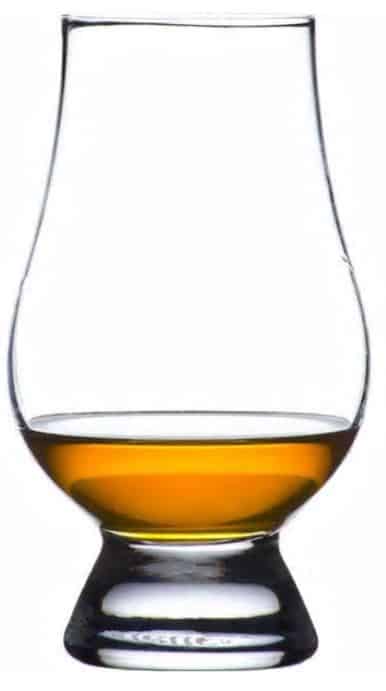then I wondered how much difference I would perceive from the same spirits in a Glencairn-style tasting glass.
So I found out. I nosed and tasted through the Chateau Garreau Bas Armagnacs, then a Hine Rare Cognac, and finally my go-to house whiskey, Old Forester Signature 100 Proof Kentucky Straight Bourbon.
**The results? In every taste, the NEAT glass delivered a better experience for me than the Glencairn.** The Glencairn and the NEAT both have dedicated fans. The Glencairn was first and was first favored for Scotch Whisky, then became popular for other whiskeys, and then all sorts of spirits.
I’ve long been fond of the Glencairn for its ability to focus the aromas in such an intense way, to display the core of the aromatic experience of the spirit. “Nothing hides in a Glencairn.” is a standard saying, and for good reason. That ability to expose was also a problem, however. In a brash, brawny spirit raw power can overcome, even obliterate, the more delicate nuances.
The Glencairn is unforgiving. It’s more about force than finesse. It will reveal the charms of a spirit, but it will just as readily exaggerate certain aspects that can make the spirit unpleasant.
The Glencairn is essentially a small, short, glass shaped a little like a glass cannon designed to collect all the aromatic components and volatize them out of the glass up into the nose of the taster. Sounds brutal….and it can be just that if you’re nosing a high-proof spirit, because the alcohol (ethanol) is also conveyed in this ‘shot’ of spirit, and ethanol can carry a mean burn.
Your nose naturally hits that zone so you sense the subtlety of different aromatic impressions which you would not be able to distinguish as clearly within an intense volatile blast.
And here is why: the NEAT glass concentrates the aromatics and alcohol in the bowl, providing a wider, larger surface for releasing the aromas. When they volatize up through the ‘pinched’ waist of the glass the aromatics continue up to that ‘sweet spot’ but most alcohols flow up the sides of the glass to the flared rim and dissipate.
Essentially, with that separation, you receive the aromatics in the zone—the sweet spot—with the lessened impact of the alcohol, which gives you the ability to appreciate all those lovely aromatics you probably paid good money for.
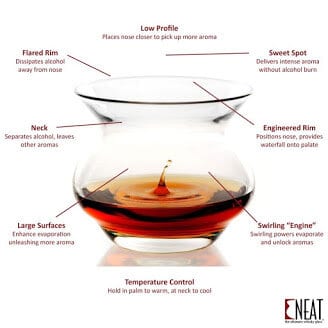
Some people are more impressed with power, intensity, and force; some look for subtlety, complexity, and layers of aroma as their ideal.
If you are in the first group, you’ll likely prefer the Glencairn, which is fine. Some like the brash, bold, ‘in your face’ peat smoke and iodine of an Islay Single Malt. The Glencairn glass will deliver all those aromas—and ethanol—in one focused sniff.
If you’re more like the second group, you’re probably going to go for the NEAT glass. The NEAT glass focuses on the aromatic components while moving the ethanol burn out of the spotlight, as is the case with Hine Rare. The Glencairn sends the ethanol up in force; the NEAT shunts the ethanol gently to the rim and away.
After my casual taste and compare trial, it was clear I preferred the NEAT glass. It provided exposure to all the components and increased my perception of the complexity of the spirit. The Glencairn seemed to punch the spirit into your nose—and in a high alcohol spirit that can stun your nasal passages with anosmia (briefly losing some of your sense of smell).
*\[Perspective: We constant nosers and sippers tend to get comfortable—or perhaps acclimated is a better word—to high-proof spirits. We also tend to forget inexperienced tasters haven’t developed that familiarity. I might be waxing poetically about my lovely, gentle, balanced spirit, while the row of students are looking at me blankly. I’m enjoying ephemeral spirits; their eyes are tearing because the ethanol just singed their nose hairs. The NEAT attenuates that burn.\]*
**Example 1:** *Chateau Garreau Bas Armagnac Folle Blanche.* This was an experimental spirit, a young Folle Blanche with short-term oak aging to emphasize the primary floral qualities of the grape variety. It was bottled at cask strength. The lovely but delicate fruit/floral expression of the Folle Blanche was shoved out of balance by the ethanol in the Glencairn glass. The NEAT glass shunted away just enough of the ethanol to allow the complexities of the Folle Blanche to emerge
**Example 2:** *Hine Rare Cognac*. The Hine is a beautifully constructed blend of different cognacs that contain some older examples, and those hints of extended age and richness are essential to the style of Hine. Again, the Glencairn made the Hine seem heavier and coarser in the nose, while the NEAT allowed those enticing, subtle aromas to separate from the alcohol and float right up to the sweet spot.
**Example 3:** *Old Forester Signature 100 Proof Kentucky Straight Bourbon*. This is my go-to house Bourbon. Reliable, consistent, and dependable, the Old Forester nose came through fine from the Glencairn. But the NEAT edged it out just that little bit to soften and warm and expand the wood-aged notes and the lovely rich caramel that characterizes Old Forester.
I’ll add that for all its attributes the NEAT glass is not what I would call a drinking glass. It is a nosing glass/tasting glass, designed for that specific purpose. So, when you come to my house you’ll get your Old Forester Signature 100 Old Fashioned in an Old-Fashioned Glass and your Woodford Reserve Double Oaked Manhattan in a martini glass. But both will have been tasted in a NEAT glass before preparing the cocktail.
[NEAT and Arsilica](https://theneatglass.com "NEAT and Arsilica") (“Changing the Way the World Drinks”) are now one company. Arsilica plans to bring forth new designs to expand its glass portfolio. [Sensation Research did an Independent study](https://sensationresearch.com/wp-content/uploads/2020/01/Glass-Vessel-Aroma-DA-Study-Sept-2019.pdf "Sensation Research did an Independent study").
Nearly six years have passed since Hoke published the article. The review holds special significance for me because Hoke became the first professional evaluator to examine the NEAT glass. I revisit the subject because many evaluators still resist change, while Hoke demonstrated remarkable foresight by recognizing how ethanol affects sensory perception and tasting results.
Harden, H. (2020, September 4). *Through a glass, brightly: Tasting with NEAT and Glencairn glasses*. Elixir Vitae. [https://violentfermentation.blogspot.com/2020/09/through-glass-brightly-tasting-with.html](https://violentfermentation.blogspot.com/2020/09/through-glass-brightly-tasting-with.html?utm_source=chatgpt.com)
## Assessing the Changing Landscape of Sensory Evaluation
Reviewers rarely echo the conclusions Hoke reached nearly six years ago. His observations show a keen awareness that evaluators should not confuse ethanol’s sensory effects with flavor, even though ethanol serves as an effective carrier for character-defining aroma compounds. Hoke recognized the problem clearly:
“… (The Glencairn’s) …ability to expose was also a problem, however. In a brash, brawny spirit, raw power can overcome, even obliterate, the more delicate nuances.”
Decades of drinking from tulips have conditioned evaluators, including the expert and novice to specific beliefs. “If ethanol remains there, in today’s scientific world, it is meant to be there.” and, “How would you separate the molecules anyway?” Ethanol presence becomes an “irrefutable” fact in the mind’s eye of all who want quick answers so they can move on.
Hoke’s description of how NEAT works is spot-on for the non-science amateur and the experienced evaluator alike. However, the neck has a special quality with a scientific explanation. Molecules are forced to contact each other in the neck as they are pushed closer together. Ever play snooker? The smaller balls move faster than large ones. Same thing with molecules. ethanol is lightest. Collisions with “heavier” flavor molecules makes them run away faster than the flavors move.
It may be uncomfortable to drink from the flared rim of a NEAT or a martini glass, However, you get a better expression of the aromas without the distraction of nose-numbing, pungent, anesthetic ethanol.
Hoke is aware that ethanol “…in a high alcohol spirit that can stun your nasal passages with anosmia.” is certainly different than flavor. Many evaluators today will say they also believe, however, you hear nothing of it when they evaluate cask-strength spirits in the tulip-funnel-ethanol-cannon.
## NEAT Sensory Science
Drs. Zsu Zsu Wang and Keith Cadwallader of University of Illinois have completed much scientific heavy lifting with a study recently released. Their research validates and quantifies the detection of aromas in presence of various levels of alcohol by volume. They prove that ethanol plays a serious, large role in sensory evaluation.
Recent studies by Arsilica have derived a formula by which the known geometry of any glassware shape will determine the concentration of ethanol at any given rim plane position. Although we developed NEAT through empirical statistical testing, the formula shows it to be accurate in balancing ethanol and character aromas.
Designing the NEAT glass was no more than application of 12th grade high-school physics class (Oops, they don’t do that anymore). New discoveries bear out what we thought all along, and Hoke Harden picked it up immediately.
## Still Controversial, NEAT Gathers Momentum
As it stands, we are on the road to changing the sensory evaluation of spirits to a more sophisticated level. Hopefully, it will invoke principles of true sensory science. The food industry has used sensory evaluation for at least three decades with serious determination. Wine is getting there quickly, and spirits, always late to the science game will get there eventually.
A case in point, the spirits industry seems to adopt changes about 10 years later than wine. Spirits evaluation remains cultish, mysterious, and somewhat personality dependent, as mythical marketing runs rampant. NEAT acceptance improves with exposure to the evaluators who matter.
## Summary
This will change as more innovative evaluators like Hoke Harden, finally apply rudimentary science to hone opinions into repeatable fact. The age of the opinionated blogger will be replaced by the educated blogger with accepted science. Tasting opinions will be more similar and repeatable. Only then will the public be able to rely on something other than “celebrity” opinions. Thanks, Hoke, for your incredible insights.
---
### [Our privacy policy is strict, honest, and reliable](https://theneatglass.com/privacy-policy/)
**Published:** June 1, 2021
**Author:** The NEAT Glass
**Content:**
## Privacy Policy
Our privacy policy is strict, honest, and reliable. Security, guardianship, and protection of your personal data is our obligation. We do not share.”The Neat Glass values your privacy. We do not sell your data. For questions, contact newsletter@theneatglass.com.”
## Our Mailing Address
Arsilica Inc.
452 Silverado Ranch Blvd.
STE. 222
Las Vegas, NV 89183
## Comment checking
When visitors leave comments, we collect data from the comments form, visitors’ IP addresses, and browser user agent strings to aid spam detection. An anonymized string created from your email address (also called a hash) may be provided to Gravatar to see if you are using it. Gravatar service privacy policy available here: https://automattic.com/privacy/. After comment approval, your profile picture is visible to the public in the context of your comment.
## Media, cookies, log-in
If you upload images to the website, avoid images with embedded location data (EXIF GPS) included. Visitors can download and extract any location data from images on the website. If commenting, you may opt in to save your name, email address, and website in cookies for your convenience so you do not have to fill in details again when you leave a re-comment. These cookies last for one year. If you visit our login page, we will set a temporary cookie to determine if your browser accepts cookies. This cookie contains no personal data and is discarded when you close your browser. When you log in, we will also set up cookies to save your login information and screen display choices. Login cookies last for two days, and screen options cookies last for a year. If you select “Remember Me”, your login will persist for two weeks. If you log out of your account, the login cookies will be removed. If you edit or publish an article, an additional cookie will be saved in your browser, which includes no personal data and indicates the post ID of the article you just edited. It expires after 1 day.
## Embedded content from other websites
Our articles may include embedded content (videos, images, articles, etc.). Embedded content from other websites behaves in the same way as if the visitor had visited the other website. These websites may collect data about you, use cookies, embed additional third-party tracking, and monitor your interaction with that embedded content, including tracking your interaction with the embedded content if you have an account and are logged in to that website.
## We do not share your data with others
If you request a password reset, your IP address will be included in the reset email.
## How long is my data kept?
Left comments and metadata are retained indefinitely, so we can recognize and approve follow-up comments automatically instead of holding them in the moderation queue. For users who register on our website (if any), we also store the personal information they provide in their user profile. All users can see, edit, or delete their personal information at any time (except they cannot change their username). Website administrators can also see and edit that information.
## Your rights over your data
If you have an account on this site or have left comments, you can request to receive an exported file of the personal data we hold about you, including any data you have provided to us. You can also request that we erase any personal data we hold about you. This does not include any data we are obliged to keep for administrative, legal, or security purposes.
## You can check on your comments
Visitor comments may be checked through an automated spam detection service.
---
## Products
### [Artisan 2Pak](https://theneatglass.com/product/the-artisan-neat-glass-2-pak/)
**Published:** March 30, 2022
**Author:** The NEAT Glass
**Excerpt:** Two (2) NEAT Artisan Spirits Glasses. Our standard, no-nonsense flagship tasting glass is perfect for individual tasting and evaluation, panels, side-by-side comparisons, or tasting with a friend. Perfect for evaluating all spirits from whiskey to vodka, liqueurs, and dessert wines such as port and sherry. Sensory science reveals all the subtle aromas and complexities, so you can discover true spirits quality. Made of European crystalline. SKU: NEAT-C2
**Content:**
# **Trusted by Experts, Engineered by Sensory Science**
What aromas are hiding behind the ethanol in your glass? Over 40 major spirits competitions trust the professional evaluation standard set by NEAT. Accordingly, it serves as a powerful diagnostic tool that reveals the true character of every spirit. Especially, for cask-strength expressions. **NEAT** is the first and only spirits tasting glass ever designed by applied sensory science to eliminate the overpowering sting of pungent ethanol. As a result, NEAT eliminates olfactory fatigue. Choose from three versions: Artisan, Elite, and Elegance.
In fact, many craft distillers use **NEAT** to make precise head and tail cuts to achieve the highest quality. In contrast, traditional tulips obscure your sense of smell with concentrated ethanol, masking true flavors. Upgrade to the professional tasting glass. **NEAT** elevates your tasting experience. Industry professionals, serious spirits enthusiasts, and collectors rely on **NEAT** which stands for Naturally Engineered Aroma Technology. More at [NEAT Sensory Science](https://www.mdpi.com/2306-5710/4/4/93). Testimonial: [See what famous spirits expert Anthony Dias Blue says about NEAT glassware.](https://theneatglass.com/truth-first-priority-professional-testimonials/)
**Product brands:** ARSILICA, NEAT
**Product categories:** Ultimate Universal Spirits Glasses
**Product tags:** Bourbon Glasses, Gin Glasses, Rum Glasses, Scotch Glasses, Tequila Glasses, Vodka Glasses, Whiskey Glasses, Whisky Glasses
---
### [Artisan 4Pak](https://theneatglass.com/product/artisan-4pak/)
**Published:** November 20, 2024
**Author:** The NEAT Glass
**Excerpt:** Four (4) NEAT Artisan Spirits Glasses.
Our standard, no-nonsense flagship tasting glass is perfect for individual tasting and evaluation, panels, or side-by-side comparisons. Perfect for tasting and evaluating all spirits from whiskey to vodka, liqueurs, and dessert wines such as port and sherry. Sensory science reveals all the subtle aromas and complexities, so you can judge the spirit’s true qualities. Made of European crystalline. SKU: NEAT-C4
Create a gift that is truly personal. Choose from one of the three engraving styles shown below and personalize all four NEAT glasses for just $16 per set. Perfect for weddings, anniversaries, birthdays, holidays, tasting clubs, private tastings, parties, and other special occasions.
Need larger quantities? Or want to use your own logo? Visit our Custom Etching page for bulk engraving options and discounted volume pricing.
**Content:**
# **Trusted by Experts, Engineered by Sensory Science**
What aromas are hiding behind the ethanol in your glass? Over 40 major spirits competitions trust the professional evaluation standard set by NEAT. Accordingly, it serves as a powerful diagnostic tool that reveals the true character of every spirit. Especially, for cask-strength expressions. **NEAT** is the first and only spirits tasting glass ever designed by applied sensory science to eliminate the overpowering sting of pungent ethanol. Compare to discover true qualities. As a result, NEAT eliminates olfactory fatigue. Choose from three versions: Artisan, Elite, and Elegance.
In fact, many craft distillers use **NEAT** to make precise head and tail cuts to achieve the highest quality. In contrast, traditional tulips obscure your sense of smell with concentrated ethanol, masking true flavors. Upgrade to the professional tasting glass. **NEAT** elevates your tasting experience. Industry professionals, serious spirits enthusiasts, and collectors rely on **NEAT** which stands for Naturally Engineered Aroma Technology. More at [NEAT Sensory Science](https://www.mdpi.com/2306-5710/4/4/93). Testimonial: [See what famous spirits expert Anthony Dias Blue says about NEAT glassware.](https://theneatglass.com/truth-first-priority-professional-testimonials/)
**Product brands:** ARSILICA, NEAT
**Product categories:** Ultimate Universal Spirits Glasses
**Product tags:** Bourbon Glasses, Holiday Gift, Rum Glasses, Scotch Glasses, Tequila Glasses, Vodka Glasses, whiskey glass - designed with sensory science, Whiskey Glasses, Whisky Glasses
---
### [Elite 4Pak](https://theneatglass.com/product/elite-spirits-glass-4pak/)
**Published:** March 20, 2022
**Author:** The NEAT Glass
**Excerpt:** Four (4) Elite Spirits Glasses. Perfect for tasting with friends, panel tastings, or side-by-side comparisons. Elite glass features a substantial pedestal base and a practical grip, which ensures competent handling and temperature control. Classy feel and comfortable heft befitting the sensory enjoyment of all fine spirits. Made of European crystalline. SKU: NEAT-E4
Create a gift that is truly personal. Choose from one of the three engraving styles shown below and personalize all four NEAT glasses for just $16 per set. Perfect for weddings, anniversaries, birthdays, holidays, tasting clubs, private tastings, parties, and other special occasions.
Need larger quantities? Or want to use your own logo? Visit our Custom Etching page for bulk engraving options and discounted volume pricing.
**Content:**
# **Trusted by Experts, Engineered by Sensory Science**
What aromas are hiding behind the ethanol in your glass? Over 40 major spirits competitions trust the professional evaluation standard set by NEAT. Accordingly, it serves as a powerful diagnostic tool that reveals the true character of every spirit. Especially, for cask-strength expressions. **NEAT** is the first and only spirits tasting glass ever designed by applied sensory science to eliminate the overpowering sting of pungent ethanol. As a result, NEAT eliminates olfactory fatigue. Choose from three versions: Artisan, Elite, and Elegance.
In fact, many craft distillers use **NEAT** to make precise head and tail cuts to achieve the highest quality. In contrast, traditional tulips obscure your sense of smell with concentrated ethanol, masking true flavors. Upgrade to the professional tasting glass. **NEAT** elevates your tasting experience. Industry professionals, serious spirits enthusiasts, and collectors rely on **NEAT** which stands for Naturally Engineered Aroma Technology. More at [NEAT Sensory Science](https://www.mdpi.com/2306-5710/4/4/93). Testimonial: [See what famous spirits expert Anthony Dias Blue says about NEAT glassware.](https://theneatglass.com/truth-first-priority-professional-testimonials/)
**Product brands:** ARSILICA, NEAT
**Product categories:** Ultimate Universal Spirits Glasses
**Product tags:** Bourbon Glasses, Christmas Gifts, gift, Gin Glasses, Rum Glasses, Scotch Glasses, Tequila Glasses, Vodka Glasses, Whiskey Glasses, Whisky Glasses
---
### [Elegance 4Pak](https://theneatglass.com/product/elegance-4pak/)
**Published:** November 21, 2025
**Author:** The NEAT Glass
**Excerpt:** Four (4) Elegance Spirits Glasses. Elegance features a lovely, tall and slender stem, perfect for Tequila, whiskey, liqueurs, and dessert wines at home or in all fine-dining and restaurant venues. The stem elevates the glass to catch the light and avoid messy fingerprints on the bowl. Classy elegance befitting the sensory enjoyment of all fine spirits. Made of European crystalline. SKU: NEAT-CS2
**Content:**
# **Trusted by Experts, Engineered by Sensory Science**
What aromas are hiding behind the ethanol in your glass? Over 40 major spirits competitions trust the professional evaluation standard set by NEAT. Accordingly, it serves as a powerful diagnostic tool that reveals the true character of every spirit. Especially, for cask-strength expressions. **NEAT** is the first and only spirits tasting glass ever designed by applied sensory science to eliminate the overpowering sting of pungent ethanol. As a result, NEAT eliminates olfactory fatigue. Choose from three versions: Artisan, Elite, and Elegance.
In fact, many craft distillers use **NEAT** to make precise head and tail cuts to achieve the highest quality. In contrast, traditional tulips obscure your sense of smell with concentrated ethanol, masking true flavors. Upgrade to the professional tasting glass. **NEAT** elevates your tasting experience. Industry professionals, serious spirits enthusiasts, and collectors rely on **NEAT** which stands for Naturally Engineered Aroma Technology. More at [NEAT Sensory Science](https://www.mdpi.com/2306-5710/4/4/93). Testimonial: [See what famous spirits expert Anthony Dias Blue says about NEAT glassware.](https://theneatglass.com/truth-first-priority-professional-testimonials/)
**Product brands:** ARSILICA, NEAT
**Product categories:** Ultimate Universal Spirits Glasses
---
### [Elite 2Pak](https://theneatglass.com/product/elite-2-pak/)
**Published:** January 13, 2023
**Author:** The NEAT Glass
**Excerpt:**
Contains a set of Two (2) NEAT Elite Spirits Glasses. Perfect for evaluating true qualities of all spirits with a friend or making side-by-side comparisons. Compare spirits, make better purchasing decisions. Elite glass features a substantial pedestal base and a practical grip, which, accordingly, ensures competent handling and assures even temperature control. In addition, a classy, hefty feel and comfortable grip compliment the sensory enjoyment of all fine spirits. Made of European crystalline. SKU: NEAT-E2
**Content:**
# **Trusted by Experts, Engineered by Sensory Science**
What aromas are hiding behind the ethanol in your glass? Over 40 major spirits competitions trust the professional evaluation standard set by NEAT. Accordingly, it serves as a powerful diagnostic tool that reveals the true qualities of every spirit when evaluating. Especially, for cask-strength expressions. **NEAT** is the first and only spirits tasting glass ever designed by applied sensory science to eliminate the overpowering sting of pungent ethanol. As a result, NEAT eliminates olfactory fatigue. Choose from three versions: Artisan, Elite, and Elegance.
In fact, many craft distillers use **NEAT** to make precise head and tail cuts to achieve the highest quality. In contrast, traditional tulips obscure your sense of smell with concentrated ethanol, masking true flavors. Upgrade to the professional tasting glass. **NEAT** elevates your tasting experience. Industry professionals, serious spirits enthusiasts, and collectors rely on **NEAT** which stands for Naturally Engineered Aroma Technology. More at [NEAT Sensory Science](https://www.mdpi.com/2306-5710/4/4/93). Testimonial: [See what famous spirits expert Anthony Dias Blue says about NEAT glassware.](https://theneatglass.com/truth-first-priority-professional-testimonials/)
**Product brands:** ARSILICA, NEAT
**Product categories:** Food & Beverage Evaluation, Ultimate Universal Spirits Glasses, Whiskey Glasses
**Product tags:** Bourbon Glasses, Rum Glasses, Scotch Glasses, Whiskey Glasses, Whisky Glasses
---
### [The Elite](https://theneatglass.com/product/the-neat-elite-glass/)
**Published:** March 20, 2022
**Author:** The NEAT Glass
**Excerpt:** One (1) NEAT Elite Spirits Glass. Elite features a substantial pedestal base and a practical grip, which ensures competent handling and temperature control. Classy feel and comfortable heft befitting the sensory enjoyment of all fine spirits and liqueurs. Pick up a few extras for a great gift to your spirits loving friends or co-workers. Made of European crystalline. SKU: NEAT-E1
**Content:**
# **Trusted by Experts, Engineered by Sensory Science**
What aromas are hiding behind the ethanol in your glass? Over 40 major spirits competitions trust the professional evaluation standard set by NEAT. Accordingly, it serves as a powerful diagnostic tool that reveals the true character of every spirit. Especially, for cask-strength expressions. **NEAT** is the first and only spirits tasting glass ever designed by applied sensory science to eliminate the overpowering sting of pungent ethanol. As a result, NEAT eliminates olfactory fatigue. Choose from three versions: Artisan, Elite, and Elegance.
In fact, many craft distillers use **NEAT** to make precise head and tail cuts to achieve the highest quality. In contrast, traditional tulips obscure your sense of smell with concentrated ethanol, masking true flavors. Upgrade to the professional tasting glass. **NEAT** elevates your tasting experience. Industry professionals, serious spirits enthusiasts, and collectors rely on **NEAT** which stands for Naturally Engineered Aroma Technology. More at [NEAT Sensory Science](https://www.mdpi.com/2306-5710/4/4/93). Testimonial: [See what famous spirits expert Anthony Dias Blue says about NEAT glassware.](https://theneatglass.com/truth-first-priority-professional-testimonials/)
**Product brands:** ARSILICA, NEAT
**Product categories:** Ultimate Universal Spirits Glasses
**Product tags:** Bourbon Glasses, Gin Glasses, Rum Glasses, Scotch Glasses, Tequila Glasses, Vodka Glasses, Whiskey Glasses, Whisky Glasses
---
### [Elegance 6Pak](https://theneatglass.com/product/neat-elegance-6-pak/)
**Published:** November 20, 2024
**Author:** The NEAT Glass
**Excerpt:** Six (6) NEAT Elegance Spirits Glasses. Elegance features a lovely, tall and slender stem, perfect for Tequila, whiskey, liqueurs, and dessert wines at home or in all fine-dining and restaurant venues. The stem elevates the glass to catch the light and avoid messy fingerprints on the bowl. Classy elegance befitting the sensory enjoyment of all fine spirits. Made of European crystalline. SKU: NEAT-CS6
**Content:**
# **Trusted by Experts, Engineered by Sensory Science**
What aromas are hiding behind the ethanol in your glass? Over 40 major spirits competitions trust the professional evaluation standard set by NEAT. Accordingly, it serves as a powerful diagnostic tool that reveals the true character of every spirit. Especially, for cask-strength expressions. **NEAT** is the first and only spirits tasting glass ever designed by applied sensory science to eliminate the overpowering sting of pungent ethanol. As a result, NEAT eliminates olfactory fatigue. Choose from three versions: Artisan, Elite, and Elegance.
In fact, many craft distillers use **NEAT** to make precise head and tail cuts to achieve the highest quality. In contrast, traditional tulips obscure your sense of smell with concentrated ethanol, masking true flavors. Upgrade to the professional tasting glass. **NEAT** elevates your tasting experience. Industry professionals, serious spirits enthusiasts, and collectors rely on **NEAT** which stands for Naturally Engineered Aroma Technology. More at [NEAT Sensory Science](https://www.mdpi.com/2306-5710/4/4/93). Testimonial: [See what famous spirits expert Anthony Dias Blue says about NEAT glassware.](https://theneatglass.com/truth-first-priority-professional-testimonials/)
**Product brands:** ARSILICA, NEAT
**Product categories:** Food & Beverage Evaluation, Ultimate Universal Spirits Glasses, Whiskey Glasses
**Product tags:** Bourbon Glasses, Rum Glasses, Scotch Glasses, Tequila Glasses, Vodka Glasses, Whiskey Glasses, Whisky Glasses
---
### [Experience 4Pak](https://theneatglass.com/product/the-experience-neat-glass-set-of-4/)
**Published:** March 30, 2022
**Author:** The NEAT Glass
**Excerpt:** Four (4) Experience Spirits Glasses. Hand-crafted, mouth-blown, durable, super flint lead-free crystal. Perfect for tasting and evaluating all spirits from whiskey to vodka, liqueurs, and dessert wines such as port and sherry. Note: Some tiny tool marks are the unique characteristic of hand-crafted glassware. Certificate of authenticity. Sensory science design reveals subtle aromas and complexities, so you can judge any spirit’s true qualitiea. Free Shipping: SKU: NEAT-X4
**Content:**
# **Trusted by Experts, Engineered by Sensory Science**
What aromas are hiding behind the ethanol in your glass? Over 40 major spirits competitions trust the professional evaluation standard set by NEAT. Accordingly, it serves as a powerful diagnostic tool that reveals the true qualities and character of every spirit. Especially, for cask-strength expressions. **NEAT** is the first and only spirits tasting glass ever designed by applied sensory science to eliminate the overpowering sting of pungent ethanol. As a result, NEAT eliminates olfactory fatigue. Choose from: Artisan, Elite, and Elegance. and Experience.
In fact, many craft distillers use **NEAT** to make precise head and tail cuts to achieve the highest quality. In contrast, traditional tulips obscure your sense of smell with concentrated ethanol, masking true flavors. Upgrade to the professional tasting glass. **NEAT** elevates your tasting experience. Industry professionals, serious spirits enthusiasts, and collectors rely on **NEAT** which stands for Naturally Engineered Aroma Technology. More at [NEAT Sensory Science](https://www.mdpi.com/2306-5710/4/4/93). Testimonial: [See what famous spirits expert Anthony Dias Blue says about NEAT glassware.](https://theneatglass.com/truth-first-priority-professional-testimonials/)
**Product brands:** ARSILICA, NEAT
**Product categories:** Mouth-Blown Universal Spirits Glass
**Product tags:** Bourbon Glasses, gift, Gin Glasses, Rum Glasses, Scotch Glasses, Tequila Glasses, Vodka Glasses, Whiskey Glasses, Whisky Glasses
---
### [Artisan Sensory Lab Diagnostics (Case of 32)](https://theneatglass.com/product/sensory-lab-diagnostic-neat-glass-case-of-32/)
**Published:** September 12, 2021
**Author:** The NEAT Glass
**Excerpt:** One full case of 32 units. Sensory lab diagnostics for evaluating alcoholic beverages, coffee, tea, seasonings and sauces, olive oils, perfumes and fragrances, personal hygiene and cleaning products, and much more. Separates, defines, and enhances different aromas by molecular weight, by dissipating ethanol which masks true aromas. Steam autoclave to 160 degrees C. The perfect lab partner for olfactory and degustation. Lab specs available. MOQ one case. Free shipping continental USA. SKU: NEAT-SD32
**Content:**
# **Trusted by Experts, Engineered by Sensory Science**
What aromas are hiding behind the ethanol in your glass? Over 40 major spirits competitions trust the professional evaluation standard set by NEAT. Accordingly, it serves as a powerful diagnostic tool that reveals the true character of every spirit. Especially, for cask-strength expressions. **NEAT** is the first and only spirits tasting glass ever designed by applied sensory science to eliminate the overpowering sting of pungent ethanol. As a result, NEAT eliminates olfactory fatigue. Choose from three versions: Artisan, Elite, and Elegance.
In fact, many craft distillers use **NEAT** to make precise head and tail cuts to achieve the highest quality. In contrast, traditional tulips obscure your sense of smell with concentrated ethanol, masking true flavors. Upgrade to the professional tasting glass. **NEAT** elevates your tasting experience. Industry professionals, serious spirits enthusiasts, and collectors rely on **NEAT** which stands for Naturally Engineered Aroma Technology. More at [NEAT Sensory Science](https://www.mdpi.com/2306-5710/4/4/93). Testimonial: [See what famous spirits expert Anthony Dias Blue says about NEAT glassware.](https://theneatglass.com/truth-first-priority-professional-testimonials/)
**Product categories:** Food & Beverage Evaluation, Ultimate Universal Spirits Glasses, Whiskey Glasses
**Product tags:** Bourbon Glasses, Gin Glasses, Rum Glasses, Scotch Glasses, Tequila Glasses, Vodka Glasses, Whiskey Glasses, Whisky Glasses
---
### [Traveling Tasters Tote. Free Shipping](https://theneatglass.com/product/traveling-tasters-tote/)
**Published:** March 20, 2022
**Author:** The NEAT Glass
**Excerpt:** The NEAT Travelers Tasting Tote includes two hand-crafted, mouth-blown Experience glasses, a lined, faux black leather carrying case with carrying handle, 2 D-rings for a shoulder strap, and a microfiber towel for polishing the Experience glasses between samples. Experience has a heavy base and hefty weight of lead-free antique crystal. Designed for those who love the experience of drinking great spirits at any tasting, anywhere. Free Shipping. SKU: NEAT-T2
**Content:**
# **Trusted by Experts, Engineered by Sensory Science**
What aromas are hiding behind the ethanol in your glass? Over 40 major spirits competitions trust the professional evaluation standard set by NEAT. Accordingly, it serves as a powerful diagnostic tool that reveals the true character of every spirit. Especially, for cask-strength expressions. **NEAT** is the first and only spirits tasting glass ever designed by applied sensory science to eliminate the overpowering sting of pungent ethanol. As a result, NEAT eliminates olfactory fatigue. Choose from three versions: Artisan, Elite, and Elegance and the Traveling Tasters Tote to compare anywhere.
In fact, many craft distillers use **NEAT** to make precise head and tail cuts to achieve the highest quality. In contrast, traditional tulips obscure your sense of smell with concentrated ethanol, masking true flavors. Upgrade to the professional tasting glass. **NEAT** elevates your tasting experience. Industry professionals, serious spirits enthusiasts, and collectors rely on **NEAT** which stands for Naturally Engineered Aroma Technology. More at [NEAT Sensory Science](https://www.mdpi.com/2306-5710/4/4/93). Testimonial: [See what famous spirits expert Anthony Dias Blue says about NEAT glassware.](https://theneatglass.com/truth-first-priority-professional-testimonials/)
**Product brands:** ARSILICA
**Product categories:** Food & Beverage Evaluation, Mouth-Blown Universal Spirits Glass, Spirit Lovers' Tasting Kit, Ultimate Universal Spirits Glasses, Whiskey Glasses
**Product tags:** Bourbon Glasses, Gin Glasses, Rum Glasses, Scotch Glasses, Tequila Glasses, Vodka Glasses, Whiskey Glasses, Whisky Glasses
---
### [Elegance 2Pak](https://theneatglass.com/product/elegance-2-pak/)
**Published:** February 15, 2024
**Author:** The NEAT Glass
**Excerpt:**
Two (2) NEAT Elegance Spirits Glasses. Elegance features a lovely, tall and slender stem, perfect for Tequila, whiskey, liqueurs, and dessert wines at home or in all fine-dining and restaurant venues. The stem elevates the glass to catch the light and avoid messy fingerprints on the bowl. Classy elegance befitting the sensory enjoyment of all fine spirits. Made of European crystalline. SKU: NEAT-CS2
**Content:**
# **Trusted by Experts, Engineered by Sensory Science**
What aromas are hiding behind the ethanol in your glass? Over 40 major spirits competitions trust the professional evaluation standard set by NEAT. Accordingly, it serves as a powerful diagnostic tool that reveals the true character of every spirit. Especially, for cask-strength expressions. **NEAT** is the first and only spirits tasting glass ever designed by applied sensory science to eliminate the overpowering sting of pungent ethanol. As a result, NEAT eliminates olfactory fatigue. Choose from three versions: Artisan, Elite, and Elegance.
In fact, many craft distillers use **NEAT** to make precise head and tail cuts to achieve the highest quality. In contrast, traditional tulips obscure your sense of smell with concentrated ethanol, masking true flavors. Upgrade to the professional tasting glass. **NEAT** elevates your tasting experience. Industry professionals, serious spirits enthusiasts, and collectors rely on **NEAT** which stands for Naturally Engineered Aroma Technology. More at [NEAT Sensory Science](https://www.mdpi.com/2306-5710/4/4/93). Testimonial: [See what famous spirits expert Anthony Dias Blue says about NEAT glassware.](https://theneatglass.com/truth-first-priority-professional-testimonials/)
**Product brands:** ARSILICA, NEAT
**Product categories:** Ultimate Universal Spirits Glasses
**Product tags:** Bourbon Glasses, Rum Glasses, Scotch Glasses, Tequila Glasses, Vodka Glasses, Whiskey Glasses, Whisky Glasses
---
## Categories
### [Academy](https://theneatglass.com/category/academy/)
**Description:** The Ultimate Spirits Glass - The Best Tasting Glass for Whiskey, Tequila, Vodka, Rum, Gin, Bourbon, and Scotch. The Ultimate Spirits Glass best tasting glass
---
### [The NEAT Newsletter](https://theneatglass.com/category/neat-news/)
**Description:** The Spirits Newsletter that gives you the skills that now more than ever depends on understanding the Science of Spirits Science must be a purchasing priority
---
## Tags
### [Academy](https://theneatglass.com/tag/academy/)
---
## Product brands
### [ARSILICA](https://theneatglass.com/brand/arsilica/)
---
### [NEAT](https://theneatglass.com/brand/neat/)
---
## Product categories
### [Ultimate Universal Spirits Glasses](https://theneatglass.com/product-category/ultimate-universal-spirits-glasses/)
---
### [Whiskey Glasses](https://theneatglass.com/product-category/whiskey-glasses/)
---
### [Mouth-Blown Universal Spirits Glass](https://theneatglass.com/product-category/mouth-blown-universal-spirits-glass/)
---
### [Spirit Lovers' Tasting Kit](https://theneatglass.com/product-category/spirit-lovers-tasting-kit/)
**Description:** #taxonomy_descriptionEverything you need to sample spirits side-by-side or taste and evaluate spirits with a friend. Know spirits better with your NEAT glass.
---
### [Food & Beverage Evaluation](https://theneatglass.com/product-category/food-beverage-evaluation/)
---
## Product tags
### [Whiskey Glasses](https://theneatglass.com/product-tag/whiskey-glasses/)
---
### [Whisky Glasses](https://theneatglass.com/product-tag/whisky-glasses/)
---
### [Scotch Glasses](https://theneatglass.com/product-tag/scotch-glasses/)
---
### [Rum Glasses](https://theneatglass.com/product-tag/rum-glasses/)
---
### [Bourbon Glasses](https://theneatglass.com/product-tag/bourbon-glasses/)
---
### [Gin Glasses](https://theneatglass.com/product-tag/gin-glasses/)
---
### [Tequila Glasses](https://theneatglass.com/product-tag/tequila-glasses/)
---
### [Vodka Glasses](https://theneatglass.com/product-tag/vodka-glasses/)
---
### [gift](https://theneatglass.com/product-tag/gift/)
---
### [whiskey glass - designed with sensory science](https://theneatglass.com/product-tag/whiskey-glass/)
**Description:** NEAT is the first and only spirits glass ever designed by direct application of true sensory science, physics, and chemistry
---
### [Holiday Gift](https://theneatglass.com/product-tag/holiday-gift/)
---
### [Christmas Gifts](https://theneatglass.com/product-tag/christmas-gifts/)
---


